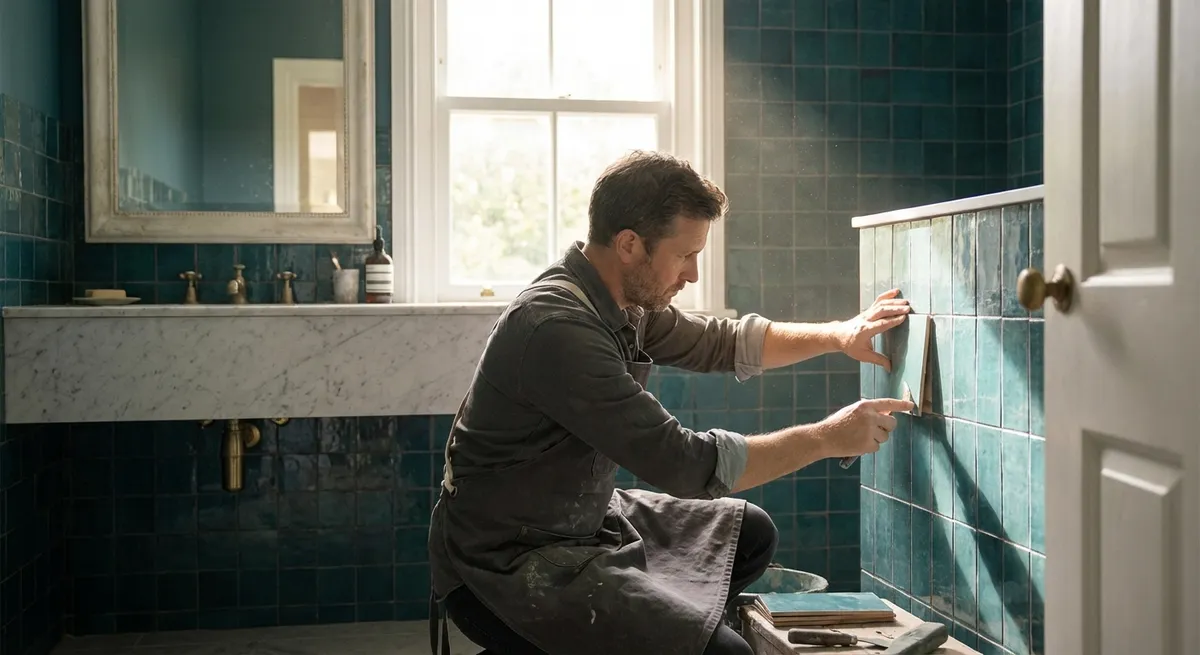
For homeowners who value refined surfaces and enduring beauty, understanding how exceptional tile repairs are planned and executed can be the difference between a floor that merely functions and one that continues to feel curated, intentional, and timeless.
1. Treat Every Tile as Part of a Composition, Not a Single Piece
Sophisticated repairs begin with perspective. Instead of focusing solely on the damaged tile, a skilled professional evaluates the entire field as a composition—light, pattern, grout, transitions, and how the eye travels across the room. A chip in a corner tile near a doorway, for example, will be perceived differently than the same damage in the center of a feature wall or beneath a freestanding tub.
This compositional awareness guides the strategy: sometimes the best approach is a meticulous in-place repair; other times, it’s a carefully planned tile replacement that respects pattern continuity and symmetry lines. In patterned or bookmatched installations, a single mismatched replacement can visually disrupt the entire design, no matter how technically “correct” the work is. The most refined repair solutions prioritize visual harmony above all, ensuring each decision serves the overall composition rather than just the individual tile.
2. Preserve Original Material Whenever Possible—But Only if It Ages Gracefully
In premium spaces, original material often holds value beyond its surface. Imported stone lots, discontinued porcelain series, or hand-crafted artisan tiles may be impossible to replicate exactly. For this reason, high-end repair strategy typically starts with the question: can the damage be stabilized and visually minimized while retaining the original tile?
Micro-fills using color-matched resins, precision polishing on natural stone, or ultra-fine edge reshaping can transform a visible flaw into a quiet, almost undetectable patina. However, preservation should never be sentimental at the expense of elegance. If a tile has experienced structural compromise—cracking through the body, debonding from the substrate, or shifting within the pattern—it can create long-term issues that no cosmetic fix can conceal. The most refined solution balances respect for original material with a ruthlessly honest assessment of how that material will age in place over the next decade.
3. Color and Sheen Matching Is a Craft, Not a Shortcut
A common misstep in repairs is focusing solely on the tile while neglecting the subtleties of color and sheen. In reality, what often reveals a repair is not the individual tile replacement but the mismatch in glaze depth, surface reflectivity, or grout tone. Light, especially in luxury spaces with layered lighting design, is unforgiving of approximations.
Professionals who specialize in premium repairs invest serious time in test panels, mock-ups, and sample boards. Grout is custom-tinted and tested under both natural and artificial light. Sealers and finishes are trialed to align with the existing surface—whether that’s a soft, honed stone, a high-gloss large-format porcelain, or a textured artisan tile. Even the direction of trowel marks or micro-texture can be replicated. The result is a repair that doesn’t simply blend—it behaves like the surrounding surface under morning light, evening ambiance, and everything in between.
4. Plan Repairs Around Movement, Not Just Damage
Luxury tile failures are often rooted less in the tile itself and more in what’s happening beneath and around it. Subtle deflection in a subfloor, seasonal movement in a slab, or inadequate expansion joints in a large-format installation can quietly stress even the most expensive materials. If repairs treat only the symptom—the cracked tile—without addressing the underlying movement, the fracture often returns, sometimes in a slightly different place.
An elevated repair strategy includes a diagnostic phase: evaluating substrate stability, checking for hollow spots, assessing expansion joint placement, and understanding where the room naturally flexes or shifts. In some cases, this may mean integrating movement joints into grout lines, re-bonding localized areas, or reinforcing specific substrate zones. The most discreet repairs are the ones that prevent a second failure; they transform a vulnerable area into one that can flex elegantly over time, without telegraphing stress through the tile surface.
5. Curate a “Future-Proof” Tile Archive Before You Ever Need It
One of the most exclusive yet practical repair strategies doesn’t happen during a repair at all—it happens at installation. For truly elevated tile work, homeowners treat extra material not as leftover waste, but as an asset. Setting aside a curated archive of spare tiles, labeled by room, batch, and location, is one of the most powerful ways to guarantee that any future repair can be executed with precision and authenticity.
This archive should include not only full tiles, but also a few cuts, trim pieces, and even grout samples or leftover pigment. These materials become invaluable years later when a single tile is damaged in a shower niche, a step edge, or beneath a pivot door. Instead of hunting for approximations or reordering from a newer batch that no longer matches, your installer can draw from a private reserve that perfectly aligns with the original installation. In truly bespoke spaces, this quiet foresight is what allows a repair to feel less like a patch and more like an extension of the original craftsmanship.
Conclusion
Exceptional tile repairs are not about erasing history; they are about preserving the visual and tactile integrity of a space with the same intentionality that shaped it in the first place. When you view repairs as part of the design language—guided by composition, material intelligence, nuanced color matching, structural insight, and thoughtful preparation—you elevate your home from merely well-maintained to truly well-curated.
In the world of refined interiors, the most successful repairs are the ones your guests never notice—and that you yourself quickly forget were ever needed.