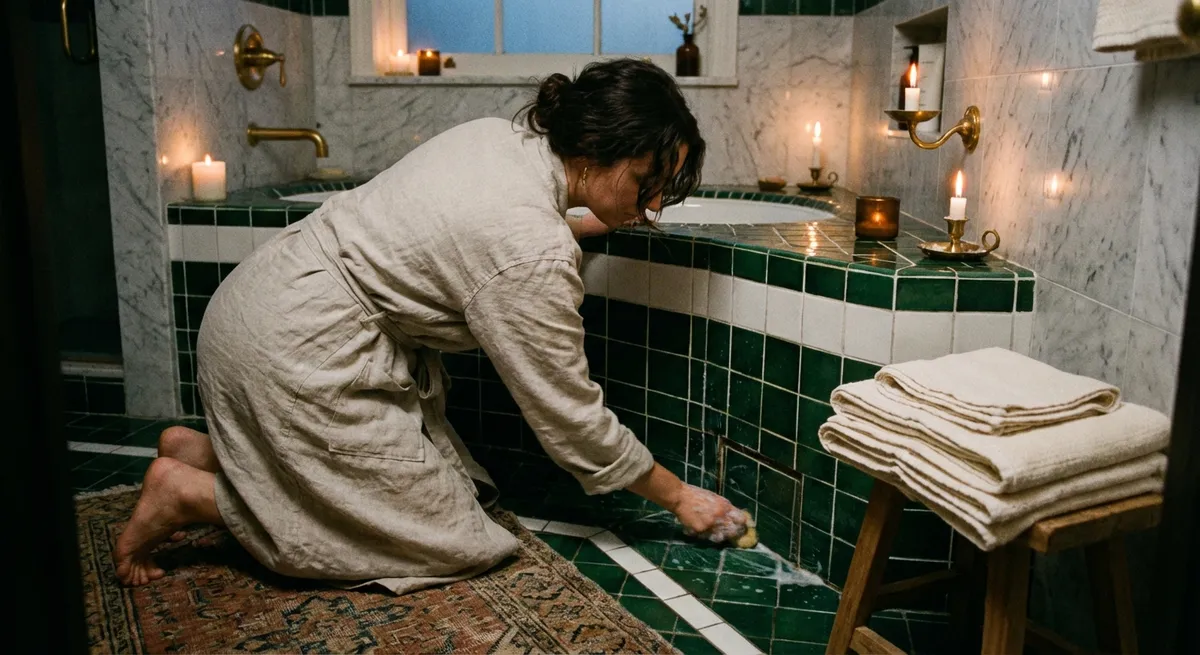
Below are five exclusive, detail-driven insights that discerning homeowners rely on to keep tile surfaces looking composed, luminous, and structurally sound.
Insight 1: Treat Grout as a Design Material, Not Just a Gap Filler
Grout is often the first element to betray age, and yet it is rarely maintained with the same discipline as the tile itself. In refined interiors, grout is approached as a visible design component, deserving its own care regimen.
Begin with an honest assessment: if the grout has lost its crisp edges, shows hairline cracking, or has uneven coloration, it is no longer performing as intended—both aesthetically and structurally. Regular, gentle cleaning with pH-neutral solutions preserves not just cleanliness, but also pigment integrity, particularly in light or custom-tinted grouts.
Once a year, schedule a visual “grout audit.” Under strong, angled lighting, inspect junctions between tiles, corners, and transitions. These are often the earliest indicators of moisture intrusion or movement in the substrate. Touch up with premium, color-matched grout or grout stain where necessary rather than waiting for wholesale failure. A carefully maintained grout field preserves the visual rhythm of the layout and protects the substrate from water, movement, and staining—quietly extending the life of the entire installation.
Insight 2: Calibrate Cleaners to the Most Delicate Material in the Room
Luxury tile spaces rarely use a single material. You might have porcelain field tile, marble mosaic insets, and metal trim in one composition. The mistake many homeowners make is purchasing a “tile cleaner” and assuming uniform compatibility. In sophisticated spaces, your cleaning protocol is calibrated to the most delicate material present.
Natural stones (marble, limestone, travertine, onyx) are particularly susceptible to acidic products. Even a seemingly benign vinegar solution, often championed in DIY circles, can etch polished stone, dulling its surface and causing a permanent, uneven haze. Certain glass tiles can also be scratched by abrasive powders or scouring pads, diminishing their clarity.
Curate a small, labeled cleaning kit specific to each tile-intensive space: a pH-neutral cleaner approved for stone or porcelain, non-abrasive microfiber cloths, soft-bristle brushes for grout lines, and separate cloths for glass or polished surfaces. Before any new product touches your tile, test in an inconspicuous corner under good light. This deliberate approach ensures that the most sensitive material in the assembly sets the standard—protecting the room’s overall composition from gradual, irreversible damage.
Insight 3: Control Micro-Scratches Before They Become Visible Wear Patterns
High-end tile is chosen for its longevity, but even the hardest porcelain or stone is not immune to the cumulative effect of micro-scratches. Over time, these faint abrasions gather into visible wear paths—often starting at entry points, under dining chairs, or along main circulation routes.
The most effective strategy is preventive rather than corrective. Place generously sized, high-quality mats or runners at all exterior entries that lead to tiled areas. These should be dense enough to capture grit rather than allow it to ride across the floor. Under dining chairs, bar stools, and movable furnishings, insist on premium felt glides that are regularly inspected and replaced before they compact or accumulate sand.
Adopt a “low-friction” cleaning approach: frequent dry dusting with a microfiber mop lifts particulate matter without dragging it across the surface. Reserve wet mopping for when it’s truly needed, and always rinse thoroughly to avoid residue that can attract more dirt. Periodically, kneel down and observe the tile at a low angle in strong light; early micro-scratches that are nearly invisible from above can be identified and their source addressed before the flooring begins to telegraph obvious traffic patterns.
Insight 4: Respect Expansion Joints as the Silent Guardians of Your Installation
The most elegant tile installations are often undone not by visible abuse, but by ignored movement. Tile, thinset, and substrates respond to temperature and humidity changes. That quiet expansion and contraction is managed by expansion joints—at perimeters, changes in plane, and large uninterrupted spans. When these joints are neglected, filled, or rigidly grouted over, the system is forced to fail elsewhere: cracked tiles, tenting, or debonding.
As part of routine maintenance, visually inspect perimeter joints at walls, thresholds, and transitions to other flooring materials. These should typically be filled with a flexible sealant rather than hard grout. If you notice rigid materials separating, cracking, or pulling away, it may indicate that the installation is moving more than expected and the joint can no longer accommodate it.
In wet areas—showers, steam rooms, and spa zones—pay special attention to vertical-to-horizontal junctions (tub to wall, shower floor to wall). Any failure or void in these joints invites moisture into assemblies that were never meant to remain saturated. Prompt, precise re-caulking with appropriate, mildew-resistant sealants preserves both the invisible waterproofing and the visible trim work. Protecting expansion joints is akin to maintaining the hinges on a finely crafted door: unseen most of the time, but essential to flawless performance.
Insight 5: Elevate Maintenance to a Calendar Ritual, Not a Reaction
Sophisticated tile stewardship is proactive, not reactive. Rather than waiting for stains, cloudiness, or cracked grout to demand attention, schedule maintenance as part of your home’s annual rhythm—much like servicing a luxury vehicle or having fine textiles professionally cleaned.
Consider establishing a simple yet elevated maintenance calendar:
- Monthly: Gentle, pH-neutral cleaning of all tiled areas; touch inspection of high-traffic zones; quick check of drain areas and corners for early signs of discoloration or mildew.
- Quarterly: Closer inspection of grout, caulk, and expansion joints; evaluation of furniture glides, entry mats, and any protective pads; careful cleaning of less-accessible edges and under movable fixtures.
- Annually: Professional deep cleaning of stone or heavily used porcelain surfaces; evaluation of whether any stone requires re-sealing; documentation with photos to compare subtle changes over time.
By approaching tile maintenance as a ritual rather than a chore, you create consistency and calm. The environment remains composed, transitions between spaces retain their crisp lines, and surfaces maintain the quiet sheen that signals a well-considered, well-cared-for home. Over decades, this disciplined care reveals its value: your tiles age gracefully rather than merely surviving.
Conclusion
Tile, when chosen and installed thoughtfully, is an architectural commitment. It is intended not for a season, but for eras of daily life. Preserving that investment—and the understated luxury it conveys—requires an equally thoughtful approach to maintenance.
By respecting grout as a design element, calibrating cleaners to the most sensitive material in the room, controlling micro-scratches, safeguarding expansion joints, and formalizing a maintenance calendar, you transform routine care into an art form. The reward is not only in surfaces that remain immaculate, but in the enduring impression of a home where every detail is quietly, confidently under control.
Sources
- The Tile Council of North America (TCNA) – Care and Maintenance Guidelines - Authoritative industry guidance on cleaning and maintaining ceramic, porcelain, and stone tile.
- Mapei – Grout and Sealant Maintenance Recommendations - Technical insights on grout performance, cleaning, and long-term care from a major manufacturer.
- Custom Building Products – Natural Stone Care and Maintenance - Detailed recommendations for cleaning and preserving natural stone installations.
- U.S. General Services Administration – Marble & Stone Maintenance - Professional protocols for maintaining stone surfaces in high-end and institutional settings.
- National Tile Contractors Association (NTCA) – Tile Maintenance Resources - Professional association resources outlining best practices for long-term tile care.