Understanding Your Surface: Reading the Tile Before You Clean
Every meaningful maintenance decision begins with an accurate reading of the surface underfoot. Porcelain, ceramic, natural stone, and encaustic cement each respond differently to moisture, chemistry, and abrasion; treating them uniformly is where most long‑term damage begins.
Porcelain and dense ceramics are typically more forgiving, but matte and textured finishes can retain residue and dull if repeatedly cleaned with heavy detergents. Polished stone—especially marble, limestone, and travertine—demands an almost architectural respect: acids, even mild ones like vinegar or lemon, can etch the surface and permanently disturb its reflection. Cement and encaustic tiles often carry a delicate, pigment-rich face that can be lightened or mottled by harsh agents in a single careless session. The more precisely you understand your tile’s absorption rate, finish type, and sealant history, the more restrained and targeted your maintenance will become.
A premium home does not treat floors as “hard surfaces” in general; it treats them as distinct materials with distinct tolerances. Keep the tile’s manufacturer data or spec sheet on hand where possible—this one document can prevent years of avoidable wear.
Exclusive Insight #1: The pH Discipline That Protects Luxury Surfaces
Most homeowners focus on fragrance or foam when choosing cleaners; professionals start with pH. The chemistry of your cleaning solution might be the single most decisive factor in how your tile and grout will look ten years from now.
For routine maintenance, a neutral pH cleaner (around pH 7) is the gold standard. On porcelain or glazed ceramic, it removes everyday soils without leaving a film that dims the surface or makes it feel slightly tacky underfoot. On natural stone, neutral pH is non‑negotiable: acidic products, including “natural” cleaners with citrus or vinegar, can etch stone, flattening its sheen in irregular patterns that are extremely difficult to restore uniformly.
Reserve alkaline or acidic cleaners for occasional, targeted correction—never daily care. Alkaline products can be effective for greasy buildup, while controlled acidic cleaners can help with mineral deposits on some non‑calcareous surfaces. However, these should be followed by thorough rinsing and are best introduced under professional guidance. The discipline of staying as close to neutral as possible is what differentiates merely clean tile from unmistakably preserved tile.
Exclusive Insight #2: Grout as the Quiet Indicator of a Floor’s Future
In a refined interior, grout is not merely a filler between tiles; it is the visual and structural cadence that defines the entire installation. Neglect it, and even the most exquisite tile will read as tired. Care for it correctly, and the floor maintains an almost architectural serenity.
Grout is more porous than the tile itself, which means it absorbs spills, detergents, and airborne pollutants readily. Over time, this leads not only to discoloration but also to gradual weakening. A subtle, high-quality penetrating sealer on cementitious grout lines, refreshed at appropriate intervals, drastically reduces both staining and cleaning effort. Epoxy grout, while less porous, still benefits from gentle, non‑abrasive care to prevent surface haze and micro-scratching that can collect soils.
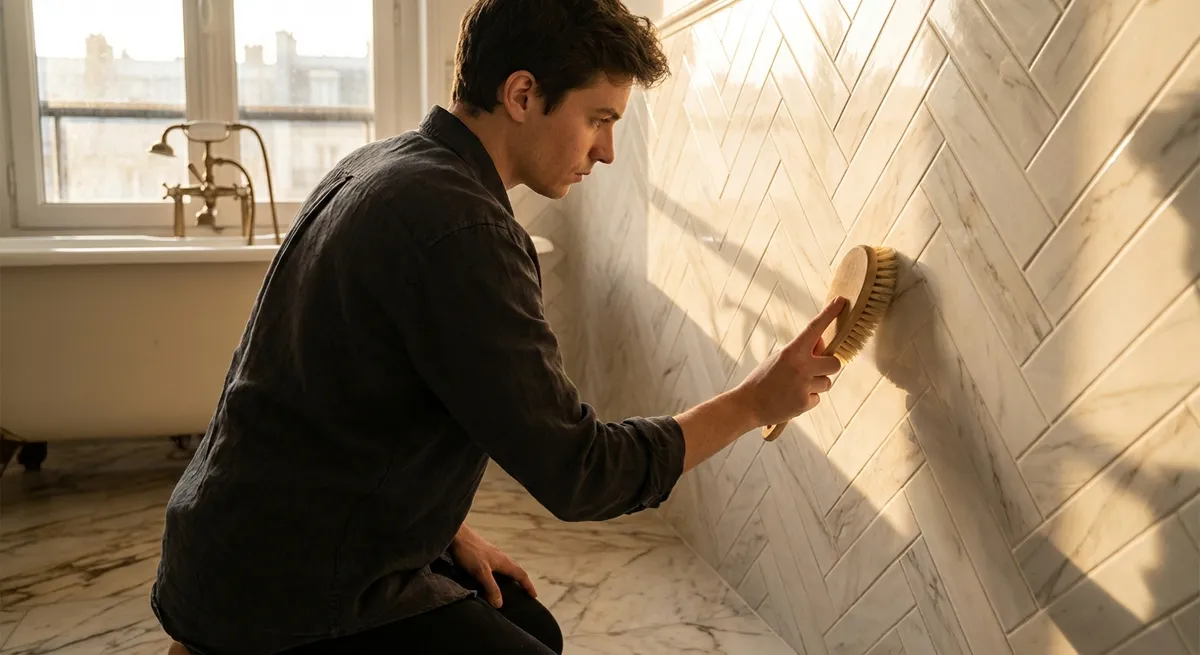
For everyday cleaning, direct your mop strokes along the grout lines rather than across them; this encourages soil removal rather than pushing debris into the joints. When dealing with localized discoloration, use a soft-bristled brush and a neutral cleaner rather than resorting to harsh scrubbing pads that can roughen both grout and tile edges. In discerning homes, grout is always read as a clue to maintenance standards—the more even, calm, and consistent it appears, the more elevated the entire room feels.
Exclusive Insight #3: The Two-Stage Cleaning Ritual Used in High-End Spaces
Most floors are cleaned in a single pass; luxury spaces are often maintained in two. The distinction is simple yet transformative: a removal stage, then a refinement stage.
The removal stage focuses entirely on dry soil. High-quality vacuuming (with a soft hard-floor attachment) or deliberate dry sweeping precedes any moisture. This avoids creating a thin slurry of grit and cleaning solution that can settle into grout and microtextures, forming residue that dulls the finish over time. The goal is to lift as much particulate matter as possible before a drop of water is introduced.
The refinement stage uses a carefully diluted, neutral pH cleaner and a mop or microfiber pad specifically reserved for tile surfaces. The key is not only in the product, but also in the method: work in controlled sections, refresh the cleaning solution regularly, and follow with a clean, damp pass to remove any residual detergent. In spaces with expansive tile, a double-bucket system—one for rinse water, one for solution—maintains clarity and avoids re‑depositing soils. The result is a floor that feels inherently clean rather than superficially perfumed.
Exclusive Insight #4: Microclimate Management—Why Air and Light Matter
Tile is often discussed as if it exists in isolation, but the microclimate of the room—the interplay of humidity, temperature variation, and light exposure—quietly influences how it ages.
In humid environments, persistent moisture can encourage subtle grout discoloration, mildew in corners, and a tacky film that attracts more soil. Discreet ventilation, from silent exhaust fans in bathrooms to thoughtful airflow in large open-plan areas, helps surfaces dry completely after cleaning or routine use. This is especially crucial for natural stone, which can be more sensitive to moisture and its mineral byproducts.
Light, too, plays a role. Direct, intense sunlight over years can gently shift the tone of some natural stones or surface treatments, while revealing every streak from careless mopping on polished finishes. In such rooms, schedule deeper maintenance in early morning or evening, when light is softer, to better see and control the visual outcome. Window treatments, UV-filtering films, and strategic rug placement can all help moderate the stress on tile in sun-saturated spaces without diminishing the architecture’s openness.
Exclusive Insight #5: The “No-Urgency” Rule for Spills—and the One Exception
Luxurious interiors are rarely defined by panic; they are defined by calm, predictable responses. Spills on tile should generally be treated with this same composure: blot, then clean, rather than scrub in haste.
For most glazed tile and sealed grout, immediate blotting with a soft, absorbent cloth followed by a neutral cleaner is sufficient. The objective is to remove the spill without driving it into the grout lines or abrading the surface with frantic rubbing. For natural stone, especially polished marble or limestone, rapid but controlled response is vital for anything acidic—wine, citrus, vinegar-based dressings—as these can etch the surface in minutes. Here, the “no-urgency” rule has one exception: move quickly, but with restraint. Blot thoroughly, avoid lateral rubbing, and neutralize with a stone-safe cleaner as soon as possible.
The deeper wisdom is to protect high-risk zones—bars, dining areas, vanities—with subtle design and behavioral strategies: coasters, trays, and well-placed runners. In a refined home, maintenance is often about anticipation rather than repair.
Conclusion
Exceptional tile work does not remain exceptional by accident. It is supported by an informed, nuanced maintenance philosophy that values chemistry over fragrance, ritual over haste, and prevention over correction. When you calibrate your routine to the material, protect the grout as an architectural element, adopt a two-stage cleaning ritual, manage the room’s microclimate, and respond to spills with composed precision, your tile surfaces stop aging in visible increments and begin to acquire a quiet, enduring patina of care.
In the most thoughtfully maintained homes, tile is never the loudest feature in the room. It is the serene constant—the surface that lets everything else be beautiful.
Sources
- Natural Stone Institute – Care and Cleaning of Natural Stone – Detailed guidance on correct cleaning methods and pH considerations for stone surfaces
- U.S. General Services Administration – Facilities Standards: Floor Finishes – Federal design and maintenance standards, including hard-surface flooring care principles
- The Tile Council of North America (TCNA) – Grout and Maintenance Basics – Authoritative recommendations on cleaning, grout care, and proper product selection
- Centers for Disease Control and Prevention – Cleaning and Disinfecting Your Home – Evidence-based guidance on safe cleaning practices and chemical use in residential settings
- University of California, Berkeley – Indoor Environmental Quality – Discussion of ventilation, humidity, and indoor conditions that indirectly affect surface longevity