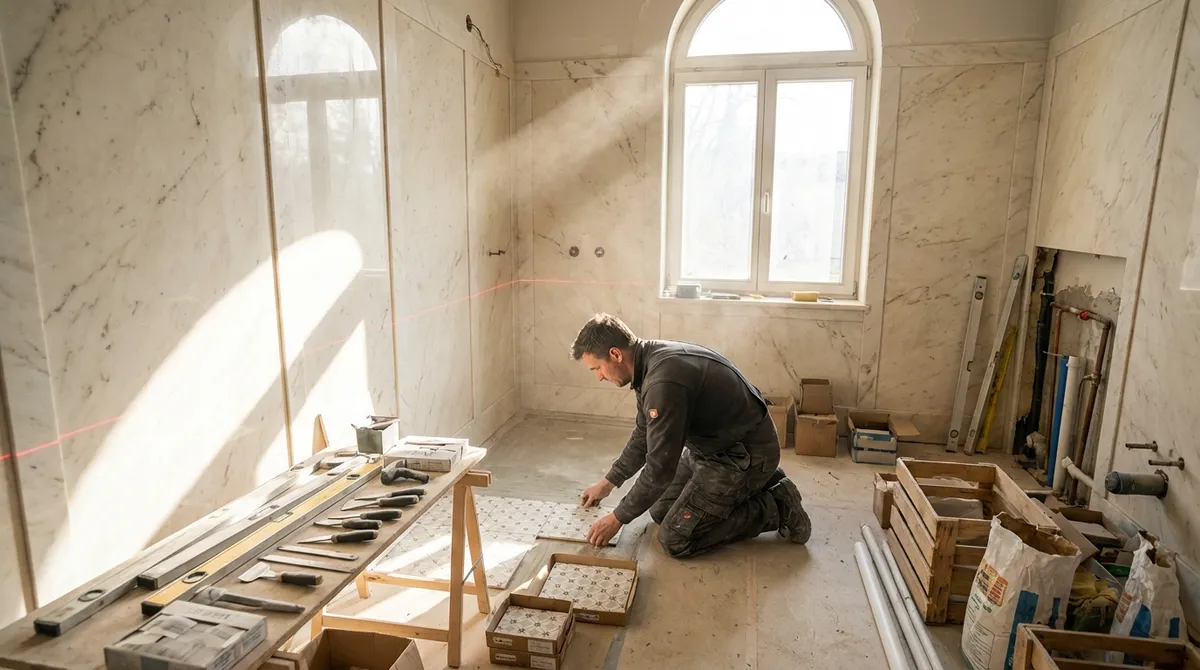
Below are five exclusive, detail-driven insights that transform tile repair from a necessary nuisance into a sophisticated, value-creating exercise.
Repair as a Design Edit, Not a Bandage
Most tile repairs are approached as damage control: replace, re-grout, move on. In refined interiors, the mindset is different—each repair becomes a considered “edit” to the original composition.
Before any work begins, step back and study the room as a whole: the way light grazes the surface, how patterns terminate at thresholds, where the eye naturally rests. If a chipped tile sits in a visually prominent zone, this may be the moment to upgrade a small field: introduce a subtly honed version of the same stone, refine the layout termination at a doorway, or re-align a pattern that has always felt slightly off.
This design-forward mindset also helps avoid the tell-tale “new square in an old quilt” effect. By coordinating the repair with adjacent elements—trim profiles, grout color, sheen level—you preserve the perception of a continuous, intentional surface. Done correctly, the room feels more resolved post-repair than it did before the damage occurred.
Precision Matching: Beyond “Close Enough” Color and Texture
Sophisticated tile repairs live or die on the quality of the match. “Close enough” reads as visual noise in a high-end space, especially when dealing with natural stone or artisanal ceramics.
For stone, request that your installer or fabricator source replacement pieces from the same quarry line or lot whenever possible. If that’s not available, prioritize veining direction, mineral movement, and base tone over exact pattern replication. A skilled professional may even rotate or selectively trim a tile so the most harmonious portion is visible. For porcelain and ceramic, insist on checking the manufacturer’s shade and caliber information on the box; mixing different shade codes can produce subtle but jarring discrepancies.
Texture is equally critical. A matte replacement in a field of polished tiles disrupts reflections; a slightly more heavily structured surface will catch shadows. For grout, advanced color-matching systems—and in some cases, grout colorant applied over existing joints—can harmonize old and new. The aim is not to erase the repair entirely, but to integrate it so seamlessly that only a trained eye, at close range, can detect the intervention.
Structural First: Luxurious Floors Start Below the Surface
No amount of aesthetic finesse can compensate for a substrate that’s moving, flexing, or poorly prepared. The most refined repair solutions begin with a structural diagnosis, not a cosmetic one.
If you see recurring cracks, hollow sounds underfoot, or loose tiles reappearing in the same zone, demand an investigation beneath the surface. Check for deflection in the subfloor, insufficient underlayment, or missing movement joints along perimeters and transitions. In wet areas, insist on a moisture assessment and a review of the waterproofing layer, particularly around penetrations, niches, and transitions between materials.
A premium repair may involve removing more tiles than strictly “necessary” in order to rebuild a proper substrate, integrate a crack isolation or uncoupling membrane, or add correctly placed movement joints. This feels more invasive in the moment but dramatically extends the lifespan of the floor or wall assembly. The real luxury here is not the tile itself—it is the confidence that the surface will remain impeccably stable for years.
Subtle Performance Upgrades Hidden in Every Repair
A well-planned repair is an ideal moment to upgrade what you cannot easily reach once the tile is back in place. Thoughtful homeowners treat this as an opportunity to quietly enhance comfort, safety, and long-term resilience.
Under heated tile floors, repairs allow access to test or replace compromised heating cables or mats in localized areas. In showers or steam rooms, opening the assembly gives you a chance to refine the waterproofing strategy, improve slope to drain, or upgrade to more advanced membranes and drain systems. On exterior terraces or balconies, you can introduce better drainage layers or frost-resistant mortars if the original assembly was marginal.
Even on a purely functional level—such as re-grouting—choose high-performance materials that outpace the original: epoxy or hybrid grouts for stain resistance in kitchens, flexible grouts in areas of minor movement, and sealers tailored to the specific stone or tile. The visible outcome may appear identical to the pre-damage condition, but the performance has been discreetly elevated.
Curated Patina: Knowing When Not to “Perfect” the Surface
True luxury is not always about flawless uniformity; it’s about intentional character. Particularly with natural stone and handcrafted tile, a certain level of patina can be a feature, not a flaw. The distinction lies in whether the surface looks neglected—or curated.
When planning repairs in older installations, decide where to preserve history and where to assert freshness. For example, a centuries-inspired limestone floor may be more compelling with a few expertly repaired but still readable “stories” in the stone, rather than aggressively replaced sections that appear too new. Skilled stone restoration can hone, fill, and refinish damage while retaining a softened, time-worn look that feels authentically evolved.
Conversely, in a contemporary, monolithic porcelain installation, the design intent is often visual stillness. Here, even small chips or hairline cracks disrupt the calm. The premium decision is to pursue a near-invisible repair, including professional resurfacing, edge re-profiling, or full-tile replacement if necessary. The art lies in discerning which story the surface is meant to tell—and ensuring each repair supports that narrative.
Conclusion
Sophisticated tile repair is less about erasing the past and more about refining it. When you approach damage as an opportunity—to edit the design, perfect the match, reinforce the structure, embed discreet performance upgrades, and calibrate patina—you move beyond simple maintenance into the realm of quiet, enduring luxury.
For the discerning homeowner, the real measure of success is that a guest never notices the repair at all—but you know that beneath every flawless surface, the details are rigorously, intelligently resolved.
Sources
- Porcelain Tile Certification Agency – Technical Resources – Guidance on tile standards, shade variation, and quality considerations
- Tile Council of North America (TCNA) Handbook – Authoritative reference for substrate prep, movement joints, and installation best practices
- Schluter Systems – Educational Articles on Substrates & Waterproofing – In-depth explanations of uncoupling membranes, waterproofing methods, and integrated shower systems
- National Tile Contractors Association (NTCA) – Technical Articles – Professional insights on crack prevention, grout technologies, and common failure modes
- Natural Stone Institute – Stone Care & Maintenance – Expert information on restoring, sealing, and maintaining natural stone surfaces and patina