Below are five exclusive, detail-driven insights for homeowners who expect their tile work to perform—and age—with grace.
Reading the Surface: Diagnosing Without Guesswork
Elegant repair begins long before any tile is lifted. The first task is to read the surface like a map of the home’s history, not simply to spot what’s broken.
A refined assessment looks beyond visible cracks to understand what caused them. Are grout joints crumbling because of movement in the substrate, or because an incorrect grout was used for the tile size and joint width? Is a loose tile the result of isolated impact, or a systemic failure in the adhesive layer? An experienced professional will listen for hollow sounds with a tapping tool, inspect expansion joints, check for moisture intrusion, and study the pattern of damage rather than each flaw in isolation.
Homeowners should expect a written diagnosis that distinguishes between cosmetic issues and structural concerns. This diagnostic clarity matters: focused repairs preserve more of the original installation and prevent the “domino effect” of unnecessary demolition. In a premium space, precision is the true luxury.
The Art of the Invisible Match: Color, Texture, and Aging
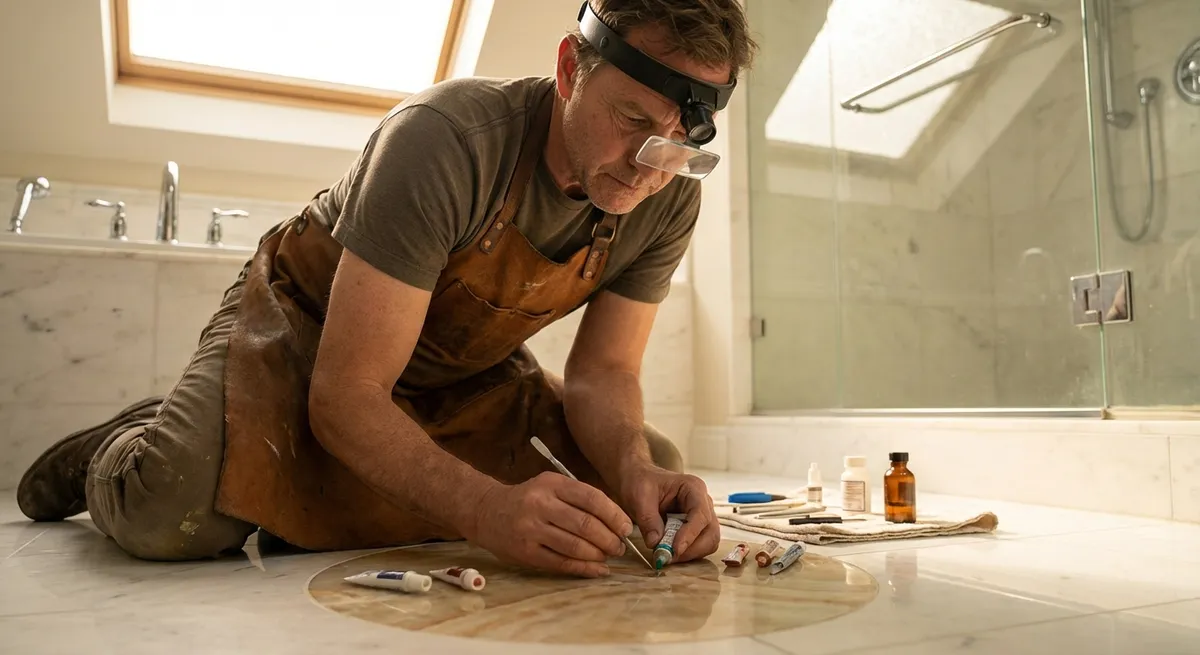
Matching a tile or grout “off the shelf” is rarely sufficient in a high-end interior. Luxury tile repair is, in essence, a form of visual forgery: the new should be indistinguishable from the old, even under unforgiving natural light.
For discontinued or imported tiles, a skilled specialist may source reclaimed stock, commission small-batch runs from artisan manufacturers, or use color-stable repair compounds that can be hand-shaded on site. Texture matters as much as tone—matte porcelain, tumbled stone, and hand-made terracotta all interact with light differently. A perfect color match that ignores surface sheen will still read as a repair.
Grout matching requires equal care. Over time, grout fades, absorbs microscopic stains, and shifts in tone. The correct approach is not to match the grout to its original color card, but to its present, gently aged appearance. Professionals often blend multiple grout colors, test samples in inconspicuous areas, and evaluate under both day and night lighting before committing.
The mark of a premium repair is simple: you can point to the area, but guests never will.
Designing Repairs for Movement, Not Just Today’s Perfection
Many tile failures in upscale homes trace back to a single oversight: the installation was designed to look impeccable on day one, not to behave impeccably over years of subtle movement.
Sophisticated repair work quietly corrects this. Where tiles have tented or cracked due to expansion, the solution is not just to re-adhere them more aggressively, but to reintroduce or refine movement joints—at perimeters, thresholds, and long runs of tile. Underfloor heating, large-format porcelain, and sun-exposed rooms all demand particular attention to expansion and contraction.
In wet areas, such as spa-like showers or steam rooms, repairs should consider the entire assembly: waterproofing membranes, slope to drains, vapor management, and appropriate flexible sealant in changes of plane. Rebuilding a damaged niche or curb is an opportunity to upgrade to modern waterproofing standards, not merely to replicate an outdated detail.
The most valuable repairs are those you never need to revisit. They are conceived not as isolated fixes, but as structural refinements that allow the surface to live and move without complaint.
Precision Demolition: Saving What Deserves to Stay
In a truly elevated interior, demolition is not brute force—it is surgery. The goal is to intervene as narrowly as possible, preserving the integrity of the surrounding tilework, adjacent finishes, and even underfloor heating systems.
Refined repair work may use oscillating multi-tools with specialty blades to cut grout joints with minimal chipping, suction devices to lift tiles cleanly, and low-impact techniques to remove adhesive layers without damaging the substrate. When radiant heating is present, professionals locate and map the system before work begins, removing thinset in carefully controlled passes to avoid nicking cables or pipes.
This level of delicacy costs more time, but it preserves what you originally invested in: the larger field of tile, the alignment of pattern and layout, and the continuity of the room. When done properly, the boundary between “old” and “new” remains academic rather than visible.
Homeowners commissioning repair work in premium spaces should explicitly ask about removal methods, dust control measures, and protection for adjacent finishes. Professional-grade containment and protection are as much a part of luxury repair as the final clean lines.
Upgrading Quietly: Turning Repairs into Performance Enhancements
A repair is also a rare, surgical opportunity to upgrade performance without redoing an entire room. Done with foresight, these interventions make your surfaces more resilient and easier to live with—without altering the visual language you already love.
Behind a shower wall, a localized rebuild might introduce a modern waterproofing membrane where none existed before, or one with superior vapor control. Beneath a few replaced floor tiles, a crack-isolation or uncoupling membrane can be added to bridge minor substrate movement. In high-traffic entries, replacing a damaged zone can be an occasion to use a more robust grout type (such as a premium modified or epoxy grout) in that area, with careful matching to maintain the appearance of the original.
Surface-level enhancements are equally discreet but transformative: re-sealing natural stone with a breathable, penetrating sealer suited to the specific material and finish; selectively re-caulking transitions with high-performance, color-matched sealants; or re-polishing etched stone tiles in a localized area rather than re-honing an entire floor.
The most sophisticated repair strategy treats every intervention as an upgrade opportunity—small in footprint, generous in long-term benefit.
Conclusion
In a finely curated home, tile repair is not damage control; it is preservation. The goal is to defend the original design, enhance the underlying performance, and restore a sense of flawless continuity. By insisting on accurate diagnosis, invisible matching, movement-conscious detailing, surgical demolition, and strategic upgrading, homeowners can ensure that their tiled surfaces age with dignity rather than drama.
When properly executed, the most luxurious repair has a single defining feature: you never think about it again.
Sources
- Tile Council of North America (TCNA) – Handbook for Ceramic, Glass, and Stone Tile Installation - Industry reference for best practices in tile installation and repair, including movement joints and substrate standards
- Schluter Systems – Tile Installation and Uncoupling Membrane Resources - Technical guidance on managing movement, waterproofing, and uncoupling beneath tile
- U.S. Environmental Protection Agency – Renovation, Repair and Painting (RRP) Program - Important information on safe renovation practices, dust control, and health considerations, especially in older homes
- Mapei – Grout and Sealant Technical Data - Detailed specifications on grout types, performance characteristics, and color matching considerations
- Laticrete – Waterproofing and Crack Isolation Systems - Information on modern waterproofing and crack-isolation products commonly used during tile repair and localized rebuilds