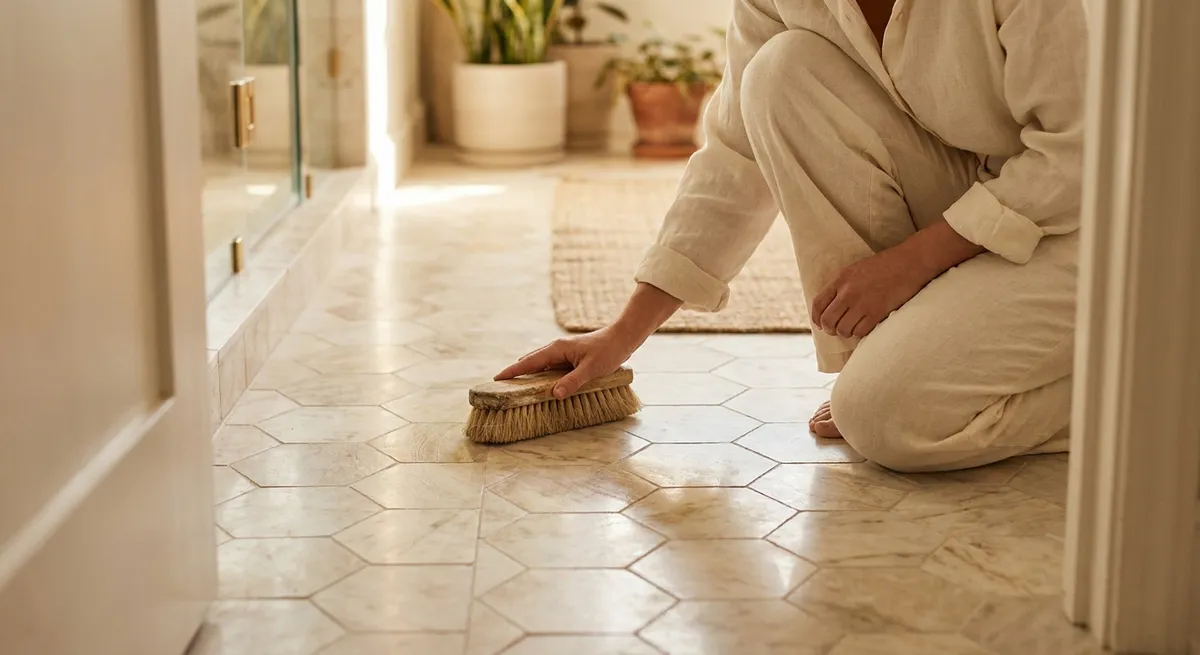
Below, five exclusive, detail‑driven insights for homeowners who expect their tile to age with grace, not merely survive.
Reading the Surface: Understanding Your Tile’s True Character
Sophisticated maintenance begins with recognition. Ceramic, porcelain, natural stone, and engineered stone each respond differently to water, cleaners, and abrasion. A polished marble vanity, for instance, can etch from a splash of citrus or perfume, while dense porcelain with a matte finish shrugs off most everyday wear. Treating them the same is the fastest route to a quietly deteriorating surface.
Study the manufacturer’s specifications and identify three details: tile composition, surface finish (polished, honed, textured, glazed), and grout type (cementitious, epoxy, or urethane). This trio dictates everything—appropriate pH levels in cleaners, acceptable tools (microfiber vs. soft bristle vs. non‑woven pads), and the safe frequency of more intensive cleaning. Think of it as a care label in a couture garment: discreet, but absolutely non‑negotiable.
Once you truly “read” your tile, maintenance stops feeling generic and begins to feel tailored. The reward is a floor or wall that still looks “just installed” years after the grout has fully cured.
The pH Discipline: Curating a Cleaner Wardrobe
Refined tile care is less about scrubbing harder and more about curating a disciplined cleaning arsenal. The single most overlooked detail is pH. Acidic or highly alkaline cleaners may produce an immediate “sparkle,” but they often extract that shine at the expense of grout integrity, sealer performance, or stone clarity.
For routine maintenance, a neutral pH cleaner specifically formulated for tile and stone is the quiet hero. It suspends dirt without attacking the surface, allowing microfiber mops and cloths to lift away residue instead of smearing it thinly across the floor. Reserve pH‑adjusted specialty products for targeted interventions—lightly acidic formulas for hard water deposits on appropriate ceramics or porcelains, and stone‑safe alkaline solutions for greasy kitchen floors.
Equally important is restraint: more concentrate is not better. Over‑dosing cleaners leaves a film that catches dust and dulls the finish, turning weekly cleanings into a cycle of accumulation rather than removal. Measure carefully, rinse when recommended, and test any new product on a discreet tile near a baseboard or behind an appliance before committing to the entire surface.
Grout as a Design Asset: Protecting the Negative Space
Most homeowners think about tile; professionals obsess over grout. That slim band of negative space is the visual framework that either crowns the installation or quietly betrays its age. Immaculate grout reads as crisp and intentional; stained or eroded grout signals neglect from across the room.
Begin with protection. If your grout is cement‑based and not epoxy or urethane, a penetrating sealer is essential in high‑use areas such as entries, kitchens, and showers. Applied correctly, it doesn’t sit on the surface like a varnish; instead, it soaks into the grout, making it less absorbent without altering the color or sheen. Plan to re‑evaluate high‑traffic grout every 12–24 months by placing a few droplets of water on the joints: if they darken immediately and soak in, it is time to reseal.
Daily, treat grout as you would a fine fabric: blot spills promptly instead of wiping them across joints, use soft bristle brushes for localized stains rather than abrasive pads, and vacuum dry debris before any wet cleaning to prevent grit from being driven into the texture. For older installations, a meticulously executed grout refresh—careful cleaning, minor joint repairs, and color‑matched sealing—can visually recalibrate an entire room without replacing a single tile.
Micro-Maintenance: The Art of Addressing Issues Before They Announce Themselves
Enduring tile installations are protected less by dramatic “deep cleans” and more by a quiet cadence of micro‑maintenance. This is the art of handling potential problems before they become visible defects.
In damp environments, such as showers and spa‑like baths, a simple daily squeegee across walls and floors can radically reduce mineral deposits, soap film, and the conditions that encourage mildew. In kitchens, treating the 30–60 cm perimeter around the cooktop and prep zones as a “precision zone” and wiping it with a neutral cleaner after messy sessions prevents oil and pigment from migrating into grout over time.
Adopt a monthly visual inspection ritual: scan for hairline cracks in grout, minor hollow sounds under tiles (tapping gently with a knuckle), or faint discoloration along corners where movement occurs. Addressing a small grout line crack with a suitable repair product or flexible sealant long before water finds its way behind the tile is the difference between a two‑hour intervention and a multi‑week renovation. The most elegant tiled spaces are not those that never encounter issues; they are those where issues are intercepted at the whisper stage, never the shout.
Light, Sheen, and Texture: Maintaining the Intended Visual Atmosphere
Maintenance is not only about cleanliness; it is about safeguarding the tile’s original visual intention. Different finishes and textures interact with light in very specific ways, and careless care routines can subtly alter that interaction over time.
High‑gloss and polished tiles are designed to reflect and elongate light. To maintain this effect, avoid powders or abrasive tools that introduce micro‑scratches, which diffuse reflections and create a permanently “hazed” look. Use soft microfiber and, where necessary, specialty polishes approved for the tile type rather than generic glass cleaners that may leave silicones or residues.
Matte and textured tiles, on the other hand, often rely on controlled shadowing to add depth and traction. Overuse of topical “shine enhancers” or wax‑like products can fill micro‑textures, making the surface appear muddy and, paradoxically, more likely to show footprints. For these, the goal is clarity, not gloss: thorough rinsing, occasional low‑moisture cleaning with high‑quality pads, and periodic, targeted stain treatment maintain the sculpted look the designer intended.
Consider how your lighting scheme—particularly low, grazing light from floor lamps or wall washers—interacts with the tile. Such light can dramatize even minor streaking or swirl marks. Adjust your cleaning pattern (long, consistent passes in one direction rather than circular motions) to align with the primary light direction, minimizing visible patterning and preserving a serene, uniform surface.
Conclusion
Exceptional tile does not merely survive daily life; it frames it with quiet confidence. When maintenance shifts from reactive scrubbing to intentional ritual—guided by surface knowledge, disciplined product choices, grout stewardship, micro‑maintenance habits, and sensitivity to light and finish—your tile begins to age the way fine materials should: acquiring depth, not damage.
In a home where every detail is considered, tile maintenance is not an afterthought. It is part of the design itself, ensuring that the surfaces underfoot and at eye level continue to feel composed, deliberate, and enduringly polished.
Sources
- [U.S. General Services Administration – Floor Maintenance Practices](https://www.gsa.gov/technical-procedures/floor-maintenance) – Technical guidance on floor care methods and appropriate products for different hard surfaces
- [University of Florida IFAS Extension – Cleaning and Preserving Tile and Grout](https://edis.ifas.ufl.edu/publication/HE632) – Educational overview of tile and grout cleaning, pH considerations, and stain management
- [Tile Council of North America (TCNA) – Frequently Asked Questions](https://www.tcnatile.com/faqs) – Industry‑standard information on tile types, grout, and recommended care practices
- [MAPEI – Guide to Cleaning and Maintaining Floor Tile](https://www.mapei.com/us/en-us/realta-mapei/issue-38/cleaning-and-maintaining-floor-tile) – Professional insights on tile maintenance, cleaner selection, and grout protection
- [DuPont / Stonetech (by Laticrete) – Stone and Tile Care Guide](https://laticrete.com/en/tile-and-stone-care-maintenance) – Manufacturer recommendations for tile and natural stone cleaners, sealers, and maintenance routines