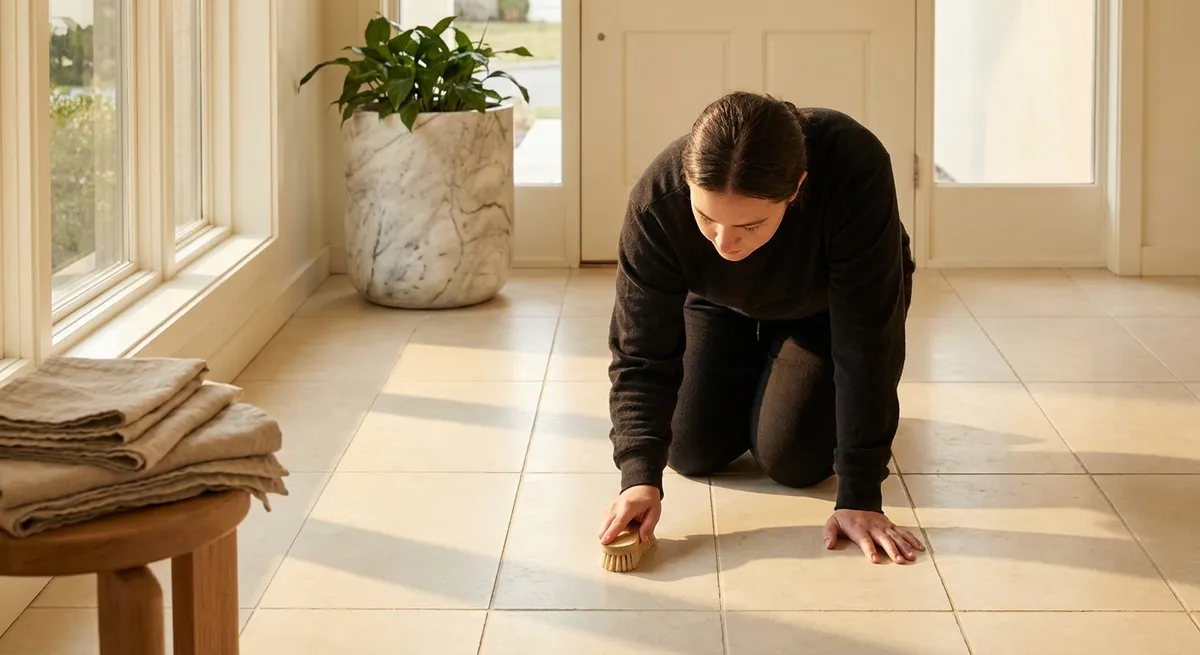
Below are five exclusive, deeply practical insights that professionals rely on but rarely articulate. Applied consistently, they transform tile from “finished surface” into a long-term architectural asset.
1. The pH Rule: Treat Every Tile as if It Were Stone
Even when your tile is technically impervious—porcelain, for example—its surrounding ecosystem is not: grout, sealers, and adjacent finishes are all vulnerable. The most refined homes obey a simple rule: nothing harsh, nothing unknown, nothing improvised.
Neutral-pH cleaners (typically in the 7–8 range) are the baseline for routine care. Acidic solutions, including common household standbys like vinegar, lemon-based cleaners, or “miracle” descalers, can etch natural stone, degrade grout over time, and strip protective sealers long before their expected lifespan. Likewise, high-alkaline degreasers used too frequently can leave films that attract soil and dull the surface, creating a perpetual cycle of “dirtier faster.”
Professionals treat tile care like skincare: daily care is gentle, precise, and consistent; corrective products are reserved for specific issues, used sparingly, and thoroughly rinsed. Before any new product touches your tile, test it in an inconspicuous corner and observe not just the immediate result but the finish once fully dry. The luxury standard is simple: if you wouldn’t use it every week for years, you don’t use it casually once.
2. Grout as Architecture: Maintaining the Lines, Not Just the Surface
Homeowners often think of grout as the “stuff between the tiles.” Professionals regard it as critical architecture: it defines geometry, absorbs micro-movements, and either elevates or cheapens the visual rhythm of the room.
Grout maintenance begins with protection, not repair. Even on dense porcelain installations, grout lines benefit from a high-quality penetrating sealer—refreshed periodically based on traffic and exposure. In kitchens, busy entries, and showers, resealing every 12–24 months maintains stain resistance and stabilizes color. On light grout shades, this single habit often makes the difference between “freshly installed” and “perpetually tired.”
Day-to-day, the aim is to minimize the grinding of abrasive particles into the joints. That means dry maintenance first (microfiber dust mopping or vacuuming with a soft-floor head), wet cleaning second. When grout does begin to discolor, resist the urge to escalate immediately to aggressive scrub pads or harsh chemicals. Start with a soft nylon brush, a neutral or slightly alkaline tile-specific cleaner, and dwell time—letting the solution sit for several minutes before agitation. The goal is not to “erase” grout to make it appear bright, but to restore its intended tone while preserving its surface integrity.
Well-preserved grout reads as crisp, continuous lines. When those lines blur, the entire installation looks older—even if the tile itself is pristine.
3. Controlled Sheen: Curating Light Rather Than Chasing Shine
In elevated interiors, tile is rarely about shine for its own sake. The most sophisticated floors do not sparkle; they manage light. Maintenance is therefore less about making surfaces “as shiny as possible” and more about maintaining the finish originally designed for the space.
High-polish stone or glazed tile is extraordinarily unforgiving of residue. Overuse of “shine-enhancing” cleaners, soaps, or oil-based products builds microfilms that streak, patch, and eventually attract soil in dull swirls. Instead, professionals rely on a deceptively modest formula: a measured dilution of a quality neutral cleaner, minimal application, and extremely thorough rinsing.
Matte and honed tiles demand a different discipline. The ambition is an even, velvety appearance, not reflective gloss. Any product that promises to “add shine” to a matte tile is misaligned with the original design intent. For these surfaces, residue control is paramount: two-bucket mopping (one for solution, one for rinse), well-wrung microfiber mops, and a final pass with clean water in highly visible areas like entry halls or open-plan living spaces.
An additional professional habit: observe your floors at low, grazing light—early morning or late afternoon. This is when streaks, film build-up, and subtle finish changes are most visible. Adjust your products and technique based on what you see in this critical light, not just under ceiling fixtures.
4. Micro-Zoning: Adapting Maintenance to How Each Area Lives
Luxury maintenance is not uniform; it is tailored. A principal bathroom with underfloor heating, a busy back hall from the garage, and a rarely used formal dining room may share the same tile, but they do not share the same life—and should not share the same care schedule.
Professionals think in micro-zones, not just rooms. For example, the first meter inside an exterior door typically experiences dramatically higher grit and moisture than the rest of the hallway. That zone benefits from more frequent dry cleaning, a strategically placed high-quality mat, and periodic deeper cleaning specifically targeted there. Similarly, the area directly in front of a kitchen island or cooktop often deserves a “quiet upgrade” in attention compared to the rest of the floor.
This zoning applies vertically as well: shower walls, niches, and bench seats all behave differently. Horizontal wet surfaces—shower floors and benches—accumulate soap and minerals faster, and therefore merit slightly more frequent, gentle cleaning than vertical walls. Where hard water is an issue, a routine wipe-down with a soft squeegee or microfiber cloth after use is a subtle but powerful habit. It minimizes mineral accumulation and dramatically extends the intervals between more intensive descaling.
By calibrating your maintenance to actual use patterns, you avoid over-cleaning low-traffic areas (which can be unnecessarily harsh on sealers and finishes) while preserving the most visible, hard-working zones in consistently immaculate condition.
5. Preventive Quiet Measures: Protecting Edges, Thresholds, and Transitions
Most homeowners look at the broad field of tile; professionals look at the edges. The elegance and longevity of a tiled space are often determined by what happens at transitions—doorways, perimeter movement joints, and interfaces with other materials such as wood or carpet.
Chairs, barstools, and movable furniture are frequent culprits. A premium floor does not simply rely on felt pads applied once and forgotten. Those pads are checked, refreshed, and replaced before they compress, collect grit, or detach. For rolling office chairs on tile, consider a high-quality, low-visual-profile mat rather than asking small hard casters to perform gracefully on grout joints for years.
Thresholds and step nosings deserve particular deference. These are areas of concentrated impact and directional change, where even a small chip or crack can visually undermine an otherwise flawless installation. Protective measures might include discrete runner rugs with non-staining backings, quiet reinforcement of existing transitions, or rethinking traffic patterns that repeatedly stress the same narrow strip of tile.
Finally, climate matters. In regions with sand, de-icing salts, or abrasive winter grit, the first line of defense is outside: generous exterior mats and a firm household habit of removing shoes at the threshold. This is not about formality; it is about protecting the microscopic surface of both tile and grout from being abraded thousands of times a month. Preventive care is rarely dramatic, but over a decade, it is unmistakable.
Conclusion
Exceptional tile work is engineered at installation—but it is perfected, year after year, in the way it is maintained. Neutral chemistry, disciplined grout care, curated sheen, micro-zoned routines, and discreet preventive measures form the quiet backbone of truly luxurious tile surfaces.
When these five habits become part of the home’s rhythm, tile stops behaving like a finish that must be constantly rescued and instead becomes a stable, elegant backdrop to daily life. The result is not only beauty that lasts, but a particular kind of confidence: the knowledge that your floors and walls are cared for with the same precision with which they were designed.
Sources
- U.S. Environmental Protection Agency – Safer Choice: Cleaning Products – Guidance on safer, less harsh cleaning formulations appropriate for routine home maintenance
- Natural Stone Institute – Care & Maintenance of Natural Stone – Professional recommendations on pH, sealing, and daily care practices for stone and grout
- Tile Council of North America (TCNA) – Tile Care & Maintenance – Industry-standard advice on cleaning methods and product selection for ceramic and porcelain tile
- MAPEI – Guide to Grout Care and Maintenance – Technical perspective on grout protection, sealing cycles, and cleaning strategies
- Stanford University – Ergonomics and Floor Safety Guidelines – Insight into slip prevention and surface safety considerations that inform sensible tile maintenance choices