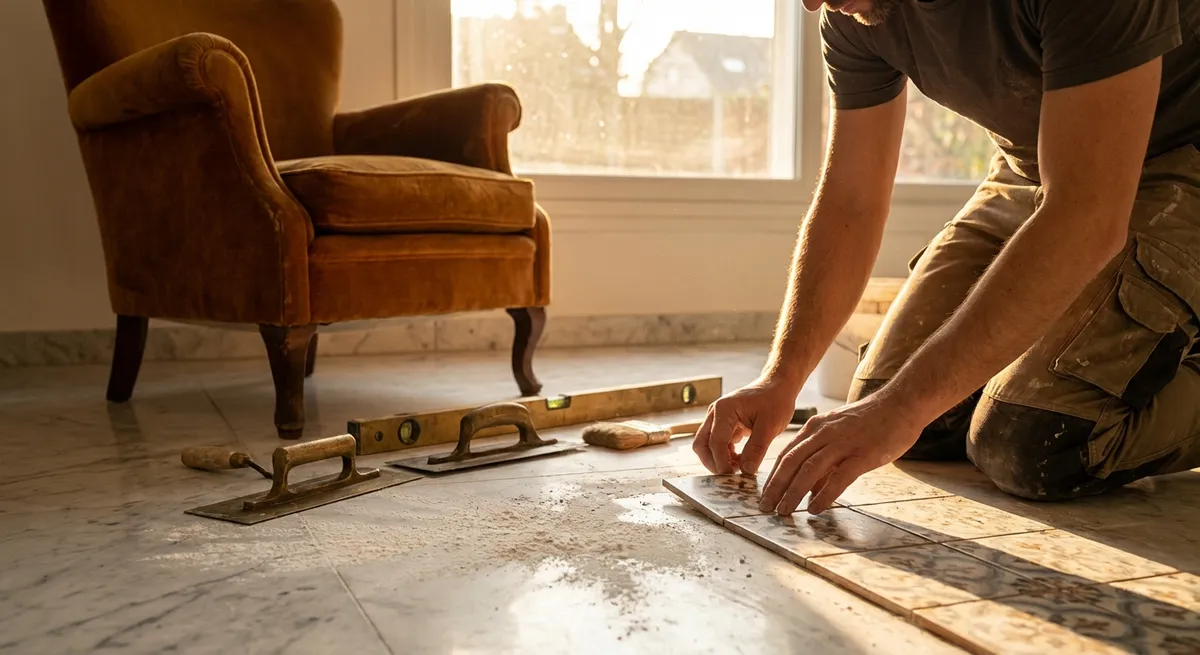
Below are five exclusive, practice-level insights that elevate tile repair from routine maintenance to a refined design discipline.
1. Reading the Surface: Diagnosing the Problem Before Touching a Tile
Sophisticated repairs begin long before the first tile is lifted. The most experienced professionals “read” the surface, treating cracks, hollow sounds, stains, or lippage (uneven edges) as clues rather than isolated flaws. Hairline cracks in a single tile may point to localized impact; repeated cracking along a line usually indicates substrate movement or structural shifts. Hollow-sounding tiles can signal insufficient mortar coverage, voids, or debonding from moisture intrusion.
In premium interiors, correct diagnosis is non-negotiable because cosmetic fixes that ignore the underlying issue inevitably fail—and often in more visible ways. Moisture behind a shower wall, for example, may present as a small grout stain yet signify compromised waterproofing. Similarly, efflorescence (salty, white deposits on grout or stone) is rarely just a surface annoyance; it is a symptom of water migration within or below the installation.
The refined approach is methodical: visual assessment, tapping and listening, moisture readings where necessary, and sometimes even small, strategic removals to inspect the setting bed. The goal is not only to correct what has already happened, but to prevent a repetition that would diminish the room’s long-term composure.
2. The Art of Invisible Matching: Color, Texture, and Sheen as a Single Equation
High-end tile repair is fundamentally an exercise in controlled invisibility. Homeowners often focus on getting “the same tile,” but seasoned professionals know that matching the tile alone is rarely enough. Time, light exposure, and wear subtly alter surfaces, so a successful repair must coordinate three variables simultaneously: color, texture, and sheen.
Color matching extends beyond the tile body into the grout line. A slightly warmer or cooler grout shade can visually “announce” a repair, even when the replacement tile is from the original batch. Texture is just as critical; a honed marble, a subtly structured porcelain, or a hand-made zellige will each scatter light differently. If the original tile has been softened by years of gentle cleaning, a brand-new piece may appear too sharp, too crisp, or too reflective.
Sheen is where many repairs fail aesthetically. A semi-polished floor repaired with a fully polished replacement can create a small but persistent visual interruption. Refined repair solutions often involve carefully adjusting the new tile on site—light honing, micro-etching, or controlled polishing—to harmonize it with its surroundings. The best result is not a perfect match in isolation, but a surface that reads as cohesive when experienced as part of the entire room.
3. Structural Sensibility: When a “Simple” Repair Requires Substrate Intervention
In elevated projects, tile repair is never treated as a purely surface-level operation. The substrate—the underlayment, mortar bed, or backer board—has as much influence on long-term performance as the tile itself. Where repeated cracking, loosening, or tenting (tiles lifting or debonding) occur, the refined response is to question what lies beneath.
Movement joints may be inadequate, uncoupling membranes may be absent, or wood subfloors may have too much deflection. In wet areas, compromised waterproofing can quietly undermine the most exquisite marble or porcelain. A polished appearance with a failing substrate is a short-lived luxury; truly premium repair solutions aim for structural calm beneath aesthetic refinement.
Sometimes this means extending the repair zone beyond the visibly damaged area to re-establish a stable, modern standard of installation. This can include installing an uncoupling membrane in targeted zones, adding movement accommodation at transitions, or addressing improper slope in wet areas. The guiding principle: if the failure mechanism remains untouched, the repair is merely temporary. For discerning homeowners, a slightly larger, well-executed intervention is almost always more elegant than recurring, piecemeal fixes.
4. Intelligent Grout Strategies: Using the Joint to Refine, Not Merely Fill
Grout is often treated as a necessary filler; in refined interiors, it is a design instrument. Repair work offers an opportunity to correct earlier grout missteps that may have always felt slightly “off”—joints that are too light and visually busy, too dark and heavy, or too wide and inelegant for the tile size and pattern.
When addressing damaged joints or replacing tiles, an expert will evaluate whether the existing grout type still serves the space: cementitious for breathability, epoxy for high-performance, or hybrid solutions for demanding zones. Advances in grout technology, including stain-resistant and color-consistent formulations, allow repair work to subtly upgrade function without altering the ambiance.
Color re-selection during a repair can be a powerful yet understated move. Slightly deepening a grout tone in a kitchen can reduce the perception of day-to-day wear. Softening contrast in a bathroom can make the room feel calmer and more spacious. A sophisticated repair plan regards grout lines not as afterthoughts, but as fine-tuning tools that can quiet visual noise and restore composure to the surface.
5. Curated Longevity: Tailored Protection Plans for High-Value Tile Installations
After a meticulous repair, the question becomes: how do we keep this surface visually and structurally serene? The answer lies in maintenance plans that are tailored, not generic. Premium spaces often combine multiple materials—polished stone, high-gloss porcelain, matte mosaics, or encaustic tiles—each with different tolerances for cleaners, sealers, and daily use.
A refined protection strategy distinguishes between what must be sealed, what should never be sealed, and what requires pH-neutral versus specialized cleaners. Natural stone, cement-based tiles, and some unglazed porcelains benefit from carefully selected sealers—penetrating for subtle protection, or enhancing for depth of color when appropriate to the design. High-gloss, fully vitrified porcelain may need no sealer at all, only the right cleaning agents to avoid film build-up or dulling.
The most thoughtful repair professionals will leave homeowners with a clear, curated maintenance roadmap specific to their installation: which products to use and avoid, how often to reseal if required, and what early warning signs (such as recurring staining or hairline grout fractures) warrant a proactive inspection. In well-appointed homes, longevity is not left to chance; it is quietly engineered through informed, ongoing care decisions.
Conclusion
Refined tile repair is not a backstage version of installation; it is its own discipline—discreet, technical, and deeply aesthetic. The difference between an ordinary patch and an elevated solution lies in what you cannot see: the accuracy of the diagnosis, the nuance of the match, the stability of the substrate, the intelligence of the grout strategy, and the thoughtfulness of ongoing protection.
For homeowners committed to maintaining a cultivated environment, approaching tile repair with the same level of intention as original design is an investment in visual continuity and everyday serenity. When handled with quiet precision, the repaired surface does not merely look restored—it feels inevitable, as though it has always belonged.
Sources
- U.S. Department of Housing and Urban Development – Residential Rehabilitation Inspection Guide – Technical context for diagnosing building and substrate issues underlying surface failures
- Tile Council of North America (TCNA) – Handbook for Ceramic, Glass, and Stone Tile Installation – Industry standards and best practices for tile substrates, movement joints, and installation details
- Schluter Systems – Technical Articles on Uncoupling and Waterproofing – In-depth resources on managing substrate movement, moisture, and modern repair approaches
- LATICRETE – Grout and Mortar Technical Data Sheets – Information on grout technologies, performance characteristics, and selection for repair scenarios
- Marble Institute of America (Natural Stone Institute) – Stone Care and Maintenance – Guidance on sealing, cleaning, and protecting natural stone and related surfaces after repair