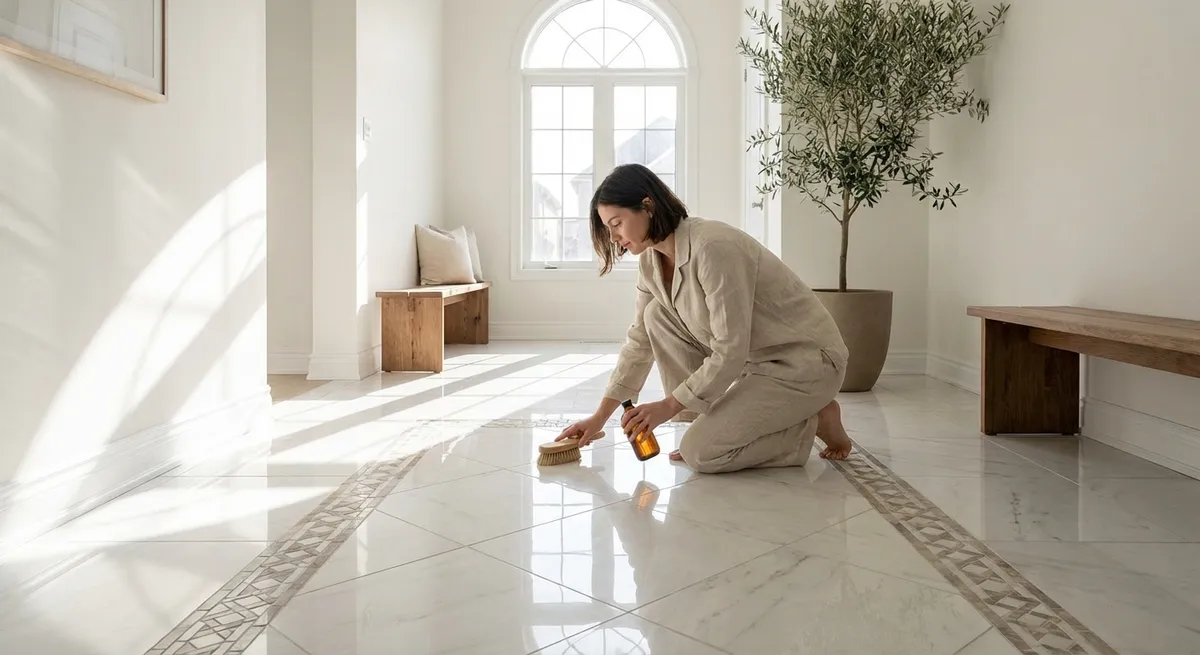
Below are five exclusive, rarely discussed insights that distinguish routine cleaning from truly elevated tile stewardship—practices that help your floors and walls age gracefully, not merely endure.
1. Calibrated Cleaning: Matching Your Routine to Tile & Grout Composition
Most homeowners clean tile as if all surfaces are essentially the same. In reality, your maintenance routine should be calibrated to the specific composition of the tile and grout, much like tailoring skincare to a particular complexion.
Porcelain and dense ceramics tolerate pH‑neutral cleaners and gentle scrubbing, while natural stones such as marble, limestone, and travertine require non‑acidic, stone‑specific formulations to avoid etching and dull spots. Cementitious grout can handle soft bristle brushes and periodic deep cleaning, but epoxy grout resists staining differently and typically only needs mild detergents and consistent rinsing.
Before selecting a cleaner, identify your tile type (porcelain, ceramic, natural stone, or cement tile) and grout composition (cementitious, epoxy, or urethane). Then, choose a single high‑quality, pH‑appropriate product and commit to it; constantly rotating products can leave residues that attract dirt and subtly cloud the finish. The most refined surfaces are maintained with restraint—simple, predictable routines, not an arsenal of aggressive chemicals.
2. Micro‑Timing Maintenance: Addressing Wear at Its Earliest Whisper
Refined tile care is rooted in timing, not intensity. Instead of waiting for visible grime or staining, you gain leverage by responding to the earliest cues of wear, often before they are obvious to anyone but you.
Develop a visual check-in ritual—once a week, walk your tiled spaces at eye level and then at a low angle, with light raking across the surface. This reveals early scuffing, fine scratches, or water dulling that overhead light conceals. Pay particular attention to transition zones: just inside entry doors, in front of vanities, beneath dining tables, and along the main kitchen work triangle. These micro‑zones often show the first signs of breakdown in grout sealers, matte finishes, and polished surfaces.
By catching a faint darkening of grout near a sink or the first haziness on a frequently mopped porcelain, you can adjust your approach—re‑seal selectively, change mop heads more frequently, or switch to a softer cleaning pad—before damage compounds. The goal is to intervene with precision so that intensive, whole‑room “rescues” become unnecessary.
3. Intelligent Moisture Management: Elevating Drying from Afterthought to Priority
For spaces like bathrooms, kitchens, and mudrooms, how surfaces dry is as important as how they are cleaned. Prolonged moisture encourages mildew in grout pores, can weaken sealers, and leaves behind mineral deposits that gradually dull the tile’s finish.
Rather than thinking of drying as a passive step, treat it as part of your maintenance design. In showers, a high‑quality squeegee and a soft microfiber cloth, used immediately after use, dramatically reduce soap film, mineral spotting, and moisture intrusion into grout. In kitchens, avoid leaving standing water or cleaning solution to “air dry” on floors—this often translates into residue‑laden tiles that attract more dirt. A well‑laundered microfiber mop head, pressed lightly over freshly cleaned surfaces, leaves tiles clean, crisp, and free of streaks.
Good ventilation is a quiet ally: use exhaust fans for a full 20–30 minutes post‑shower and allow air to circulate around tiled walls and floors by avoiding heavy clutter against splash zones. Over time, this disciplined handling of moisture preserves grout integrity and keeps subtle surface details—beveled edges, textured glazes, and honed finishes—visibly refined rather than filmed or hazy.
4. Precision Protection: Thoughtful Barriers That Respect the Design
Tile is durable, but not invulnerable. The most elegant homes rely on discreet, carefully chosen protections that preserve the integrity of the tile while respecting the design vision.
At entryways, opt for dual‑stage protection: a high‑quality exterior mat to capture grit and a thin, low‑profile interior rug or runner to absorb residual moisture. This not only protects the tile from micro‑abrasions but also reduces the constant fine scratching that slowly softens the surface sheen, particularly on dark or high‑polish tiles. Under dining chairs and barstools, use felt glides rather than plastic or metal tips, and check them seasonally; worn felt can trap grit and act like sandpaper.
In kitchens, consider subtly zoned runners in front of the sink and range—choose backing materials that do not off‑gas or react with the tile finish and that allow minimal lateral movement to avoid scuffing. For high‑end stone or specialty tiles, ask your installer or supplier about compatibility between tile finishes and underlayment materials used beneath rugs and mats, avoiding rubber backings that may discolor or imprint certain surfaces over time. Protection, done intelligently, should feel invisible—felt in the preservation of surfaces, not seen as visual clutter.
5. Strategic Sealing & Resealing: Treating Grout as a Design Element, Not a Background
In sophisticated interiors, grout is never merely a filler; it is a design line that frames each tile. Preserving that crisp definition requires a more nuanced approach to sealing and resealing than the usual “every few years” rule of thumb.
Start by understanding whether your tile or grout actually needs sealing. Glazed porcelain and many ceramics typically do not absorb sealers and are better maintained with proper cleaning alone, while cementitious grout and many natural stones benefit significantly from a penetrating, breathable sealer. Instead of sealing entire rooms on an arbitrary schedule, monitor high‑traffic and high‑moisture zones closely by performing a simple absorption test: place a few drops of water on the grout or stone and observe. If they darken quickly and do not bead, the protective layer is waning.
When resealing, mask edges carefully and work with precision, applying just enough product to saturate the grout lines or stone surface and wiping excess from tile faces promptly to avoid haze. Consider enhancing sealers only when they genuinely complement the design; they can deepen color and bring out veining but may alter the visual temperature of the room. The most luxurious tiled spaces maintain grout lines that are clean, legible, and tonally consistent—a result born of selective, intelligent sealing rather than blanket, infrequent applications.
Conclusion
Impeccable tile work is sustained not by dramatic interventions, but by small, consistent acts of discernment. Calibrating your cleaning to the exact materials underfoot, tending to wear the moment it appears, honoring the role of drying, deploying discreet protections, and treating grout as a core design element—these are the practices that allow a tiled space to mature with grace rather than simply resist damage.
When maintenance becomes a quiet ritual rather than a reactive chore, your tile surfaces begin to tell a different story: one of considered care, lasting refinement, and a home where every detail has been given thoughtful attention.
Sources
- U.S. Environmental Protection Agency – Safer Choice: Finding Safer Products – Guidance on selecting cleaning products that are effective yet less harsh on surfaces and indoor air quality
- Natural Stone Institute – Caring For Your Stone – Detailed recommendations for appropriate cleaning, sealing, and maintenance of various natural stone materials
- The Tile Council of North America (TCNA) – Ceramic Tile FAQ – Authoritative information on cleaning ceramic and porcelain tile, including best practices and cautions
- Centers for Disease Control and Prevention – Cleaning and Disinfecting Your Home – Evidence‑based guidance on cleaning and moisture control relevant to bathrooms, kitchens, and other tiled areas
- Harvard T.H. Chan School of Public Health – Healthy Buildings: Moisture and Mold – Explains the importance of moisture management and ventilation in maintaining healthy, long‑lasting interior surfaces