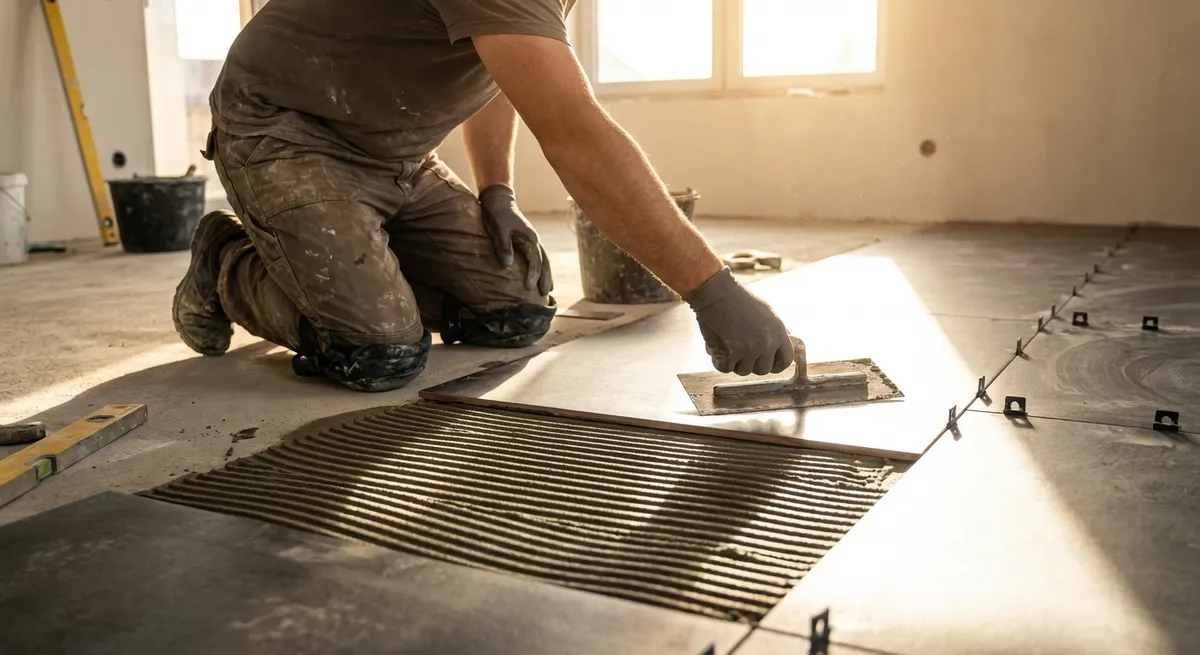
For homeowners who expect more than “good enough,” tile installation becomes less of a trade and more of a quiet science. The following five insights, drawn from professional practice, reveal what truly separates a merely acceptable installation from one that feels unquestionably correct.
1. Subfloor Truth: The Surface You Never See Dictates Everything You Do
Refined tile work begins long before the first tile meets mortar. The true foundation is the subfloor, and its condition determines whether your tiled surface will feel solid and remain crack-free for decades.
A premium installation starts with assessing deflection—the amount your floor flexes under load. Tile and stone demand a rigid substrate; even subtle bounce telegraphs into hairline grout cracks and eventual tile failure. Professional installers use the L/360 or L/720 standards (span divided by allowable deflection) as a benchmark, reinforcing joists, sistering beams, or shortening spans as needed.
Equally important is flatness, often misunderstood as “level.” Tile does not require a perfectly level floor; it requires a sufficiently flat one. Large-format tiles, especially planks and slabs, are unforgiving of dips and humps. A skilled installer will:
- Use straightedges and lasers to map high and low points.
- Employ self-leveling underlayments or patch compounds strategically, not indiscriminately.
- Correct structural issues before cosmetic ones, ensuring flatness is permanent, not superficial.
The tile you see will only be as refined as the surface you never see.
2. Mortar as an Interface, Not Glue: Tuning the Bond to the Tile
To the untrained eye, thin-set mortar is simply “tile adhesive.” In a high-level installation, mortar is treated as an engineered interface between tile and substrate, carefully chosen and handled to respect both materials.
Different tiles—porcelain, natural stone, glass, large-format panels—impose different demands on mortar. Premium practice involves:
- Selecting mortars with the correct deformability (often labeled as “flex” or “modified”) for substrates subject to slight movement.
- Using large-and-heavy-tile (LHT) mortars when working with oversized or particularly dense tiles to limit sagging and maintain precise alignment.
- Considering cure times and environmental conditions so the mortar chemistry can perform as designed.
Coverage is equally critical. Professionals target a minimum of 80% coverage indoors (and more in wet areas), but refined installations treat that as a baseline, not a goal. Back-buttering large or warped tiles, combing mortar in consistent, directional ridges, and pressing and sliding tiles to collapse those ridges all contribute to a continuous, void-free bond.
The result is not just adhesion, but a unified assembly—substrate, mortar, and tile working as a single resilient surface.
3. Managing Geometry: Laying Out Spaces, Not Just Tiles
Beautiful tile work does not begin with the first row against a wall; it begins with an understanding of the room as a whole. Elegant installations are designed around how the eye and body move through a space, not the convenience of starting in a corner.
Sophisticated layout involves:
- Establishing a primary sightline—often the longest view into or through the room—and aligning grout joints or major tile seams along that axis.
- Avoiding “sliver cuts” (narrow strips of tile) at focal points such as entries, thresholds, and under large openings. Instead, the field is often centered or balanced to keep cuts generous and intentional.
- Coordinating transitions between rooms so grout lines carry cleanly from one space to another whenever possible, even across different tile sizes or patterns.
Professional installers will often dry-lay tiles or create a chalked mock-up to visualize how cuts will look at perimeters, around islands, and along built-ins. The ultimate objective is a layout that feels inevitable—nothing appears forced, compromised, or improvised.
When geometry is managed with this level of care, your tile no longer feels like a surface treatment; it becomes an architectural element that choreographs how the room is perceived.
4. Movement Joints: The Invisible Detail That Prevents Visible Failures
One of the most misunderstood aspects of tile installation is movement accommodation. Tile assemblies do not appreciate being locked into rigid perfection. Temperature swings, humidity changes, structural settlement, and even daily heating and cooling cycles all cause subtle expansion and contraction.
Rather than resisting this movement, sophisticated installations anticipate it.
Key practices include:
- Perimeter gaps: Leaving intentional, concealed spacing where tile meets walls, cabinetry, or vertical elements, later covered by baseboards or trim. This allows the field of tile to expand and contract independently.
- Soft joints: Replacing rigid grout with a color-matched, flexible sealant at strategic locations—transitions between rooms, changes in substrate, or long runs of tile flooring.
- Respecting structural joints: Where a building has expansion or control joints, those joints must be carried through the tile assembly, not bridged. Failure to honor them often leads to cracking along those hidden lines.
These details can feel counterintuitive to those who equate luxury with total rigidity and uninterrupted grout. Yet, counter to instinct, the installations most likely to endure in pristine condition are the ones quietly allowed to move.
5. The Art of Flat Planes: Warpage, Lippage, and the Discipline of the Hand
For discerning homeowners, one of the quickest giveaways of amateur work is lippage—the small but visually disruptive differences in height between adjacent tiles. In spaces with low, raking light (hallways, near windows, long walls), even minimal irregularity becomes dramatically apparent.
Achieving near-perfect planes requires both technical strategy and manual discipline:
- Tile selection: Even factory-calibrated tiles exhibit minor warpage, especially large-format rectangles and planks. Experienced installers review tile warpage before committing to specific offsets (e.g., avoiding a 50% offset on tiles with noticeable bow, and choosing a 1/3 or less offset instead).
- Leveling systems: Mechanical clip-and-wedge systems can help control lippage, but they are tools, not magic. The installer’s skill in managing mortar thickness and properly seating tiles still governs the outcome.
- Controlled pace: High-end installations often move more slowly, allowing time to continuously check planes with straightedges, adjust individual tiles, and correct minor inconsistencies before the mortar sets.
In the best work, the finished surface feels uncompromisingly even yet quietly understated. The goal is not to draw attention to the perfection of the tile plane, but to ensure nothing about it ever distracts from the space itself.
Conclusion
What separates a refined tile installation from an ordinary one is rarely a single dramatic gesture. It is the accumulation of disciplined decisions: how the structure is stiffened, how the substrate is flattened, how the pattern is composed, how movement is accommodated, and how each tile is finally set into its bed of mortar.
For homeowners pursuing an elevated standard, understanding these underlying principles transforms the conversation with any installer. Instead of simply requesting “nice tile,” you can speak the quiet language of subfloor rigidity, mortar performance, layout geometry, movement joints, and plane precision.
The result is not just a beautiful floor or wall, but a tiled environment that feels unshakably correct—today, and many years from now.
Sources
- TCNA Handbook for Ceramic, Glass, and Stone Tile Installation - Industry reference for best practices, standards, and methods for tile installation
- ANSI A108 / A118 / A136.1 Specifications for the Installation of Ceramic Tile - Technical standards governing mortar, setting materials, and installation procedures
- Schluter Systems Technical Articles - Detailed guidance on substrates, movement joints, uncoupling, and waterproofing systems
- Custom Building Products: Technical Bulletins - Practical information on mortars, large-format tile, substrates, and movement accommodation
- American National Standards Institute – Flooring and Tile Resources - Overview of standards relevant to flooring and tile assemblies