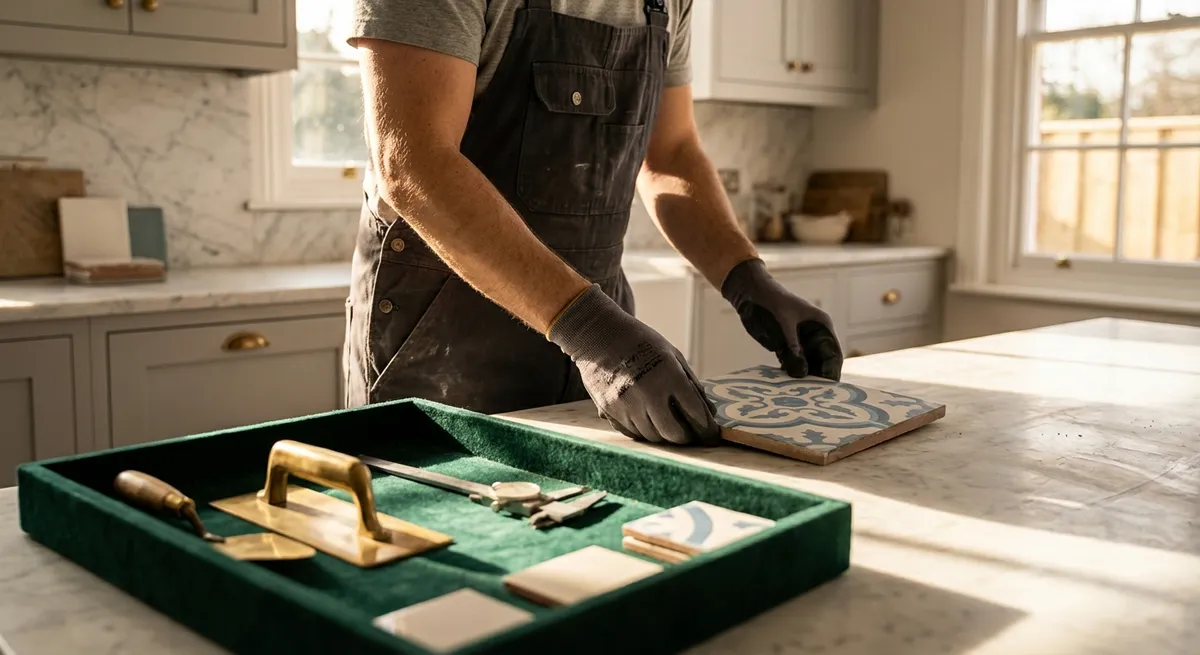
Rethinking “Repair”: From Patchwork to Preservation
Many tile repairs fail not because the technique is poor, but because the intent is too narrow. A purely technical fix might stop water intrusion, yet leave a visual scar that disrupts the entire field. In a premium setting—bookmatched marble, continuous terrazzo, or large-format porcelain—the objective is preservation of the overall composition, not simply replacement of a damaged piece.
Begin by identifying what you are actually preserving: pattern continuity, grout rhythm, joint alignment, or the interplay of reflectivity under natural light. A properly conceived repair plan considers where the eye travels first in a room, what surfaces are most frequently backlit, and which tiles act as “anchors” for the design. Rather than asking, “How do I fix this tile?” reframe the question as, “How do I protect the visual integrity of this entire surface?” That shift alone leads to more restrained, more elegant decisions.
Exclusive Insight 1: Treat Color Matching as a Lighting Project
Perfect color matching is not achieved on a workbench; it is resolved under the actual lighting conditions of the room. A grout or caulk that looks seamless under cool overhead LEDs may appear abruptly warmer at sunset, especially near windows or glass doors. The same holds for replacement tiles—glaze tones and veining can subtly shift alongside changing color temperatures.
Before committing to any repair material, test samples directly in place and at multiple times of day. Observe them under morning light, evening light, and the artificial scheme you use most often. For grout, prepare two or three close variants rather than a single “best guess,” applying short sample runs in an inconspicuous section. With stone or porcelain, dry-lay several candidate replacement tiles next to existing ones and step back, viewing them at a shallow angle where differences become more pronounced. The most successful repairs are those that remain invisible not in a photograph, but in the lived, shifting light of the space.
Exclusive Insight 2: Use Joint Strategy to Disguise New Work
The most refined tile repairs rarely position a single new tile in the middle of a field. Instead, they are disguised within the logic of the joint pattern. Joints and layout lines are powerful tools; when used intelligently, they can make repairs vanish into the rhythm of the installation.
If a damaged tile is centrally located, consider extending the repair to the nearest full joint line or natural termination point—such as a doorway, niche, or change in plane—rather than stopping abruptly at the broken piece. In some cases, replacing a subtle cluster of tiles in a staggered arrangement is less conspicuous than inserting a solitary “perfect match.” On patterned or veined surfaces, align replacement cuts along existing grout joints or natural stone veining so the eye reads them as intentional divisions rather than interruptions. By letting the geometry of the installation guide your repair boundaries, you shift the perception from “patch” to “designed edge.”
Exclusive Insight 3: Elevate Substrate Correction Above Surface Perfection
Homeowners often focus on the visible symptom—a cracked tile, hollow sound, or lifted corner—while the true issue lies beneath. In a premium environment, correcting the substrate is non-negotiable; otherwise, even the most beautiful replacement tile will fail again. Micro-movements in the subfloor, inadequate decoupling, or moisture migration often reveal themselves first in the most refined installations, where long, continuous surfaces amplify even the slightest shift.
Before any visible work begins, insist on a careful assessment of what sits below the tile: the condition of the underlayment, the presence of appropriate membranes, and moisture levels in the slab or subfloor. In wet areas, verify waterproofing integrity before retiling—especially around niches, benches, and transitions. In some cases, the correct solution may involve a small, surgically precise demolition to access and address a localized failure, followed by reinstallation using modern decoupling systems or updated waterproofing assemblies. A visually seamless repair that ignores substrate issues is, at best, a temporary illusion.
Exclusive Insight 4: Custom Blending for Seamless Grout Restoration
Grout aging is subtle: edges soften, micro-texture develops, and the surface acquires a light patina from cleaning over time. When a repair introduces brand-new grout into a mature field, the mismatch in texture and sheen can be as jarring as a wrong color. For design-conscious spaces, grout work should be approached with the same sensitivity as color-matched paint touch-ups in a gallery.
Where possible, request that your professional create a custom blend of grout colorants to sit between what the grout was originally and what it has become. This can involve tinting grout sealers or using specialized grout colorants to harmonize older and newer sections. Application technique is equally important: feather the edges of any new grout into the existing joints rather than stopping sharply, so the transition is gradual, not abrupt. In high-visibility zones, it may be worth regrouting or recoloring a larger contiguous area—such as an entire shower wall or a full backsplash section—rather than only the immediate repair site, to ensure a consistent visual “finish” across the surface.
Exclusive Insight 5: Plan Repairs with Future Access in Mind
Truly elevated repair strategies acknowledge that future access may one day be necessary—for plumbing, heating elements, or integrated lighting. Instead of fighting that reality, sophisticated homeowners quietly plan for it. A cleverly concealed “service zone” can protect the rest of the installation from invasive work years down the line.
In bathrooms, consider designating an area (often behind a removable panel, within a niche, or along a baseboard-height row) that allows future access to valves or concealed systems without disturbing the primary feature surfaces. In heated floors, document the exact layout of heating cables or mats before tile installation; keep this information with the home records so any later cutting or drilling can be planned with precision. When repairs are needed, discuss with your tile professional how to reinforce potential future access points using removable or semi-removable assemblies, rather than fully embedding every component in mortar. The most refined homes feel effortless partly because they are secretly engineered for graceful maintenance.
Choosing a Professional Who Understands Visual Quiet
Not every contractor approaches repair with a design-first mindset. For a high-end installation, select professionals who speak fluently about layout, sightlines, and light—not only mortar types and setting beds. Ask to see examples of previous repair work, not just new installations. Look for repairs that are difficult to locate, even when you know where to look.
During consultation, notice the questions they ask: Do they inquire about how you use the space? Do they study the room from multiple vantage points? Do they mention protecting adjacent finishes and integrating their work with joinery, cabinetry, or metal trims? A refined repair professional will be as concerned with dust control, protection of neighboring surfaces, and the sequencing of tasks as with the repair itself. In a carefully curated home, that level of discretion is not a luxury; it is the baseline.
Conclusion
Elegant tile repair is an exercise in restraint, precision, and foresight. It respects the original design intent while quietly reinforcing the performance of the surface for years to come. By treating color as a function of light, using joint patterns to camouflage intervention, prioritizing substrate integrity, refining grout integration, and planning for future access, homeowners can ensure that every repair serves the larger narrative of the room. In the most considered homes, the finest compliment a repair can receive is simple: no one ever notices it happened.
Sources
- Tile Council of North America (TCNA) Handbook - Industry standards and best practices for tile installation and repair assemblies
- Schluter Systems Technical Articles - Guidance on substrates, waterproofing, and decoupling systems for long-lasting tile work
- Mapei Tile & Stone Installation Systems - Product data and technical insights on mortars, grouts, and repair materials
- Laticrete Technical Data Sheets - Detailed performance information on premium installation and restoration products
- U.S. Department of Housing and Urban Development – Residential Rehabilitation Guide - Professional guidance on finishes, including tile, within broader residential rehabilitation practices