Below are five exclusive, often overlooked insights that quietly separate everyday tile jobs from installations worthy of a truly refined home.
Designing the Substrate: Where Luxury Tile Really Begins
Exceptional tile work begins long before the first tile is set; it begins with the substrate—the surface beneath the visible finish. For stone, large-format porcelain, or intricate mosaics, the substrate must be flat, stable, and appropriate for the building’s structure and climate. A premium installation often includes self-leveling underlayment, movement joints planned at the substrate level, and careful coordination of transitions to adjacent flooring.
Astute homeowners ask not just, “What tile will you use?” but, “What are you building underneath it?” In high-end projects, installers will evaluate deflection (how much the floor flexes under load) and may recommend additional joists, underlayments, or uncoupling membranes to protect against future cracking. This level of preparation is rarely visible to guests, yet it’s the difference between tile that feels integral to the home and tile that telegraphs every structural flaw beneath it.
In bathrooms and wet rooms, substrate design becomes even more consequential. Waterproofing membranes, carefully sloped shower pans, and properly detailed niches are part of a system, not a series of isolated steps. The most elegant showers feel seamless because every underlying layer was orchestrated with the final experience—and longevity—in mind.
Grout as a Design Instrument, Not an Afterthought
To the untrained eye, grout is a necessary filler. To a meticulous homeowner, it’s an integral design element. Grout color, joint width, and texture subtly dictate how a tile field reads: continuous and monolithic, rhythmically patterned, or intentionally grid-like. Choosing bright white grout with a high-contrast tile can emphasize every line and joint; selecting a tone-on-tone shade creates a calmer, more architectural surface.
Elite installations consider grout through three lenses: aesthetics, maintenance, and performance. Sanded versus unsanded grout, or newer high-performance and epoxy formulations, each introduce different levels of stain resistance, flexibility, and sheen. In kitchens and busy entries, many homeowners now favor advanced, stain-resistant grout systems that maintain their refined appearance with far less intervention, avoiding the dingy, worn effect that can undermine even the most beautiful tile.
Grout joint width is equally critical. Ultra-narrow joints can produce a sophisticated, stone-like expanse, but only if the tile is precisely manufactured and the substrate exquisitely flat. A knowledgeable installer will balance the desire for minimal joints with the realities of tile size variation, room dimensions, and expected movement. When executed well, grout becomes a subtle framework that elevates, rather than competes with, the tile itself.
Light, Shadow, and the Geometry of the Room
The most captivating tile installations are designed as much for light as for pattern. Large-format tiles, high-gloss finishes, and textured surfaces respond dramatically to the way natural and artificial light cross a room. A carefully leveled wall with rectified tiles can reflect light like a sheet of glass; a misaligned surface will broadcast lippage (uneven tile edges) in sharp, unforgiving shadows.
Sophisticated homeowners should walk the space with their installer at different times of day to see how light moves across walls and floors. Long, linear tiles set parallel to windows will showcase even the slightest irregularities—ideal when perfectly executed, merciless when rushed. In narrow hallways, the direction of a plank tile or a chevron layout can either elongate the space or visually compress it.
Accent lighting also deserves strategic attention. Recessed downlights over a tiled wall can dramatize texture, while continuous cove or under-cabinet lighting can soften transitions and highlight crisp grout lines. Thoughtful planning ensures that lighting works with the tile to produce a nuanced, layered visual experience, rather than unintentionally spotlighting every minor deviation in plane.
Precision at the Edges: Transitions, Terminations, and Thresholds
True luxury in tile work is often revealed at the edges, not the center. Where a tiled floor meets hardwood, carpet, or stone, the transition can either feel jarringly improvised or elegantly predetermined. Premium projects treat thresholds as designed moments: carefully sized metal trims, flush transitions, and aligned joints that acknowledge the architectural grid of the home.
Wall terminations deserve equal care. The choice between bullnose trim, mitered edges, metal profiles, or a perfectly aligned tile edge against painted plaster dramatically affects the perceived craftsmanship of a bathroom or kitchen. In a refined shower, for example, niche edges that align with grout joints and tile modules can create a sense of effortless order—despite the very deliberate calculations required to achieve it.
Doorways, stair risers, and step-downs are frequent sites of compromise; they are also opportunities for quiet excellence. Homeowners who insist on dry-fitting layouts at key transitions—examining how rows of tile will intersect at thresholds, corners, and changes in elevation—often end up with installations that feel architecturally coherent, rather than merely “tiled.”
Collaborating Like a Connoisseur: How to Engage Your Installer
The most successful tile installations arise from a collaboration in which the homeowner behaves less like a passive client and more like a curator. This doesn’t mean micromanaging every trowel stroke; it means asking elevated questions and aligning expectations long before adhesives are mixed.
Key conversations might include:
- How will you center and balance the layout relative to major sightlines and focal points?
- Where will we “hide” cuts, and which areas must receive full, uncut tiles?
- What is your plan for expansion and movement joints, both visible and concealed?
- Which specific mortar, grout, and membrane systems will be used, and why were they chosen for this space?
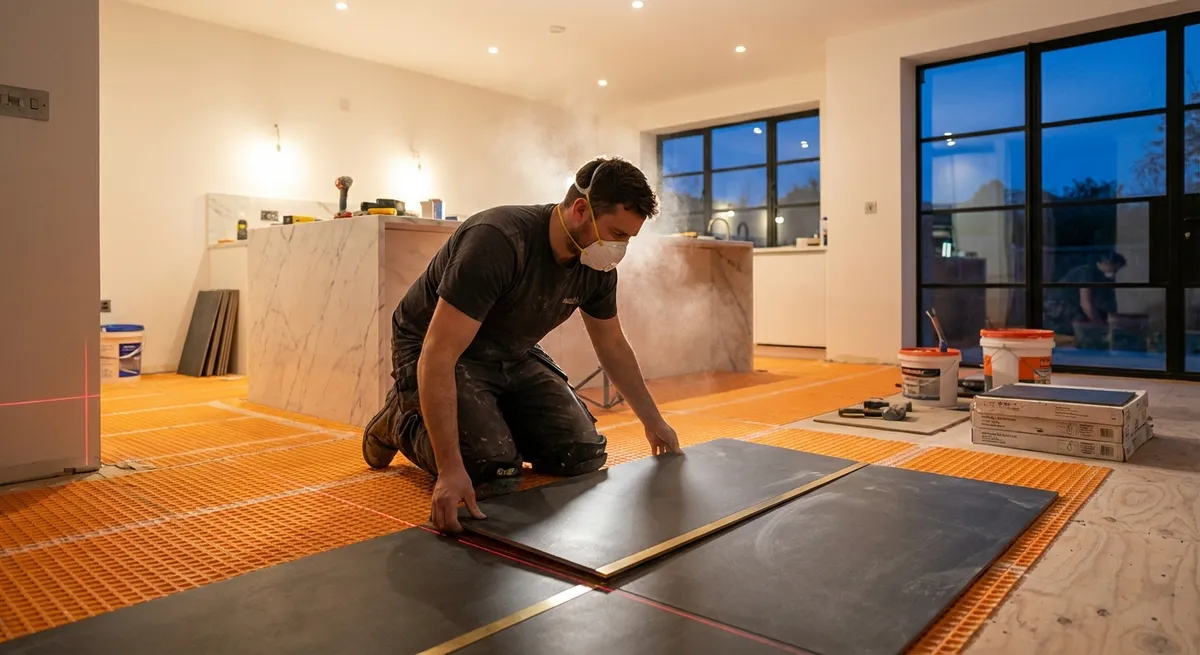
Discerning homeowners also request a dry layout in critical areas—floors, shower walls, and feature walls—to confirm proportions, pattern orientation, and the placement of cuts. This step not only refines the visual outcome but fosters mutual trust with the installer. When both parties share a clear, detailed vision, the final result feels as composed and intentional as a custom piece of millwork or furniture.
A premium tile installation is not an accident of good taste; it is the culmination of informed decisions, technical discipline, and aesthetic restraint. Approached this way, even a simple porcelain floor becomes part of the architectural language of your home—quiet, enduring, and unmistakably considered.
Conclusion
Tile, when handled with precision and foresight, shifts from mere surface to permanent architecture. By paying close attention to what happens beneath the tile, between the joints, at the edges, and in conversation with light, homeowners elevate their projects from standard to exceptional. Pairing a refined eye with the right technical questions transforms the installation process into a true craft collaboration—one that yields spaces that feel calm, coherent, and enduringly sophisticated.
Sources
- Tile Council of North America (TCNA) Handbook - Industry-recognized standards and best practices for tile installation systems
- American National Standards Institute (ANSI) A108/A118/A136.1 - Formal standards governing tile installation, mortars, and related materials
- Schluter Systems – Waterproofing and Uncoupling Membranes - Technical insights into substrate preparation, crack isolation, and movement accommodation
- Mapei – Guide to Selecting Tile Mortar and Grout - Detailed descriptions of high-performance mortars and grouts for various tile and stone applications
- The Spruce – Understanding Grout Types and Uses - Accessible overview of grout options, maintenance considerations, and aesthetic implications