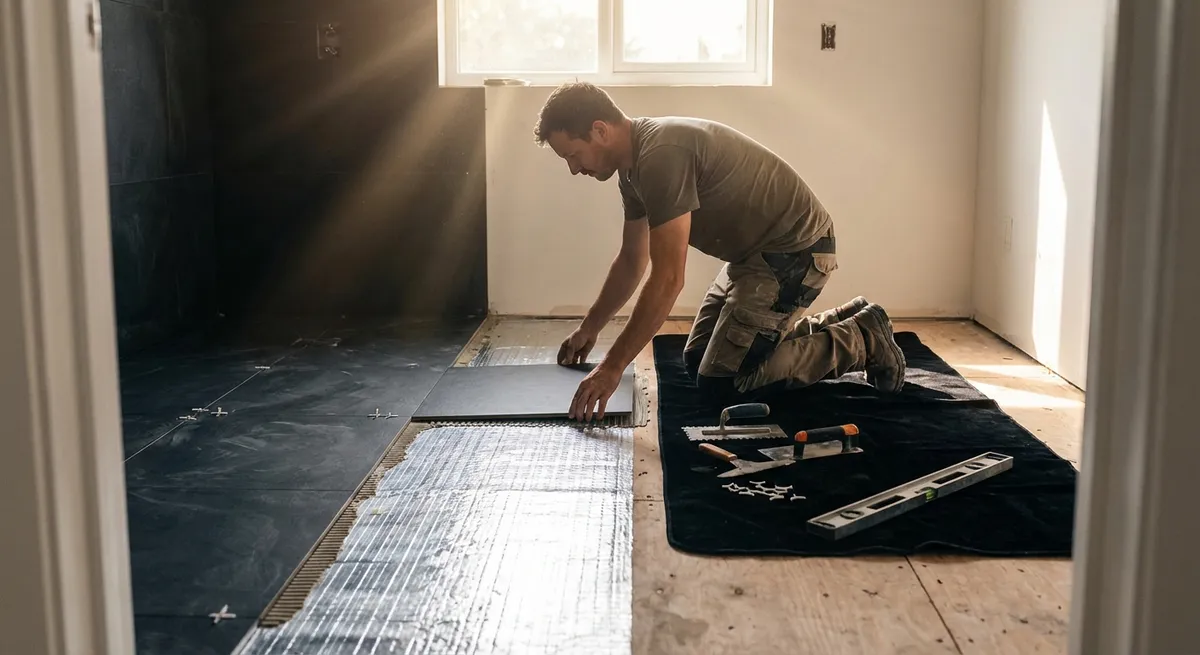
What follows is a deeper look at tile installation as a layered system rather than a single step, with five exclusive insights that discerning homeowners can use to shape conversations with their installers—and ultimately, the quality of their finished rooms.
Building from the Invisible Up: Why the Substrate Is the Real Luxury
When tile fails, it almost never begins at the surface. It begins in the layers you never see. A truly premium tile installation starts with an almost obsessive respect for the substrate—the subfloor, wall sheathing, or existing surface that will receive your tile.
Concrete slabs must be evaluated for moisture, cracks, and flatness. Wood-framed floors demand rigid underlayment, proper joist spacing, and deflection control to prevent subtle movement that will telegraph as cracked grout or “hollow” tiles years later. Wall installations in wet zones require cement board or other appropriate backer, not just “moisture-resistant” drywall. Each of these decisions influences the feel underfoot, the sound of your footsteps, and the long-term poise of the surface.
The most sophisticated tile projects tend to start with comprehensive substrate testing: moisture readings in slabs, laser-leveled surveys of flatness, and a clear plan to correct any deficiencies before a single tile is unpacked. That quiet precision, entirely invisible at the end, is one of the most defining hallmarks of a truly elevated installation.
Orchestrating Mortar, Membranes, and Movement as a System
Tile is often described as “hard and durable,” but in reality, an installation is a subtle choreography of components moving together in controlled ways. Mortar, membranes, and movement joints must be treated as an integrated system, not as interchangeable products.
Choice of mortar—standard thinset, modified mortar, or specialty formulations for large-format or porcelain panels—dictates bond strength, cure times, and performance over heated floors or challenging substrates. Uncoupling or crack-isolation membranes protect tile from small structural shifts and are essential for large-format tiles or installations over existing concrete with hairline cracking. Waterproofing layers in showers and wet rooms must be continuous, correctly detailed at corners and penetrations, and fully compatible with both substrate and tile.
What elevates an installation is not merely using “the right products,” but specifying them as a coordinated assembly. Professional installers working at a luxury level often rely on manufacturer-tested systems—from substrate preparation through grout and sealers—because they understand that warranties, performance, and long-term stability all depend on how these layers interact.
Exclusive Insight #1: Flatness Is More Important Than Level
For luxury tile work, most homeowners ask, “Is the floor level?” The more sophisticated question is, “Is the floor flat?”
Tile tolerates slight changes in level far better than it tolerates even tiny waves, dips, or humps. With large-format tiles and ultra-thin grout joints—favorites in high-end interiors—minor deviations in flatness become painfully visible as lippage, where one tile edge sits proud of its neighbor. Natural light streaking across a floor, or a sleek reflection from a large window, can exaggerate these imperfections.
A premium installation typically begins with evaluating substrate flatness against strict standards (for example, industry guidelines often specify maximum allowable variation over a certain distance). Self-leveling underlayments or patching compounds are then used to refine the plane, not merely to “get it close.” When interviewing installers, ask how they measure flatness, how they correct it, and how they plan to handle transitions between adjoining rooms with different finished floor heights.
Pattern as Architecture: Designing Layout Beyond the Obvious
Tile layout is more than a pattern; it is a way of guiding the eye and defining the feeling of a room. In understated luxury spaces, the pattern is rarely loud, but it is always intentional.
Thoughtful layout begins by centering lines where the eye naturally rests—along major sightlines, under chandeliers, in shower niches, and behind freestanding tubs. Balanced cuts at opposing walls, aligned grout joints at door thresholds, and pattern continuity between rooms create a sense of quiet coherence. Contrast this with installations where a full tile is centered randomly, leaving an awkward sliver along a prominent baseboard or in the shower corner.
Refined projects often involve a dry layout or a scaled drawing before any adhesive is opened. For intricate mosaics, herringbone compositions, or book-matched stone, this planning becomes almost curatorial, ensuring that veining, directional tiles, and focal points all resolve elegantly. An installer attuned to this level of detail is not merely “laying tile,” but completing the visual architecture of the room.
Exclusive Insight #2: Joint Design Is a Style Decision, Not Just a Technical One
Grout joints are often treated as a technical requirement, but in a truly refined installation, they are a deliberate design element. The width, alignment, and color of grout lines can make the same tile feel traditional, contemporary, or formally architectural.
Narrow joints create a carpet-like continuity, ideal for minimalist interiors, but demand exceptional substrate flatness and precise installation. Slightly wider joints can lend a handcrafted, European sensibility, particularly with natural stone or handmade tiles. Grout color can either disappear—matching the tile to achieve a monolithic effect—or purposely contrast to highlight the shape and rhythm of the pattern.
On the technical side, joint placement and width are also essential for managing movement, transitions, and tolerances. For example, rectified porcelain often allows for tighter joints than non-rectified ceramic, but pushing widths too narrow in a room with temperature swings or structural movement can lead to stress and cracking. The most successful installations strike a balance between aesthetic intent and long-term performance, treating joints as a carefully calibrated design tool.
Performance Underfoot: Sound, Heat, and Everyday Use
The luxury of a tiled surface is not solely visual. It is also tactile and acoustic. The way tile sounds, responds to warmth, and feels underfoot can significantly elevate—or undermine—the experience of a room.
High-end installations over wood framing often incorporate underlayments that reduce impact noise and create a more solid, confident footfall. In multi-level homes or apartments, acoustic performance is a practical and aesthetic consideration, shaping how lively or hushed the space feels. Radiant floor heating, when paired correctly with tile and appropriate mortars, turns what might otherwise feel cool into a deeply inviting surface, especially in primary suites, spa baths, and kitchens.
Premium work also anticipates how the tile will be used: choosing slip-resistant textures in wet zones, more forgiving finishes in family spaces, and formats well-suited to furniture loads and rolling traffic. The aim is a surface that looks refined while quietly accommodating the rhythms of daily life without fuss.
Exclusive Insight #3: The Edge Details Often Reveal the Craft
If the field tiles are the main composition, the edges are the punctuation—and in many installations, this is where the difference between adequate and exceptional work becomes obvious.
At transitions to carpet, wood, or stone, refined installations use carefully chosen profiles or custom stone thresholds rather than abrupt or mismatched trim. Stair nosings align cleanly with riser tiles, maintaining both safety and harmony of proportion. Shower niches and benches are wrapped so that grout lines align, miters are crisp, and any exposed edges feel deliberate, not improvised.
Metal profiles—brushed stainless, brass, or color-coated trims—can add a tailored finish when porcelain edges are not inherently attractive. Mitred corners, when appropriate for the material, offer a sculpted, monolithic feel. During planning, ask your installer how they intend to finish exposed edges, steps, window returns, or the tops of shower curbs. The answer will tell you much about their standards.
Exclusive Insight #4: Large-Format Tile Demands a Different Discipline
Oversized tiles and porcelain panels are favorites in contemporary luxury design for their seamless, gallery-like presence. Yet they demand an entirely different discipline than traditional formats.
Handling and cutting large slabs requires specialized tools, extra hands, and a meticulous approach to transportation and staging. Mortar coverage must be nearly perfect to prevent voids beneath the tile, which can cause cracking or an uneven sound underfoot. The tolerance for substrate imperfections is minimal—any deviation telegraphs instantly across such a large surface.
Installers working at a premium level with large-format tiles often use advanced leveling systems, back-buttering techniques, and detailed layout planning to ensure consistent joint widths and minimal lippage. When these elements are handled skillfully, the result is a surface that feels not just tiled, but architecturally continuous.
Exclusive Insight #5: Waterproofing Is a Design Decision, Not Just Insurance
In baths, spas, and outdoor living areas, the most luxurious surface is the one that stays beautiful because the layers beneath it are impeccably protected. Waterproofing is often viewed as a technical necessity, but it is also a key architectural decision.
Fully bonded waterproofing membranes—liquid-applied or sheet systems—define where and how water is allowed to travel. They determine whether a shower feels like a confidently dry envelope or a space that invites quiet worry over time. Their placement dictates details like the height of waterproofing on walls, the treatment of niches and benches, and the integrity of corners and change-of-plane joints.
Well-designed assemblies anticipate not just splashing but vapor, condensation, and the behavior of water in niches, window reveals, and linear drains. In premium projects, the waterproofing is treated with the same seriousness as the visible finish: documented, sometimes flood-tested, and integrated into the broader design intent. This mindset ensures that the tranquil appearance of a luxury bath is matched by structural calm beneath the surface.
Conclusion
In truly exceptional spaces, tile is not an isolated finish. It is the visible expression of a carefully considered assembly—substrate, membranes, mortar, layout, joints, and detailing—working quietly in concert. For the discerning homeowner, understanding these layers transforms tile installation from a commodity into a craft.
By asking deeper questions about flatness versus level, joint design, edge conditions, large-format discipline, and waterproofing strategy, you signal that your expectations extend beyond the obvious. The reward is a surface that feels resolute underfoot, reads effortlessly to the eye, and ages with the poise of considered architecture rather than the fatigue of a hurried finish.
Sources
- Tile Council of North America (TCNA) Handbook – Industry reference for substrate preparation, installation methods, and performance standards
- American National Standards Institute – ANSI A108/A118/A136.1 – Technical standards governing tile installation materials and practices
- Schluter Systems – Educational Resources – Detailed guides on membranes, profiles, and integrated tiling systems
- Mapei – Tile & Stone Installation Systems Technical Library – Product data and system-based approaches for mortars, grouts, and underlayments
- University of Florida IFAS Extension – Concrete Floors and Slabs – Background on concrete slab behavior, moisture, and cracking relevant to tile substrates