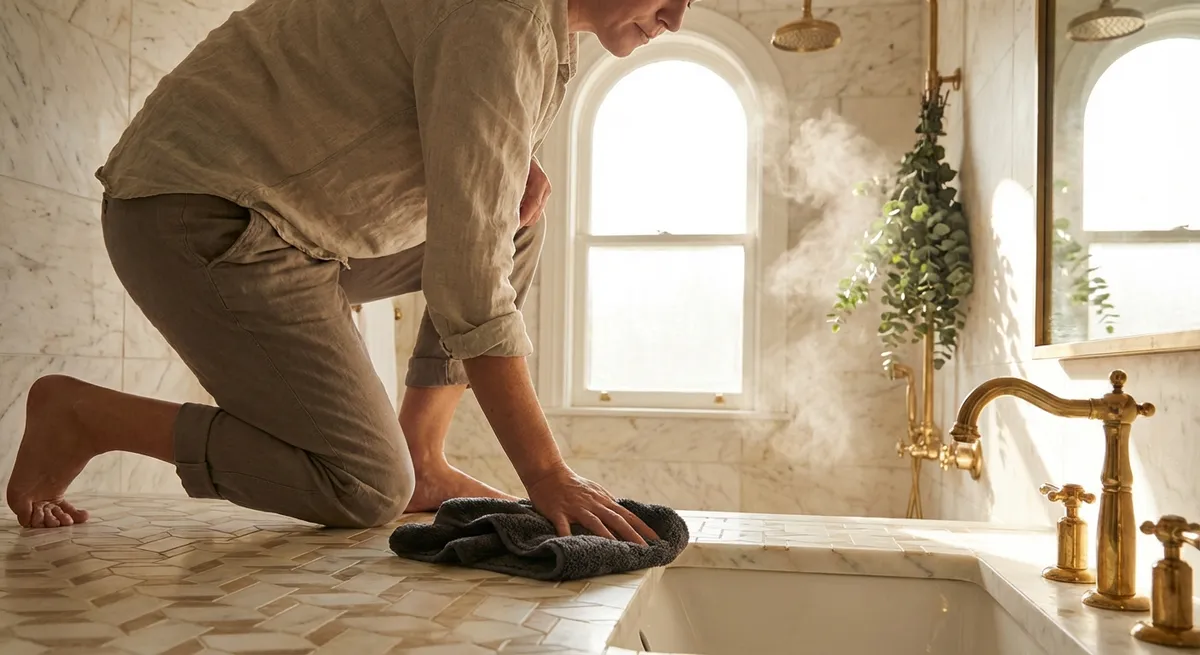
Below is a refined approach to tile care, built around five exclusive insights that discerning homeowners can apply immediately—subtle adjustments that yield a visibly elevated result over time.
Designing a Maintenance Ritual Around Your Exact Tile Composition
Most tile care advice fails because it treats “tile” as a single category. In a refined home, your surfaces are rarely generic: porcelain in a steam shower, marble on a vanity, handmade zellige in a powder room, perhaps encaustic cement on an entry floor. Each carries its own chemistry, texture, and vulnerability.
Begin by drafting a discreet “surface dossier” for your home. List every tiled area with four details: material (porcelain, ceramic, marble, limestone, cement, glass, terracotta), finish (polished, honed, matte, textured), location (wet zone, high-traffic floor, backsplash, decorative accent), and the existing sealer or treatment, if any. This brief document becomes the foundation of your care strategy.
Once you understand your surface inventory, you can match pH-neutral cleaners to sensitive stones, slightly more alkaline formulas to heavily used porcelain floors, and gentle, minimal routines to artisanal tiles that age gracefully with light patina. Instead of a single “bathroom cleaner” everywhere, you curate your maintenance in the same way you curated the materials. The result is longevity without the harsh “over-cleaned” look that can strip character from high-end finishes.
Moisture as an Architectural Variable, Not Just a Cleaning Detail
Water is both tile’s ally and its quiet saboteur. While tile itself may be dimensionally stable, grout, backer boards, substrates, and sealers all have a relationship with moisture that must be managed, not merely tolerated.
Treat every wet zone—showers, steam rooms, laundry rooms, around tubs—as a microclimate. After each use, the goal is not just “dry enough,” but rapid moisture reduction. Rather than relying solely on an exhaust fan, pair mechanical ventilation with intentional air movement: a discreet ceiling fan on a low setting near a tiled shower, a small, nearly silent floor fan hidden under a vanity for occasional deep drying, or a transom window cracked open for cross-ventilation in temperate months.
Equally important is grout and caulk continuity. Micro-gaps around fixtures, niches, and bench interfaces admit moisture behind the tile, where it lingers and compromises both adhesive and grout. Inspect these intersections twice a year. Any slight cracking or separation in flexible caulk around tubs, sinks, or shower perimeters should be addressed promptly with a matching, high-performance silicone or hybrid sealant. Precision in these minor seams often determines whether a shower still feels new a decade later.
Curated Cleaning: Microfiber, Minimalism, and Controlled Contact
For tile, “how” you clean matters as much as “what” you use. Abrasives, stiff bristles, and overly wet mopping are the enemies of refined surfaces, especially where high-gloss glazes, natural stone, and decorative inlays are present.
Adopt a microfiber-first philosophy. Flat microfiber mops and cloths capture fine dust and grit before it can abrade glazed or polished surfaces underfoot. Reserve any bristle brushes for grout lines only—and even then, select soft or medium bristles, working in controlled, linear motions rather than aggressive scrubbing. On polished stone, avoid circular scouring motions that can create visible halos over time.
Chemically, normalize pH-neutral cleaners for all stone and most glazed tile. Strong acids (including “miracle” limescale removers) etch stone, degrade grout, and can strip subtle sheen. Alkalis, especially in high concentration, can haze or dull certain finishes. For routine care, a modest amount of pH-neutral cleaner in warm water, paired with microfiber, is sufficient. Reserve targeted specialty products for occasional build-up rather than weekly use.
Finally, refine your drying habit. On vertical surfaces like shower walls or high-end backsplashes, a quick wipe-down with a dedicated microfiber towel after cleaning (or even after daily use in a primary shower) prevents mineral spotting and soap film, preserving crisp reflections and color clarity.
Strategic Sealing as a Design Decision, Not a Default
Sealing is often treated as a checkbox task—“seal all the things”—but in a home with nuanced materials, sealing should be strategic. Some surfaces benefit enormously; others can be compromised if sealed incorrectly.
Porcelain and many dense ceramics typically do not require sealing on their face, but their cementitious grout almost always does. Choose penetrating, breathable sealers for grout so moisture can escape while staining agents are slowed. On heavily used kitchen floors or family entries, a premium penetrating grout sealer can preserve fresh joints even in the presence of dark soils and everyday spills.
For natural stone and cement tile, the choice of sealer directly influences the aesthetic. A natural-look penetrating sealer maintains the original matte character; an enhancing sealer deepens tones and can impart a more saturated, luxurious appearance. Decide intentionally: in a sun-drenched marble bathroom, you may want to preserve the stone’s powdery softness, while in a moody, cement-tiled entry, a subtle enrichment may be desirable.
Critically, build a calendar around re-sealing. Penetrating sealers do not last indefinitely, especially on floors and in showers. A simple water-drop test (if water darkens the surface quickly, it’s time to re-seal) performed annually on key areas keeps you ahead of staining. Consider this not as maintenance drudgery, but as the periodic “conservation work” one might schedule for fine furnishings or artwork.
Gentle Restoration: Correcting Minor Flaws Without Over-Correction
Even in the most carefully maintained homes, small imperfections appear: a faint scratch on a polished porcelain tile, a slightly dulled patch on marble near a sink, a grout joint that has absorbed a bit more life than you intended. The instinct to “deep clean” aggressively is understandable—but it is often the moment when refined surfaces lose their quiet elegance.
Approach restoration as a sequence of the least invasive steps first. For light grout discoloration, begin with a pH-neutral or mildly alkaline cleaner and a soft brush; avoid jumping directly to harsh acids. If a small area remains stubborn, consider a poultice formulated for grout stains or a carefully applied oxygen-based cleaner, neutralized and rinsed thoroughly after treatment.
On stone, investigate professional honing and polishing long before resorting to DIY abrasives. Many etches and micro-scratches can be blended back into a uniform finish by a stone care professional with specialized pads and compounds, preserving the overall plane and reflectivity. The result is not a “perfect” laboratory surface, but a calm, gently renewed one that still feels architectural rather than over-processed.
Where individual tiles are visibly compromised—chipped edges, cracked pieces—discreet replacement can be preferable to aggressive cosmetic tinkering, particularly in focal areas. The key is to maintain spare tiles from the original installation, stored in a dry, labeled box. This quiet foresight allows your tile professional to execute targeted, nearly invisible corrections when needed, protecting the integrity of the whole.
Conclusion
Elegance in tile is not solely a function of pattern, price, or provenance; it is the culmination of daily habits, seasonal checks, and thoughtful restraint. When you treat tile care as a curated regimen—attuned to material, moisture, chemistry, and the art of gentle correction—your surfaces move beyond “clean” into something more distinguished: calm, enduring, and quietly precise.
In a refined home, maintenance is not an afterthought; it is part of the design language itself. The more intentionally you tend to your tile, the more effortlessly luxurious your spaces will feel, year after year.
Sources
- Natural Stone Institute – Care and Cleaning Guidelines – Authoritative guidance on appropriate cleaners, sealing, and maintenance for natural stone surfaces.
- Tile Council of North America (TCNA) – Grout and Maintenance FAQ – Technical insights on grout behavior, sealing, and proper cleaning approaches.
- MAPEI – Guide to Choosing and Using Sealers – Detailed discussion of different sealer types and how they interact with tile and stone.
- US Environmental Protection Agency – Safer Choice Cleaning Products – Background on safer, lower-impact cleaning formulations relevant to indoor air quality and surface care.
- University of Massachusetts Amherst – Household Cleaning Products Chemistry – Educational overview of pH, surfactants, and how different cleaners act on surfaces and finishes.