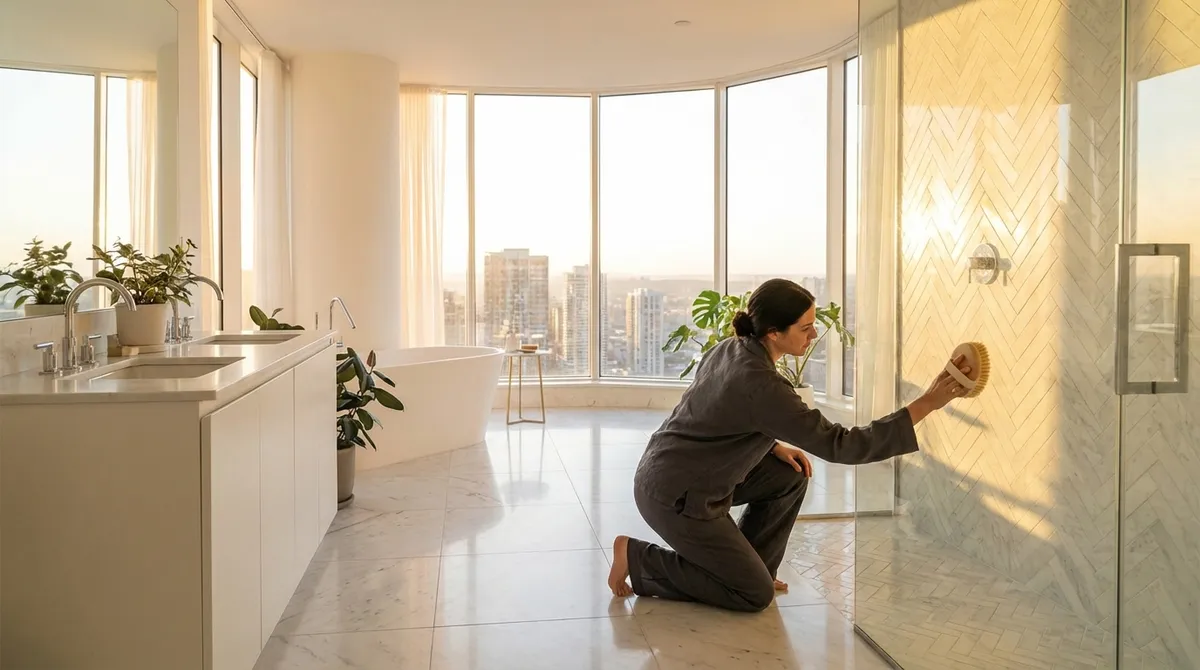
Below are five exclusive, under-discussed insights that elevate tile care from serviceable to exceptional—tailored for those who expect their floors and walls to age with poise, not just survive.
1. Treat Grout as a Precision Detail, Not a Background Element
In most homes, grout is an afterthought. In elevated spaces, it is treated as carefully as the tile itself.
Begin by understanding your grout type—cementitious, epoxy, or urethane—and its finish (sanded, unsanded, or specialty). Each responds differently to cleaning solutions, pH levels, and sealers. A neutral-pH cleaner remains the safest default for routine care, but the real sophistication lies in periodic “grout reviews”: scheduled inspections under clear daylight and warm artificial lighting.
Look for faint edge shadowing, minor discoloration at traffic lanes, or early micro-cracking along movement joints. These are not failures yet; they are early signals. Promptly addressing a subtle stain or a hairline gap with spot cleaning and micro-repair preserves the visual continuity of the installation and prevents the domino effect of water intrusion, efflorescence, and staining.
Approach grout maintenance as you would tailoring: small, precise adjustments that keep the entire look perfectly aligned.
2. Calibrate Cleaning to the Tile Body, Not Just the Surface Look
The most refined tile care routines distinguish between what the tile appears to be and what it actually is. Porcelain in a marble-print, honed limestone, tumbled travertine, glossy ceramic, or handmade zellige: each has a distinct absorption profile, surface porosity, and resistance to abrasion.
Rather than adopting a single “universal” cleaner, establish a small, curated “cleaning portfolio” designed around your actual tile bodies:
- A neutral-pH cleaner for frequent maintenance on most porcelain and glazed ceramics.
- A stone-specific cleaner (often slightly less aggressive and free of chelating agents that attack calcium) for marble, limestone, and travertine.
- A dedicated degreaser, used sparingly and diluted, reserved for kitchen build-up rather than general mopping.
Test any new product in a discrete corner and evaluate not just cleanliness but sheen, clarity, and tactile feel once dry. Overly aggressive cleaners may etch natural stone, dull satin glazes, or strip protective finishes. The goal is not “as clean as possible” but “as clean as necessary while preserving material character.”
This calibrated approach enables you to respect each tile’s inherent qualities, allowing surfaces to age with dignity rather than fatigue.
3. Control Micro-Abrasives Before They Reach the Tile
Most visible wear on flooring is not from rare accidents, but from the relentless micro-abrasion of grit, sand, and fine particulate. For premium tile installations—especially those with honed or matte finishes—proactive grit management is one of the most powerful, yet underrated, maintenance practices.
Think in layered zones:
- Exterior threshold: A robust scraper or brush mat to capture coarse debris.
- Interior threshold: A high-quality absorbent mat to pick up fine particles and moisture.
- Transition areas: Subtle runners or area rugs in the first 3–6 feet inside primary entries, particularly on honed stone or large-format porcelain.
Vacuuming should precede any mopping. Even a soft mop can become a sanding tool if dragged across unnoticed grit. Use a vacuum with a hard-floor setting or a soft brush head to avoid scuffing edges.
The refinement lies in consistency, not intensity. A brief, daily or near-daily pass in key traffic channels does more for the long-term elegance of your tile than any occasional “deep clean” can achieve.
4. Align Temperature, Humidity, and Cleaning Timing With the Material
Truly elevated maintenance accounts for the environment in which the tile lives. Temperature, humidity, light, and even cleaning timing subtly alter how tiles and grout respond to products and water.
On heated floors or sunlit expanses, hot surfaces can accelerate cleaner evaporation, leaving streaking and residue. In these areas, clean in smaller sections, slightly lower the concentration of cleaning solution, and use a barely damp—rather than wet—mop or cloth. Buff dry with a clean microfiber towel to restore clarity and avoid water spots, particularly on darker or high-gloss tiles.
In high-humidity environments like bathrooms and steam showers, schedule cleaning soon after use, while the room is still slightly warm. This can help loosen soaps and residues, but always ensure adequate ventilation post-cleaning to prevent moisture lingering in grout lines and corners.
For natural stone, be especially attentive to long-standing moisture along edges, niches, or corners, as chronic dampness can encourage discoloration and mineral deposits. A compact squeegee used as part of the post-shower ritual is a subtle yet powerful tool for preserving both grout and stone.
The most sophisticated environments are not just cleaned; they are maintained in harmony with how the space is actually used and how the materials respond.
5. Establish a “Quiet Schedule” of Micro-Maintenance Intervals
The most beautiful tiled homes rarely undergo dramatic rescue missions. Instead, they benefit from a quiet, predictable cadence of small interventions that prevent visible decline.
Rather than thinking in terms of “spring cleaning,” develop a multi-scale schedule:
- Weekly: Light vacuuming and mopping of traffic lanes with neutral-pH cleaner; quick visual scan of grout lines at thresholds, sinks, and shower entries.
- Monthly: Inspect movement joints (at perimeters, changes of plane, around tubs and counters) for softening, cracking, or gaps in silicone or hybrid sealants; address minor issues before water or dirt intrudes.
- Biannually: Reassess whether penetrating sealers on natural stone or cementitious grout need refreshing, using simple water-drop tests to gauge absorption.
- Annually: Conduct a “surface audit” under strong, raking light—look across the plane of the tile to detect early micro-scratches, subtle etching, or small chips. Address localized concerns with professional-grade repair kits or a specialist, rather than waiting for widespread deterioration.
This approach transforms maintenance into an ongoing conversation with your surfaces. The investment in time is modest, but the outcome is profound: a tiled environment that remains composed, coherent, and quietly luxurious year after year.
Conclusion
Exceptional tile work is never just about the installation. Its true test is how it matures. When grout is treated as a design detail rather than filler, when cleaning is calibrated to the tile body, when grit is controlled before it abrades, when environmental conditions are considered, and when maintenance follows a quiet, deliberate rhythm, your tiled spaces stop merely surviving daily life—they begin to age gracefully with it.
For the homeowner who sees each surface as a long-term commitment rather than a seasonal trend, these practices are not excess; they are the natural language of stewardship. In that language, brilliance is not loud—it is sustained.
Sources
- U.S. Environmental Protection Agency – Safer Choice: Products – Guidance on safer cleaning products and ingredients suitable for routine home maintenance
- Natural Stone Institute – Stone Care, Maintenance & Restoration – Detailed recommendations for cleaning and sealing marble, limestone, and other natural stone tiles
- MAPEI Technical Library – Tile & Stone Installation Systems – Professional guidance on grout types, sealers, and maintenance practices
- LATICRETE Surface Care Products – Manufacturer information on appropriate cleaners and maintenance strategies for different tile and grout systems
- U.S. Department of Energy – Energy Saver: Air Sealing Your Home – Useful background on managing indoor humidity and air movement, indirectly supporting moisture control around tiled surfaces