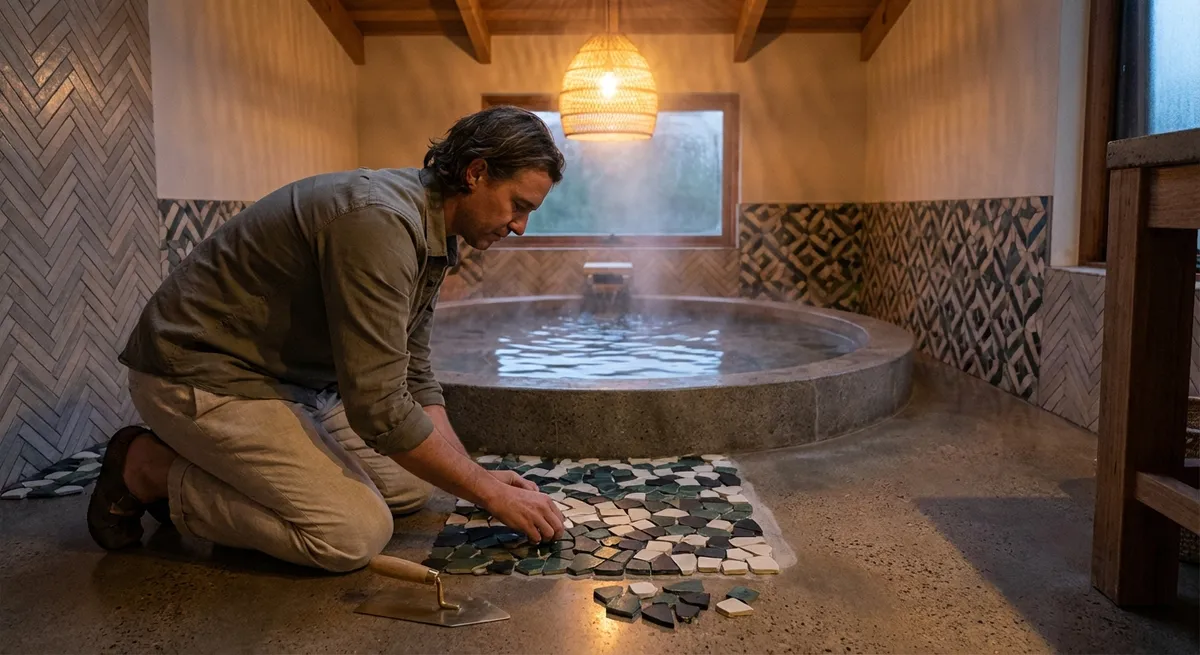
Below are five exclusive, design-forward insights that move beyond the usual “pattern and color” conversation. Each one is about refining the experience of tile—how it’s seen, how it’s touched, and how it shapes the atmosphere of a room.
1. Design the “Tile Horizon” to Control How the Eye Travels
Most tile layouts are planned from the floor up or the ceiling down. A more nuanced approach is to design a “horizon line”—a deliberate visual boundary where the tile terminates or transitions—and then choreograph the room around it.
In a bathroom, for example, extending wall tile to a tailored height that aligns with window sills, mirror tops, or door frames creates a calm, architectural band around the room. That continuous line reads as intentional, even if the tiles themselves are understated. In kitchens, a backsplash that quietly aligns with upper cabinet bases, open shelf brackets, or the top of a range hood feels composed rather than merely functional.
This horizon doesn’t have to be perfectly straight or uniform. Slight shifts—where a niche interrupts the line, or where a different tile format continues it around a corner—can add visual interest while keeping the overall composition cohesive. The refinement lies in pre-planning: your tile layout should be drawn against elevations of cabinetry, windows, and doors, not chosen in isolation. When the horizon is carefully considered, the eye travels smoothly, and the room feels more expensive without a single extra tile.
2. Pair Finish and Light, Not Just Color and Pattern
Color and pattern tend to dominate tile conversations, yet in sophisticated spaces, finish and light interaction are often doing the quiet heavy lifting. The same tile in a different finish—matte, satin, honed, polished, or lappato—can shift a room from hazy softness to razor-sharp clarity.
In naturally bright rooms, a softly honed or satin finish avoids harsh reflections and hotspots, producing a velvety, gallery-like backdrop. In low-light spaces, a selectively placed glossy tile—perhaps just inside a shower niche or as a slender border—can catch what little light exists and softly amplify it. The most refined schemes often combine finishes within one color family: a matte field tile paired with a subtly glossy accent of the same tone reads as dimensional rather than decorative.
Consider direction of light as seriously as you consider grout color. North-facing windows, recessed downlights, and wall washers all reveal tile differently. Ask your installer to dry-fit a few sample tiles under actual site lighting: walk the room at different times of day and note which surfaces shimmer, which flatten, and where fine textures become visible. You’re not choosing “a tile”; you’re curating a light-responsive surface.
3. Use Format Shifts, Not Busy Patterns, to Define Zones
In high-end interiors, spatial transitions are usually signaled with restraint, not spectacle. Tile is a powerful tool here—but the sophistication comes from format shifts rather than loud mosaics or abrupt color changes.
Imagine a bathroom where the floor is one continuous stone-look porcelain in a single color. Instead of switching entirely to a different tile in the shower, the format simply tightens: large rectangles in the main area give way to smaller rectangles or mosaics in the wet zone, using the same material and hue. The change in scale alone tells your brain that the function has shifted. It’s a quiet zoning technique that feels custom and deliberate.
The same logic applies in open kitchens. A seamless floor that gradually transitions from large-format tiles in the main circulation area to a more intricate pattern within a cooking alcove or under a dining niche can subtly “draw a rug” in tile, without an additional material. Keep your palette extremely tight—ideally a single color or stone look—and let proportion, not pattern, distinguish spaces. This restraint is often what separates a designer-grade project from a merely well-executed renovation.
4. Calibrate Grout as a Design Instrument, Not a Necessity
For most projects, grout is an afterthought—a color chip chosen at the counter. In refined tile work, grout is treated as a design instrument that can either reveal the geometry of the layout or nearly erase it.
If you want a monolithic, stone-like impression from porcelain or ceramic, select grout that nearly disappears against the tile in both color and value. This approach is especially effective with large-format tiles; the joints become faint hairlines that feel like natural veining rather than a grid. Conversely, if your intention is to celebrate pattern—herringbone, chevron, or basketweave—a slightly contrasting grout (one or two tones darker or lighter, not starkly opposite) articulates that geometry without tipping into graphic overload.
Pay attention as well to joint width and consistency. Narrow, perfectly even joints telegraph craftsmanship and uplift even mid-range tiles. Wider joints can suit rustic or handmade tiles, where slight irregularities are part of the charm. Ask your installer what joint width they recommend for your tile and then push for the tightest width that still complies with manufacturer guidelines and allows for clean alignment. That extra degree of control makes the finished surface feel both calmer and more intentional.
5. Treat Thresholds and Edges as Your Luxury Signature
The most elevated tile projects are often revealed at the edges: thresholds, steps, corners, and terminations. These are the areas where budget installations usually default to metal trims or abrupt cuts, while truly considered spaces resolve transitions with almost invisible grace.
Instead of a standard metal edging strip, explore bullnose pieces, factory-finished trims, or mitered corners that preserve the visual continuity of the tile. Where tile meets wood flooring, consider a flush, custom-milled threshold that matches the tone of the wood and the thickness of the tile assembly, so there is no perceptible step or ridge underfoot. In showers, a linear drain aligned with a grout joint or tucked against the wall allows floor tile to run uninterrupted, giving the impression that the surface was conceived as a single plane, not patched around hardware.
Even practical details like stair risers and nosings can become refined gestures. Wrapping the same tile from riser over the tread edge, or choosing a complementary stone or metal strip that is deliberately repeated on each step, feels tailored rather than improvised. When every edge is resolved with care, the entire room reads as bespoke—even if the tiles themselves are modestly priced.
Conclusion
Exceptional tile design is rarely about louder color, more pattern, or the latest trend. It’s about precision in how surfaces begin, end, and shift; how they respond to light; and how they quietly guide movement and perception.
By designing a deliberate “tile horizon,” pairing finish with light, using subtle format shifts to define zones, calibrating grout as a genuine design tool, and elevating edges and thresholds, you transform tile from a hardwearing necessity into an architectural language. These are the moves that make a space feel composed rather than simply finished—tile work that doesn’t shout, yet cannot be ignored.
Sources
- Ceramic Tile Education Foundation – Understanding Tile Layout - Explains professional layout considerations that underpin refined design decisions
- Tile Council of North America (TCNA) Handbook - Industry standards and best practices for installation details like grout joints and transitions
- Architectural Digest – How to Choose the Right Tile for Every Room - Design-focused guidance on tile selection, including finish and spatial impact
- Houzz – Tile Transitions and Threshold Ideas - Real-world examples of sophisticated transitions and edge treatments
- Porcelanosa – Tile Finishes and Characteristics - Technical and aesthetic insights into different tile finishes and how they interact with light