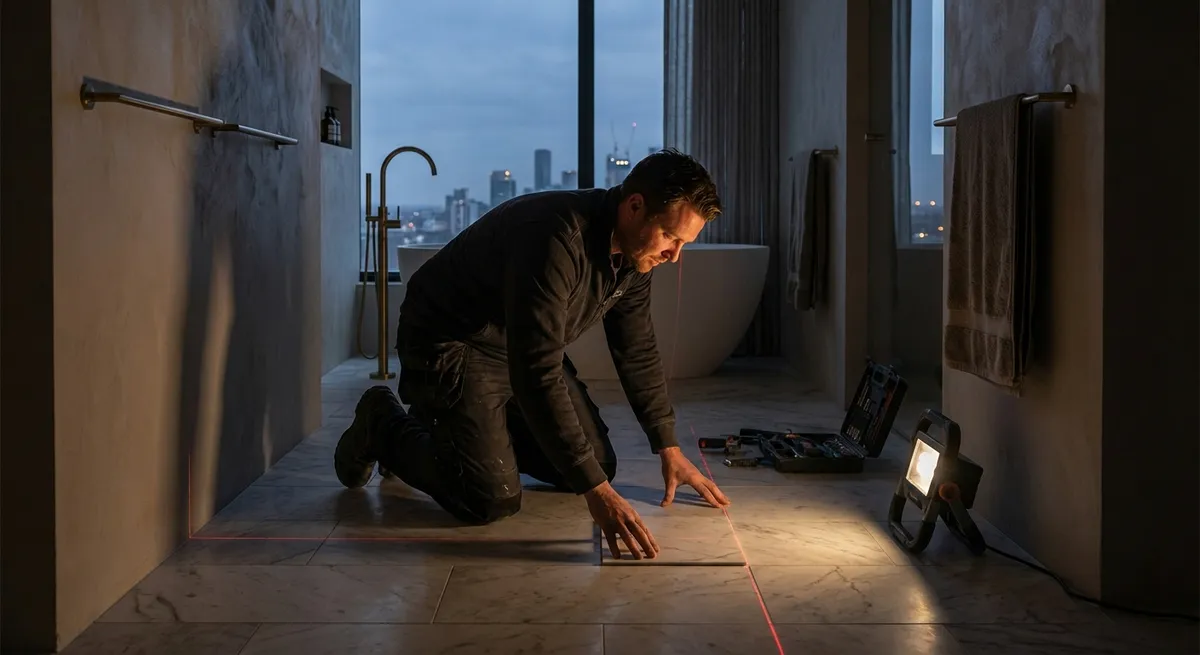
The Substrate Standard: Designing a Surface You’ll Never See
Elite tile installation begins long before the first piece is set. The substrate—the underlying surface—dictates how your tile will age, move, and ultimately perform. High-end installers obsess over flatness tolerances, moisture content, and structural rigidity because even a slight deviation telegraphs through the finished surface as lippage, hairline cracks, or subtle hollows.
For large-format porcelain or natural stone, a premium installation often includes self-leveling underlayments, decoupling membranes, and careful assessment of floor deflection. In wet areas, a reputable installer will specify and test waterproofing membranes, ensuring proper overlap, corners, and transitions rather than relying on “water-resistant” backer alone. The most refined projects treat the substrate as a precision-built component, not a rough starting point. When your installer speaks in millimeters, slope percentages, and movement joints instead of “close enough,” you’re hearing the language of enduring luxury.
Grout as Design Language, Not Afterthought
In sophisticated interiors, grout is part of the composition, not filler between tiles. Its color, texture, joint width, and performance characteristics shape the mood of a room as decisively as the tile itself. A narrow, precisely executed joint can evoke seamless stone slabs; a carefully chosen contrasting grout can lend architectural rhythm and definition.
Discerning homeowners increasingly request high-performance grout formulations—epoxy, hybrid, or advanced cementitious products—not only for stain resistance but for color stability and crisp joint profiles. Premium work pays attention to the interaction between tile edge type (rectified vs. pressed), joint width, and lighting. Under grazing light, poorly compacted or uneven grout lines appear amateurish; properly tooled joints read as tailored seams. Treat grout specifications as part of your design brief rather than a line item to be “decided later” at the jobsite.
Light, Sightlines, and the Art of the First Impression
The most exceptional tile installations are choreographed with the room’s light and sightlines in mind. A skilled installer will stand at your entry, your primary seating area, or the point where you first glimpse a bathroom and plan the layout from that vantage—deciding where full tiles should present, where cuts should disappear, and how patterns will lead the eye.
Natural and artificial light reveal everything: a polished marble shower niche slightly out of plumb, a misaligned decorative border, or an inconsistent pattern break at a doorway. On high-end projects, layout decisions account for where sunlight grazes a wall, where under-cabinet LEDs will wash a backsplash, and how reflections will highlight (or betray) surfaces. Rather than centering everything by default, refined installers emphasize aligned grout lines with architectural features—window mullions, door casings, and major fixtures—to create a calm, deliberate visual field.
Precision at the Edges: Profiles, Transitions, and Terminations
Luxury tile work reveals itself at the edges—where the tile meets another material, a corner, or the air itself. Sharp, exposed cuts at outside corners or sloppy caulk lines betray otherwise beautiful tile. In elevated projects, metal profiles, stone trims, or meticulously mitred edges are chosen to complement the metal finishes and millwork in the room, creating a cohesive language across all details.
Floor transitions receive the same care. A flush, thoughtfully detailed junction between tile and hardwood or carpet avoids trip points and visual clutter. Subtle height planning, underlayment choices, and transition profiles allow spaces to flow rather than “step” from one material to the next. In showers and wet rooms, the best installations conceal slopes and drains within the pattern rather than interrupting it—linear drains aligned with grout joints, for example, or recesses designed to feel integrated rather than tacked on. When you find yourself unable to say where the tile “stops,” that is usually the sign of a carefully orchestrated edge strategy.
Quiet Performance: Movement, Moisture, and the Long View
True tile luxury is as much about the next twenty years as it is about the final day of installation. Subtle elements—movement joints at perimeters, proper sealant use at changes of plane, and respect for expansion around heated floors—are non-negotiable in serious work. A refined installer designs for movement, allowing the tile assembly to respond to temperature shifts, building settlement, and seasonal changes without cracking or debonding.
In moisture-prone spaces, performance is about layered defense: waterproofing behind the tile, correct drain detailing, continuous slopes, and breathable yet protected assemblies to prevent mold. Premium natural stone requires additional sophistication: understanding porosity, sealing regimes, and the interaction between stone and setting materials to prevent staining or warping. These are not glamorous topics, but they are the quiet guarantees behind a bathroom or kitchen that remains as composed in year ten as it was on installation day.
Conclusion
Luxury tile installation is not about dramatic gestures; it is about an almost obsessive commitment to what the eye cannot immediately name but instinctively trusts. When substrate integrity, grout strategy, visual choreography, edge detailing, and long-term performance are all considered as part of a single design discipline, tile becomes more than a finish—it becomes architecture. For homeowners who appreciate refined detail, partnering with an installer who speaks in this language is the surest way to ensure that every tile, every joint, and every transition contributes to a space that feels effortlessly complete.
Sources
- Tile Council of North America (TCNA) Handbook - Industry reference for installation methods, substrate requirements, and performance standards
- ANSI A108 / A118 / A136.1 Specifications - Technical standards governing ceramic tile installation and setting materials
- Schluter Systems: Waterproofing and Uncoupling Membranes - Detailed guidance on substrate preparation, waterproofing, and decoupling strategies
- Custom Building Products – Grout Selection and Technology Guide - Overview of advanced grout types, performance characteristics, and design considerations
- National Kitchen & Bath Association (NKBA) Design Guidelines - Professional kitchen and bath layout principles that influence tile planning, sightlines, and transitions