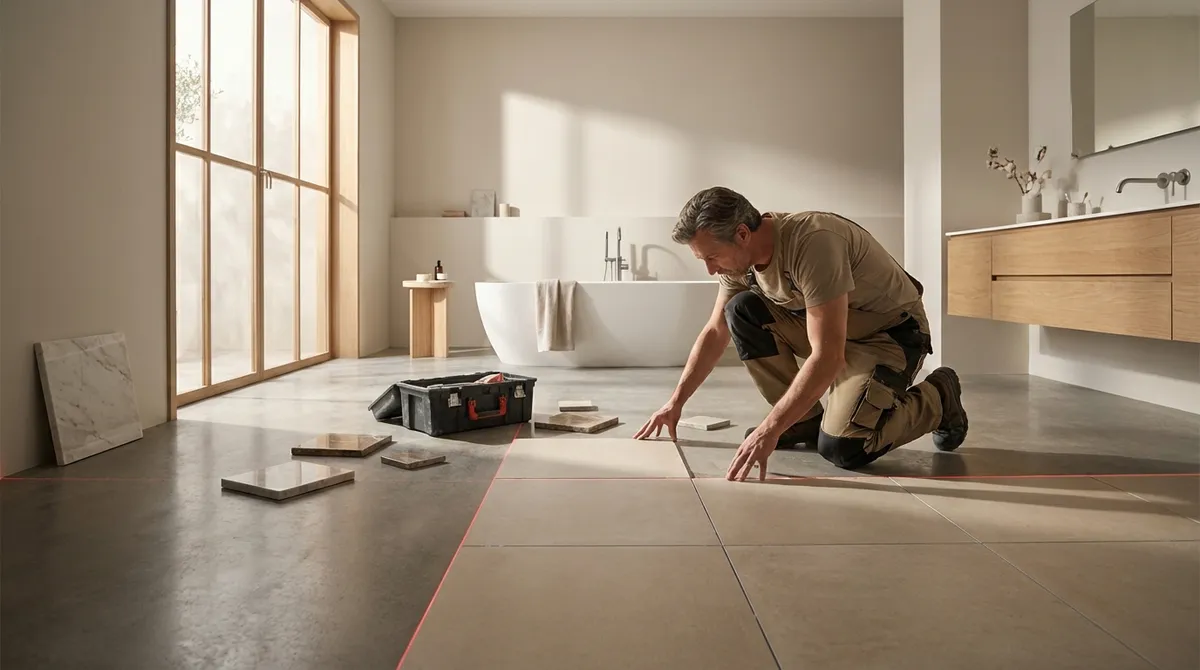
This guide steps beyond the usual advice and shares five exclusive, behind-the-scenes insights that discerning homeowners should know before the first tile is set.
Building the Invisible Foundation: Substrates, Flatness, and Movement
The most exquisite tile layout fails if it’s forced to conform to a flawed surface. Premium installations begin not with the tile itself, but with an uncompromising approach to what lies beneath.
A refined installer will assess floor and wall flatness with long straightedges, not just a casual eye. For large-format tile—now common in luxury spaces—industry guidelines typically call for very tight flatness tolerances; even a few millimeters of deviation can telegraph as lippage (one tile edge sitting proud of another) once the light hits the surface.
In high-end work, substrates are often corrected with patching compounds, self-leveling underlayments, or mortar bed systems to achieve an almost furniture-grade plane. On walls, cement backer boards or foam-core boards are installed with meticulous fastening patterns and seams reinforced with alkali-resistant mesh tape and thinset.
Movement accommodation is another invisible luxury detail. Professional installers design in movement joints at perimeters, transitions, and sometimes within large expanses of tile, allowing the system to flex with temperature and structural changes. To the eye, these joints read as clean shadow lines or slim silicone seams—but they are critical to preventing tenting, cracking, or debonding over time.
The Science of Adhesion: Mortars, Membranes, and Material Pairings
Not all tiles are set with the same mortar, and in a premium installation, product selection is as curated as the tile itself. Porcelain, glass, natural stone, and large-format panels each demand specific chemistry to bond reliably and age gracefully.
A sophisticated installer evaluates three core factors: the tile’s porosity, the substrate, and the environment. Dense porcelain and glass typically require modified thinset mortars with higher polymer content for superior adhesion. Natural stone may need white mortars to avoid shadowing or staining. Exterior or wet environments call for mortars and waterproofing systems designed to withstand freeze-thaw cycles, hydrostatic pressure, or constant exposure to moisture.
Waterproofing and crack-isolation membranes are another mark of elevated practice. Instead of relying solely on tile and grout to keep water in check—an outdated assumption—high-caliber projects employ sheet or liquid-applied membranes behind or beneath tile to create a continuous, sealed envelope. In showers, steam rooms, and spa-like baths, this attention ensures not just performance, but also the longevity of adjacent cabinetry, framing, and finishes.
When these systems are thoughtfully layered—substrate, membrane, mortar, tile—the result is an installation that feels monolithic yet is engineered to cope with the nuanced stresses of daily life.
Grout as a Design Instrument, Not a Last-Minute Decision
In lesser projects, grout is an afterthought chosen from a small fan deck at the end of the job. In refined spaces, grout is approached the way a tailor approaches stitching: functional, yes, but also capable of making the silhouette.
The width of the joint influences the entire aesthetic. Ultra-narrow joints (1/16" or 1.5 mm) can create a near-seamless field with rectified porcelain, but they demand perfect squareness and flatness. Slightly wider joints can introduce rhythm and soften visual severity, especially in handmade or artisanal tiles where slight irregularities are part of the charm.
Color selection, too, is strategic. Tone-on-tone grout allows the tile to read as a continuous surface—popular for stone-look porcelains and large-format slabs. A deliberate contrast, on the other hand, can highlight pattern, emphasize a herringbone or chevron layout, or lend a modern grid effect in contemporary spaces.
Material choice matters. High-performance cementitious grouts with added polymers or pre-mixed resin-based grouts offer improved stain resistance and color consistency, critical in kitchens and high-traffic areas. Epoxy grouts, while more labor-intensive, provide exceptional durability in spa baths and steam showers. An attentive installer will also tool grout joints carefully and clean the tile surface methodically, avoiding the hazy film and uneven joints that betray rushed work.
Light, Sightlines, and the Geometry of a Room
The most distinguished tile work is not defined only by what’s underfoot or overhead, but by how the installation interacts with light and architecture. Before a single tile is cut, seasoned professionals are studying sightlines: what a guest sees first from the entry, how the shower wall reveals itself from the bedroom, how natural light grazes a floor throughout the day.
Tile layout is plotted relative to focal points—bathtub centers, vanity lines, fireplace openings, and the primary axis of the space. Instead of starting in a random corner, installers frequently “center” layouts on important architectural features, allowing cuts to fall in less conspicuous areas or be concealed under cabinetry and trim.
Light is a powerful critic. On walls that receive strong side lighting from windows or sconces, even minor lippage becomes immediately visible. In these areas, additional care is taken with substrate preparation, tile selection (some finishes hide irregularities better than others), and setting techniques. Vertical and horizontal grout lines are aligned with millwork, door frames, and adjacent finishes to create an intentional visual grid rather than a collection of competing lines.
This is where technical precision meets spatial choreography. When executed thoughtfully, the result is a room that feels balanced and calm, even if the viewer can’t quite articulate why.
Collaboration as a Luxury: Involving Your Installer Early
For homeowners who care deeply about outcomes, one of the most powerful—and underrated—moves is to bring a skilled tile installer into the conversation early, ideally alongside the designer, architect, or builder.
Premium installations thrive on advance planning. An experienced installer can advise on tile formats that suit the space’s proportions, recommend layouts that minimize awkward cuts, and flag potential conflicts with plumbing locations, drain types, or door swings long before they become expensive site problems. They can also coordinate with electricians and plumbers to ensure niche heights, valve placements, and outlet locations align gracefully with tile courses.
Early collaboration also enables mock-ups. A single board or small wall section with the actual tile, grout color, and lighting conditions allows you to refine decisions about layout direction, joint width, and pattern strength before committing to the entire room. For complex patterns or large-format panels, this step is invaluable.
In high-end projects, the tile installer is not just a tradesperson but a craft partner—someone whose expertise can protect your investment and elevate the design beyond what’s on the mood board.
Conclusion
Impeccable tile work is quiet, but it is never simple. It’s the expression of countless micro-decisions: the tolerance of a subfloor, the chemistry of a mortar, the alignment of a grout joint, the anticipation of how light will reveal every plane.
For homeowners pursuing a refined, enduring result, understanding these deeper layers transforms the process. You begin to ask better questions, recognize genuine craftsmanship, and make decisions that support not only how your space looks on day one, but how serenely it will age.
In the end, tile is more than a surface. When installed with understated precision, it becomes the architectural calm that everything else in the room can confidently build upon.
Sources
- Tile Council of North America (TCNA) Handbook - Industry standards and best practices for tile installation, including substrate preparation and movement joint guidelines.
- ANSI A108/A118/A136.1 Tile Installation Standards (via ANSI) - Technical standards detailing performance requirements for mortars, grouts, and installation methods.
- Schluter Systems – Waterproofing, Uncoupling, and Movement Joints - Manufacturer guidance on membranes, substrate preparation, and movement accommodation.
- Mapei Technical Articles on Grouts and Mortars - In-depth explanations of grout and mortar types, selection criteria, and performance characteristics.
- University of Florida IFAS – Home Moisture Management - Background on moisture, vapor, and building assemblies, relevant to waterproofing and tile system longevity.