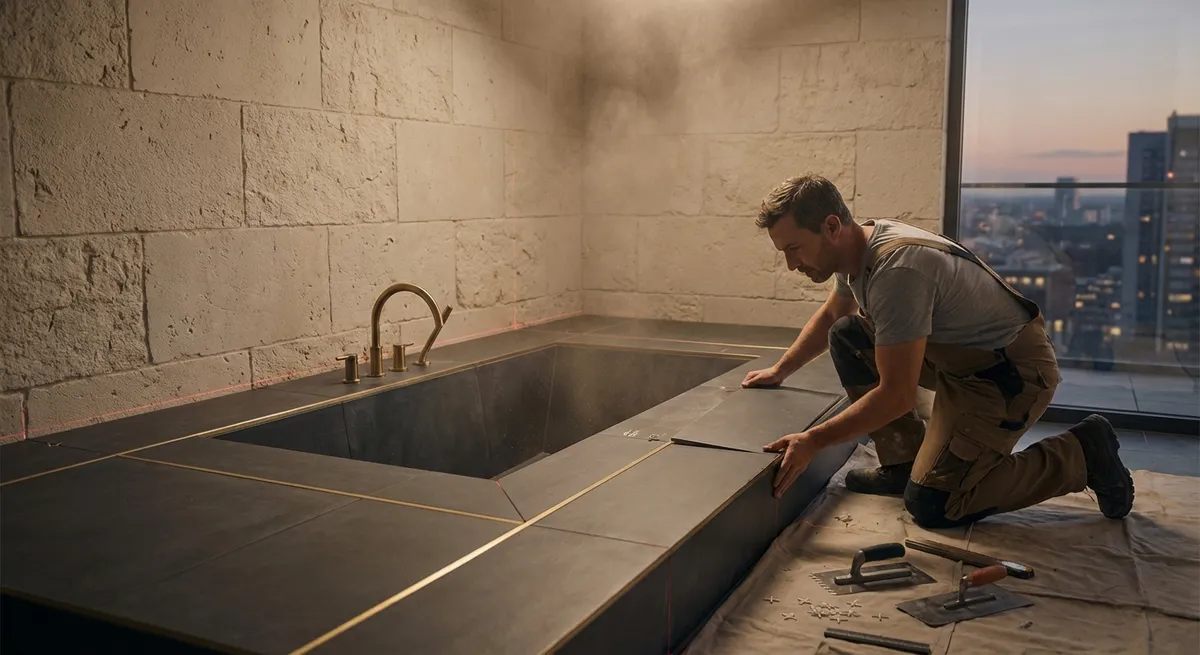
Below, we explore five exclusive insights that distinguish truly elevated tile installation from the merely acceptable—details that seasoned professionals obsess over, and discerning homeowners come to appreciate every day they live with the results.
The Grid Behind the Beauty: Designing the Invisible Reference Lines
Flawless tilework begins long before thinset meets substrate. High-caliber installers design an underlying grid that governs every decision, from where cuts fall to how grout joints align with architectural features. This is less about “centering the room” and more about orchestrating the entire space around a few carefully chosen reference lines.
A refined layout considers how tiles relate to door thresholds, bath fixtures, window mullions, and even furniture placement. For example, a continuous grout line that aligns with a shower niche, the edge of a vanity, and a window jamb will create a subtle sense of order that your eye reads as calm and intentional. Conversely, slivers of tile against key focal points—even if technically acceptable—broadcast compromise.
The most meticulous installers will perform dry layouts and even snap multiple reference lines to test options before committing. They study how cuts resolve in corners, how patterns turn through doorways, and whether symmetry or visual balance best serves the room. The result is a tile field that feels naturally “meant to be,” even if the underlying geometry was painstakingly composed.
Substrate as Foundation: Why Flat Is Not the Same as Level
In elevated tile installation, the floor beneath the tile is treated as a critical design substrate, not a disposable layer. Homeowners are often told their floors need to be “level,” but for tile—especially large-format pieces—flatness is the more crucial metric. A floor can be out of level yet perfectly flat, and your tile will still sit beautifully; the reverse is rarely true.
Premium installations emphasize substrate preparation with almost obsessive care: self-leveling underlayments, patching, grinding high spots, and reinforcing weak zones are standard practice, not add-ons. This is particularly vital for large-format porcelain, gauged porcelain panels, and natural stone, all of which magnify even minor undulations into lippage and shadow lines.
When substrates are properly prepared, grout joints remain crisp, edges stay aligned, and each tile feels firmly and evenly supported. Over time, this translates into fewer cracks, less hollow-sounding areas, and a surface that looks as flawless in its tenth year as it did the week it was installed. For a discerning homeowner, insisting on substrate testing and preparation is one of the most effective ways to elevate the final result.
Adhesive as Engineering: Matching Mortar to Material and Scale
At a sophisticated level, tile adhesive is not a commodity; it is a calibrated component of the system. Each material—porcelain, ceramic, marble, limestone, glass—responds differently to weight, moisture, and thermal movement. Large-format tiles and thin porcelain panels add further complexity, demanding mortars with specific rheology (how they spread and hold) and bond strength.
Expert installers select and mix mortars based on tile type, substrate, and location: a medium-bed (or large-and-heavy-tile) mortar to support substantial floor pieces without sagging, a flexible polymer-modified product over substrates with potential movement, or specialty mortars designed for glass or moisture-sensitive stone. They consider open time, pot life, and back-buttering requirements not as technical trivia, but as tools for predictable, high-performance installations.
For homeowners, the key insight is this: “using the right thinset” is not a throwaway detail. It is engineering. When adhesives are matched correctly, tiles remain firmly bonded, resist cracking, and age gracefully even under thermal cycling, heavy traffic, or moisture exposure. Asking your installer what mortar system they plan to use—and why—reveals quickly whether you’re working with a true craftsperson or a commodity contractor.
Grout as Design Language: Color, Joint, and Texture in Harmony
Grout is often treated as a necessary filler, yet in a refined installation it becomes a deliberate design language. The width of the grout joint, its color, and its finish (matte, satin, or slightly polished) collectively determine whether your surface reads as a monolithic plane, a subtle grid, or a pronounced pattern.
For rectified porcelain, a narrow joint can emphasize a near-seamless effect, especially with a carefully matched grout tone. For handmade or tumbled tiles, a slightly wider joint highlights their irregularity and character, giving the surface a crafted, tactile presence. In stone installations, a near-tonal grout can soften transitions; in geometric mosaics, a contrasting grout can sharpen each shape and intensify the pattern.
Advanced installers go further: they mock up small areas with different grout samples and lighting conditions. They consider how grout will appear under warm vs. cool light, and how it will age with use. They also understand when to specify epoxy or high-performance grout for demanding areas such as showers or busy kitchen floors, balancing stain resistance with aesthetic goals. The result is a surface where grout contributes to the narrative of the room rather than silently undermining it.
Continuity Across Thresholds: Orchestrating Rooms, Not Just Surfaces
The most luxurious tile installations are not confined to a single room; they orchestrate transitions between spaces with deliberate continuity. Instead of allowing each area to become an isolated project, elevated installers and designers consider how the eye travels—from entry to hall, from bath to bedroom, from interior to terrace.
One sophisticated approach is to run consistent grout lines through aligned doorways, even if tile formats or patterns change. Another is to employ carefully positioned thresholds or metal profiles as “punctuation marks” between materials—stone to wood, tile to carpet—so that each transition feels intentional rather than abrupt. On steps, niches, and window sills, miters are planned so that veining, patterns, or edges wrap gracefully, echoing architectural lines.
This kind of continuity requires meticulous measurement, clear drawings, and collaboration between installer, designer, and client. Yet the payoff is profound: rooms feel interconnected, proportions feel resolved, and the home reads as a single, composed environment rather than a sequence of disconnected surfaces. For homeowners seeking a truly curated atmosphere, asking how tile will transition between spaces is as important as choosing the tile itself.
Conclusion
Refined tile installation is defined not by what draws attention, but by what quietly prevents distraction. Invisible grids, precisely prepared substrates, engineered adhesives, deliberate grout choices, and choreographed transitions all contribute to an atmosphere of effortless sophistication.
For homeowners who value enduring quality and architectural calm, engaging an installer who thinks at this level is not a luxury—it is the difference between a surface that simply exists and one that enriches daily life. When you approach your next tile project, frame your conversations around these deeper layers of craft. The tiles themselves may be what you select, but it is the rigor behind them that you will live with, year after year.
Sources
- Tile Council of North America (TCNA) Handbook - Authoritative industry guidelines on substrate prep, setting materials, and installation standards
- American National Standards Institute (ANSI) A108/A118/A136.1 - Technical standards governing ceramic tile installation and setting materials
- Schluter Systems Technical Library - Detailed resources on underlayments, movement joints, waterproofing, and transitions between tile and other materials
- Mapei Tile & Stone Installation Systems - Technical data and selection guides for mortars, grouts, and related products
- LATICRETE Tile Installation & Care Guide - Educational content and system-based recommendations for high-performance tile installations