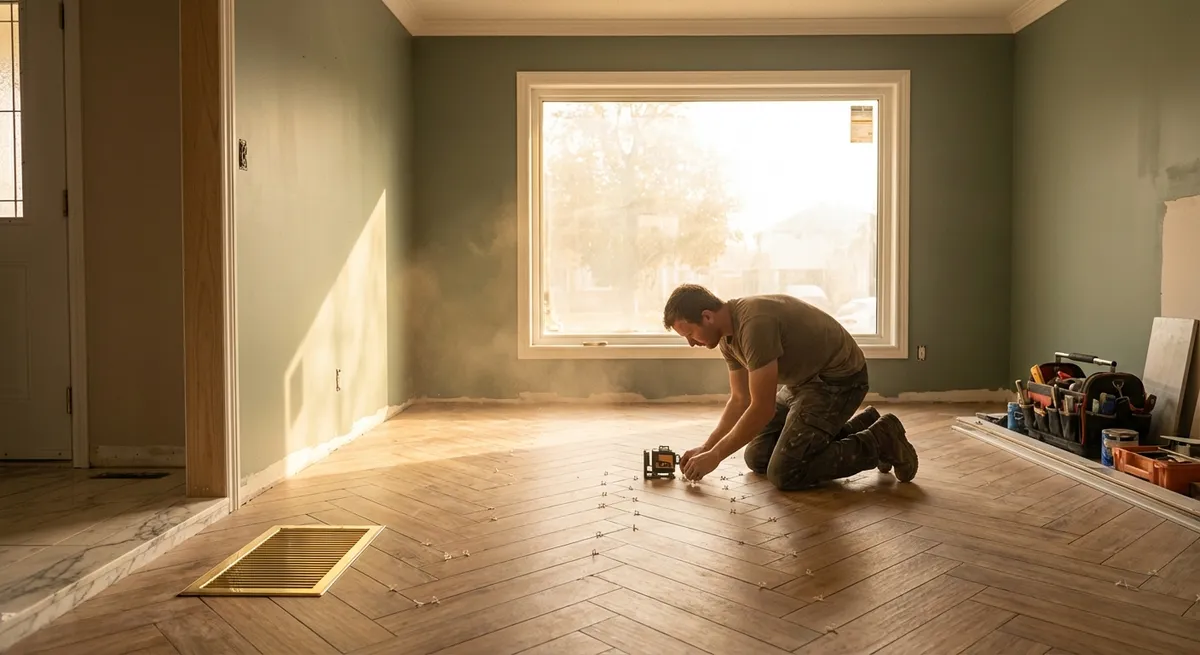
For homeowners who appreciate refinement, understanding these subtleties will help you ask better questions, set better standards, and ultimately achieve a space that feels deliberately composed rather than merely covered in tile.
Designing from the Threshold: The Power of the First View
Every tile installation is experienced first from a single vantage point: the moment you enter the room. Professionals who work at a higher level design the layout from this exact sightline, not from the center of the room or a random wall.
Rather than starting the layout by simply “finding the middle,” an elevated approach frames what you see at the doorway: full, balanced tiles drawing the eye inward, with cut pieces discreetly positioned away from this primary view. In a bath, this might mean prioritizing full tiles along the tub front or the back wall of the shower, where the geometry is most prominent. In a kitchen, it might be aligning a key grout joint with the centerline of the range or the sink window, so the tile grid supports the room’s existing architectural rhythm.
This strategy is subtle but transformative. The human eye instinctively reads alignment, even if you’re not consciously measuring joints. When your installer walks the space with you before any thinset is mixed—discussing where full tiles should land, where cuts will hide, and how the pattern will meet doorways and transitions—you’re no longer buying “a tile job.” You’re commissioning a composition.
Elevation as a Design Tool, Not a Technical Afterthought
Most tile conversations fixate on floor plans, but the most refined projects treat elevations—the vertical faces of walls, niches, and transitions—as the real stage. In luxury installations, the wall layout is drawn with the same care as custom cabinetry, often long before the first box of tile arrives.
Consider a shower: instead of simply tiling “up to the ceiling,” a meticulous installer will coordinate grout lines with plumbing fittings, niche locations, and even the top of the glass partition. Valves can be centered within a single tile or symmetrically straddling a grout joint; decorative borders can frame a mirror with precise reveals; large-format tiles can be stacked so that their horizontal lines run uninterrupted behind a floating vanity. Each decision signals intention.
For homeowners, the critical insight is timing. These alignments demand early coordination—ideally at the rough‑in stage. Ask your tile professional to review the wall elevations before plumbing and electrical are finalized. Confirm heights for shower heads, controls, and niches relative to tile coursing. Your reward will be a space where fixtures feel embedded in the architecture rather than applied afterward.
Managing Scale and Proportion: When Large-Format Isn’t the Answer
Large-format tile suggests luxury, but in a refined interior, scale must be in proportion to the room. A 24" x 48" floor tile installed in a compact powder room can feel more like a graphic poster than a quiet surface, especially if the layout produces awkward slivers or heavily cut corners.
A sophisticated approach weighs the relationship between tile size, grout joint, and room dimension. In an elegantly composed room, tiles often “speak softly,” with modules that echo existing architectural proportions: the width of a window bay, the length of a vanity, or the span of a hallway. Sometimes this means stepping down from a dramatic slab‑like format to a more measured size that allows for cleaner boundaries and fewer compromised cuts.
Pay particular attention to how modules resolve at key boundaries—tub aprons, cabinet kicks, door thresholds, and stair nosings. A tile that looks magnificent in a showroom can become visually noisy when forced to bend around small protrusions. Ask your installer to mock up a couple of layout options on the floor before setting: observe not just the tile itself, but how its scale behaves at the edges of your room. True luxury often lies in the absence of visual strain.
Curated Grout and Edge Details: Silent Signals of Craft
In a premium installation, grout is not an afterthought—it is part of the design palette. The most polished projects avoid stark high‑contrast grout unless it is deliberately chosen as a graphic element. Instead, they select tones that sit just off the tile color, softening the grid and allowing the material itself to take precedence.
Equally important are edge conditions. Budget work often relies on generic metal trims or exposed tile edges. Elevated installations use carefully chosen profiles or mitered corners to maintain a continuous, sculpted feel. Porcelain with a clean factory edge might pair beautifully with a minimal, color‑matched profile; natural stone in a niche or on an outside corner can be mitered so the face appears to wrap like a single monolithic block. Even base transitions—where tile meets painted wall—can be refined with a micro‑bevel grout joint instead of a heavy caulk line.
Homeowners should request a dedicated discussion about grout and terminations before work begins. Ask to see grout samples against your tile in both natural and artificial lighting. Clarify how outside corners, window returns, and top edges will be finished. When these details are handled with intention, the tiled surface feels as though it belongs to the architecture, not layered on top of it.
Substrate Discipline: The Hidden Foundation of a Calm Surface
The true mark of a luxury tile installation is not just what you see; it’s what you don’t feel: no hollow spots underfoot, no minuscule lip between tiles catching your bare feet, no unexpected dips where light pools unevenly. This serenity is only possible when the substrate—the surface beneath the tile—is treated as a precision component rather than a mere base.
High‑end installers will routinely flatten floors beyond the minimum code or industry requirements, using self‑leveling compounds or meticulous patching to achieve a surface that allows large-format tiles to sit in a single, even plane. On walls, particularly in showers and feature areas, they check studs for plumb, correct bows, and select appropriate backer materials and waterproofing systems that preserve flatness. This obsessive preparation is what keeps grout joints perfectly consistent and virtually eliminates lippage.
As a homeowner, you don’t need to manage the technical process, but you should absolutely insist on its importance. Ask: How will you prepare the substrate for large-format tile? What are your tolerances for flatness? Which waterproofing system will you use, and how will it impact wall thickness and alignment with adjacent finishes? The answers will reveal whether you’re working with a tradesperson who installs tile—or a craftsperson who engineers surfaces.
Conclusion
Exceptional tile work is not defined by how complicated the pattern is, how expensive the tile was, or how striking the color appears on social media. It is defined by poise: quiet, consistent lines; considered relationships between tile, architecture, and light; and a substrate so controlled that the finished surface feels inevitable.
When you understand the decisions behind this level of refinement—designing from the threshold, coordinating elevations, respecting scale, curating grout and edges, and insisting on substrate discipline—you can collaborate with your installer as a true partner. The result is a room where the tile does more than cover a surface; it completes the space with composed, enduring calm.
Sources
- Tile Council of North America (TCNA) Handbook - Industry reference for tile installation methods, tolerances, and best practices
- American National Standards Institute (ANSI A108/A118/A136.1) - Standards governing professional ceramic and stone tile installation
- Schluter Systems – Substrate Preparation and Waterproofing - Guidance on substrate flatness, waterproofing, and detailing for long-lasting tile work
- Custom Building Products – Large Format Tile Installation Tips - Practical considerations for installing large-format tile successfully
- LATICRETE – Grout Color Selection and Design - Overview of grout types, color selection, and their impact on finished aesthetics