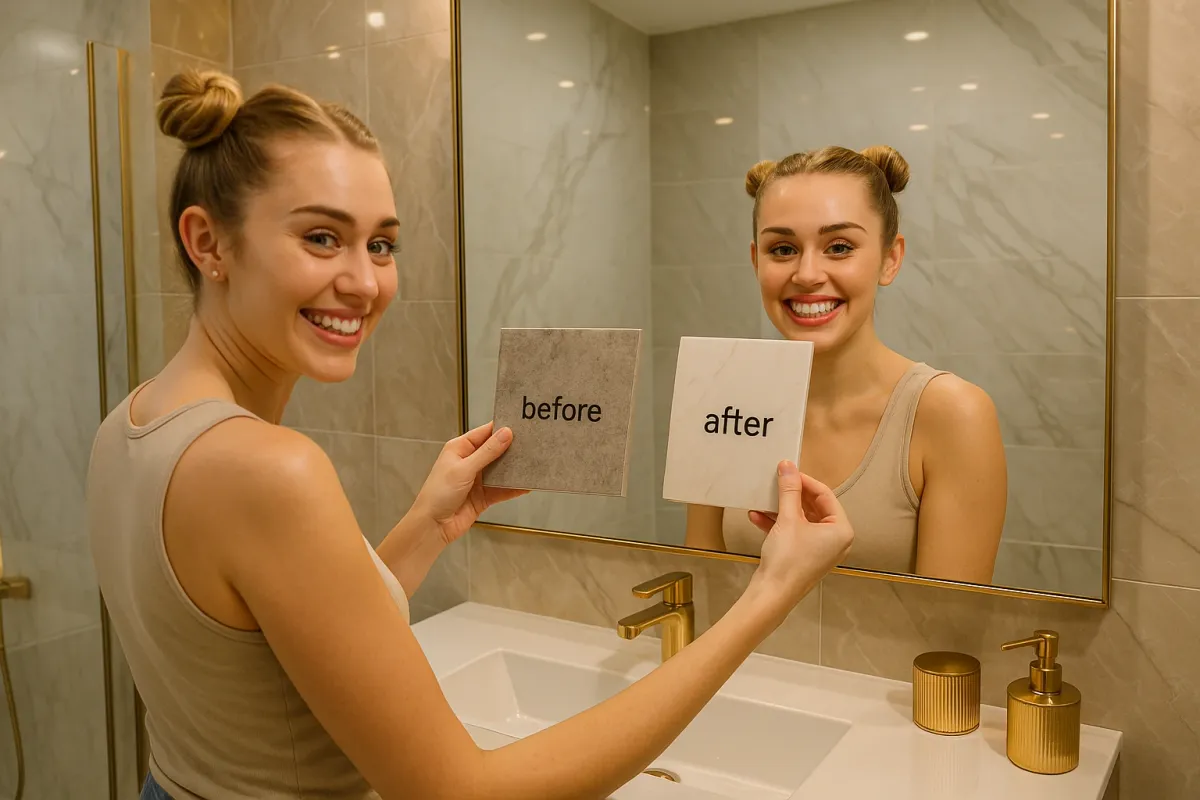
That exact shift is happening in high-end interiors and tile work. The most sophisticated homes completed this year aren’t shouting with aggressive patterns or trend-chasing finishes; they’re whispering with precise lines, quietly luxurious materials, and details that feel like they’ve always belonged. Just as a well-executed smile makeover is invisible as “work” and visible only as harmony, truly premium tile installations don’t scream renovation—they simply look right.
Below, we translate the cosmetic “glow-up” conversation around Miley’s new smile into five exclusive, timely insights for homeowners planning a tile project now—whether it’s a statement bath, a gallery-caliber foyer, or a kitchen worthy of a design feature.
1. From Overdone to Effortless: Embrace Subtlety Over Showpiece Syndrome
Cosmetic dentists critiquing Miley’s earlier veneers used words like “too big,” “too bright,” and “not in proportion to her face.” The update is lighter, more tailored, and more her. The same principle applies to tile: luxury in 2025 is moving away from loud pattern overload and toward cultivated restraint.
Instead of covering every surface in busy marble veining, consider one impeccably executed feature plane—say, a single bookmatched shower wall—balanced by quieter large-format tiles elsewhere. Overly graphic encaustic patterns across floor and walls can feel like those oversized veneers: a design that enters the room before you do. The most current high-end projects use tile like a well-edited wardrobe: a few strong pieces, cut and placed to perfection, surrounded by textures that support rather than compete. Ask your installer to mock up full-scale layouts on-site before committing; like a smile trial in cosmetic dentistry, it lets you see when something feels “too much” before it’s permanent.
2. Proportion Is the New Status Symbol: Align Your Tile Like a Perfect Bite
Fans love Miley’s revised teeth because they finally fit her features—neither too dominant nor too small. In dentistry, this is all about the “golden proportions” of a natural smile. In tile, proportion and alignment play the same starring role, and discerning homeowners are starting to notice the difference instantly on social media walkthroughs and real-estate reels.
Window and niche centers that don’t line up with grout joints read as subtly “off,” the visual equivalent of a misaligned bite. Premium tile work now treats everything—from outlet placement to shower valve height—as part of a single composition. Before installation, insist on a detailed elevation drawing that shows every grout line in relation to architectural elements and fixtures. Request that your tile setter dry-lay a section to confirm joint alignment at eye level. This additional design pass is what separates standard installations from the kind you see in meticulously styled celebrity homes: nothing important gets cut in half, and every major line feels intentional.
3. Finish, Not Flash: Choosing Sheens That Flatter Your Space Like Good Lighting
Commentary around Miley’s updated look has focused heavily on how the new smile handles light—less glary, more natural, almost as if the enamel has a softer, more believable sheen. Tile behaves the same way. High-polish, hyper-reflective surfaces can look glamorous on Instagram, but in real life they magnify every lippage error, grout inconsistency, and speck of dust.
The most sophisticated installs right now lean toward satin or honed finishes, especially in large formats. These sheens absorb and diffuse light like luxury foundation rather than bouncing it back like a spotlight. In bathrooms with strong vanity lighting (or kitchens with statement pendants), a honed stone-look porcelain on the walls paired with a subtly textured matte floor tile creates a glow that feels edited and flattering—on both space and skin. Before finalizing, ask your tile provider for samples in at least two sheens and view them at different times of day in your actual lighting. You’re not just choosing tile; you’re choosing how your room—and everyone in it—will be lit.
4. Precision at the Micro Level: Grout Lines as the “Gumline” of Your Tile
The reason Miley’s new smile feels so right isn’t only the teeth—it’s the gumline. Contour, coloration, and transitions are all tuned so the eye sees harmony, not hardware. In tile, grout is your gumline, and it is shockingly responsible for whether your installation reads as luxurious or merely adequate.
Today’s premium projects are quietly abandoning thick, high-contrast grout lines in favor of hairline joints and ultra-precise spacing. Rectified porcelain allows for joints as tight as 1/16", but they only look expensive when substrates are perfectly flat and the layout is meticulously planned. Ask your installer how they will handle inside and outside corners: Will they maintain joint spacing around the turn? Miters? Schluter trims in a finish that truly complements your fixtures, not “whatever’s on the truck”? Specify grout color with the same attention you’d give paint: bring home sample sticks, smear test patches on scrap tile, and view them dry—not wet—under your lighting. A half-shade too dark can frame every tile like a postage stamp; a half-shade too light can make even a flawless install look slightly “off.”
5. Authenticity Over Aggressive Editing: Let Materials Age Beautifully, Not Perfectly
Miley’s new smile is being praised because it looks less “filtered” and more like an elevated version of her natural teeth. That same craving for authenticity is reshaping what high-end clients are asking for in tile. Hyper-synthetic high-gloss everything is giving way to surfaces with believable variation, tactility, and a bit of soul.
If you love real stone, embrace it fully: specify a sealing schedule, understand that a few hairline fissures and tonal shifts are a feature, not a flaw, and choose honed or brushed finishes that age gracefully rather than chasing pristine perfection that will never survive daily life. If your lifestyle or maintenance tolerance calls for porcelain, choose collections with carefully curated variation, not cartoonish veining. Discuss with your installer how they will “blend boxes” to avoid abrupt color patches, much like a skilled colorist blends hair tones. The installations that will still look current a decade from now are those that feel inherently believable, like they belong to the architecture rather than to a fleeting filter trend.
Conclusion
The conversation around Miley Cyrus’s new smile is, at its core, a conversation about design maturity: moving from conspicuous change to calibrated refinement, from “look what I did” to “this is simply who I am.” Tile, at the luxury level, is undergoing the same transformation.
If you’re planning a tile project right now, think like a discerning cosmetic dentist: honor the bones of the space, prioritize proportion over drama, choose finishes that flatter in real light, obsess over the micro-details that others overlook, and don’t be afraid of authentic, well-chosen materials that age with character. When done well, your tile installation won’t just look new—it will look inevitable, as if your home has finally become fully itself.