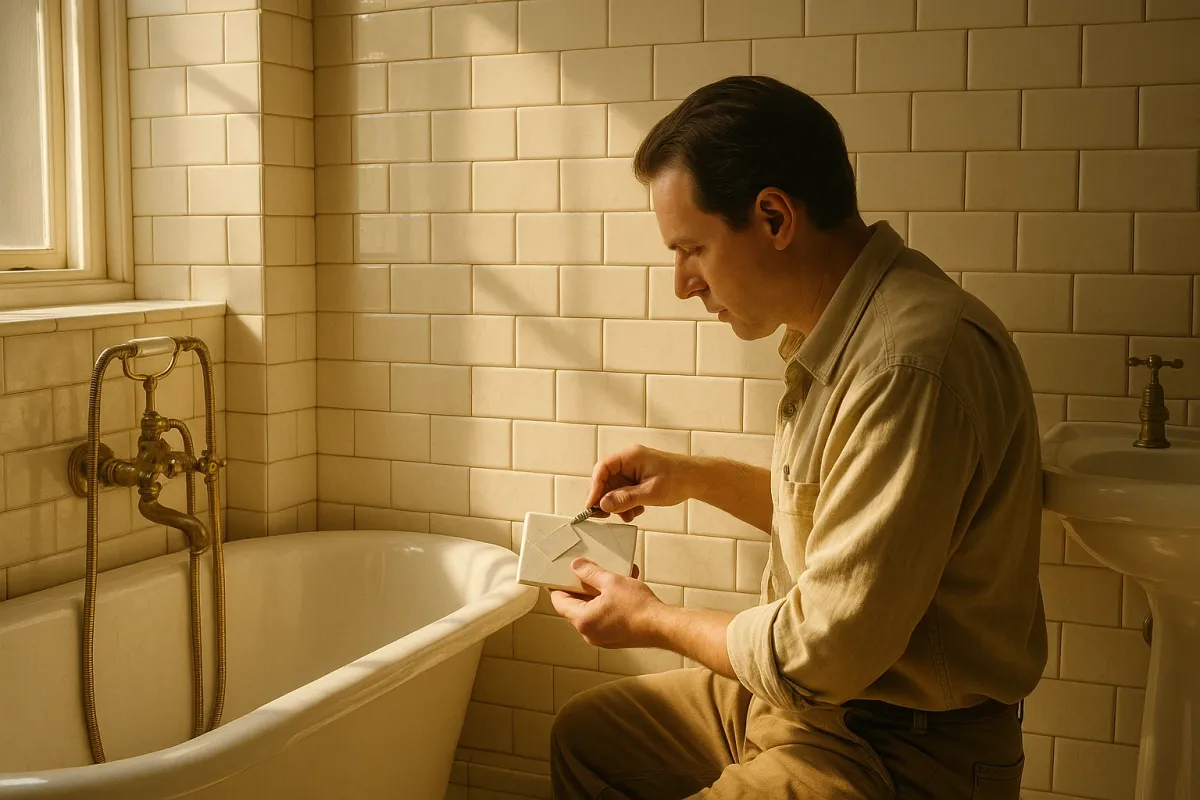
At Tile Pro Tips, we see the same shift every day. Homeowners are asking less about “what’s trending” and more about “what will feel timeless in 20 years?” The answer, of course, is the same language those century-old houses speak fluently: proportion, craftsmanship, and materials chosen with intention.
Inspired by this renewed fascination with historic homes, let’s translate that old-world elegance into contemporary tile design—so your next renovation feels less like a quick upgrade and more like a future heirloom.
1. Elevate the “Background”: Treat Floors Like Architectural Tailoring
In the photos of those historic houses, notice how the floors never scream for attention—yet you can’t imagine the room without them. Mosaic entry halls, honed stone corridors, checked kitchens: they function like a perfectly tailored suit. Understated, but absolutely precise.
Bring that tailored approach into your tile decisions:
- Think in long views, not just single rooms. When you open your front door, where does your eye travel? Consider a continuous tile material or color family that visually threads foyer, kitchen, and adjacent halls together. This creates the same sense of architectural calm you see in old estates.
- Refine the scale to suit the space. Grand corridors in those homes often carry larger-format stone; intimate vestibules showcase finer mosaics. In a modern setting, a compact powder room becomes jewel-like with small-scale mosaics, while a generous kitchen feels serene in larger-format porcelain or stone.
- Dial back the gloss. Many of those old floors have a soft, velvety sheen—not mirror shine. Honed or matte tiles read more expensive, age more gracefully, and better echo the quiet patina of heritage homes.
- Upgrade the “barely visible” details. Specify narrow grout joints, well-matched grout colors, and precise transitions to wood or carpet. High-end floors rarely announce themselves; they whisper through seamless execution.
Treat your tile flooring as background architecture, not décor. The more controlled and considered it is, the more everything else in the room feels custom.
2. Borrow Historic Patterns, Edit Them for Modern Minimalism
The viral images of encaustic vestibules, basketweave bathrooms, and border-framed halls prove one thing: pattern, when done with discipline, is timeless. What dates a room isn’t pattern itself—it’s pattern without restraint.
To pull historic patterning into a contemporary home:
- Limit the palette to two or three tones. Most enduring floors are built on monochrome or near-monochrome schemes—think charcoal and ivory, or warm beige and cream. Let geometry, not loud color, carry the drama.
- Use borders like architectural lines. Traditional houses often use tile borders to “draw” rooms on the floor. In a modern setting, a contrasting border around a kitchen floor can subtly zone the cooking area within an open plan, or create a “rug” effect under a dining table—no textile required.
- Modernize heritage layouts. Classic checkerboard? Shift it on the diagonal. Victorian-style encaustic? Choose larger, simplified motifs. Basketweave? Render it in elongated rectangles for a sleeker, gallery-like effect.
- Reserve highly decorative patterns for compressed spaces. Small entries, mudrooms, laundry rooms, and powder baths can carry ornate mosaics gracefully. In large spaces, err toward simplified patterns to avoid visual noise.
Think of it as curating history: you’re quoting beloved motifs from those 19th- and early-20th-century homes—but editing them with the restraint that defines today’s luxury interiors.
3. Make Walls Feel Built-In, Not Tiled-On
One of the most striking features in the “beautiful old houses” collection is how finishes feel integrated into the architecture, not just applied to it. Wainscoting, paneling, and millwork all look like they were born with the building.
Tile can—and should—do the same:
- Embrace tile wainscoting in wet-prone rooms. Instead of stopping backsplash tile at an arbitrary height behind a vanity, run a coordinated tile wainscot around the entire powder room at chair-rail height, capped with a slim bullnose or a minimalist stone ledge. It feels architectural, not decorative.
- Wrap corners and returns. In kitchens, carry backsplash tile cleanly around inside corners, window recesses, and side walls of range hoods. This creates the same enveloping feel you see in thick plaster walls of historic homes.
- Align with existing “lines of the room.” Let upper cabinet bases, window sills, or hood bottoms determine backsplash termination heights. Luxury is alignment: when reveals, grout lines, and architectural elements share a logic, the room reads as custom-built.
- Consider full-height, single-material feature walls. In a primary bath, a full-height stone-effect porcelain behind the tub can evoke the drama of an old-world marble-clad chamber—without the maintenance burden of soft stone.
The goal is to make tile feel inseparable from the architecture, as if walls and surfaces were conceived together rather than second-guessed later.
4. Use Grout as a Deliberate Design Line, Not an Afterthought
Those viral historic floors get a lot of love for their materials, but look closer: the grout is doing quiet, disciplined work. Lines are consistent, colors are intentional, and the rhythm they create is part of the charm.
To achieve that same level of refinement:
- Match or mute on large expanses. On big floor or shower surfaces, keep grout color close to the tile tone. This minimizes busyness and gives you that monolithic, stone-like presence associated with high-end spaces.
- Lean into contrast where craft is the star. If you’ve invested in a handmade or zellige-style tile, a slightly contrasting grout can subtly showcase the wavy edges and irregularity—much like the mortar lines in historic brickwork.
- Align grout joints with architectural breaks. Center tile layouts under focal windows, align grout lines with shower niche edges, and avoid slivers at thresholds. Old homes feel composed because elements “land” gracefully; your grout layout should do the same.
- Choose performance like a professional. In today’s luxury projects, epoxy or high-performance grouts are quietly becoming the standard—stain-resistant, color-stable, and less likely to age poorly. They preserve that “just-installed” elegance for far longer, echoing why those century-old floors still photograph so beautifully.
When grout is specified with the same care as the tile, you move from “nice renovation” into “this feels like it’s always been here.”
5. Curate Patina Intentionally: Where to Embrace Age, Where to Defy It
One reason the Bored Panda gallery is so captivating is patina: the softened edges on stone treads, the gently dulled sheen of terracotta, the hairline cracks in old glazes. We’re collectively rediscovering that a space can look better as it ages.
In a modern home, you can choose where your tile will gracefully evolve—and where it should remain pristine:
- Select inherently characterful materials in low-risk zones. Tumbled stone or rustic terracotta in a mudroom or sunroom can slowly develop the same romantic wear as those old-world entries. Pair with precise installation for balance: rustic surface, refined execution.
- Use “patina-mimic” porcelains where you want durability. Today’s high-end porcelains can convincingly echo limestone, marble, and cement, without the etching and staining of the originals. They’re ideal for busy kitchens, family baths, and households that prefer low-maintenance luxury.
- Plan lighting to flatter surface texture. Grazing wall lights over uneven or handmade tiles will emphasize their depth and shadow—the same way sunlight rakes across plaster in historic interiors. The right light angle can turn a simple shower wall into a sculptural surface.
- Coordinate fittings with the tile’s aging story. An unlacquered brass faucet set against a honed limestone-look tile will age in concert, developing parallel patinas. In contrast, a polished chrome shower set in a pristine white porcelain will keep the space feeling crisp and modern for years.
By deciding—consciously—how you want your surfaces to age, you channel what makes those century homes so captivating: they don’t just survive time; they collaborate with it.
Conclusion
As social media swoons over those “50 Beautiful Old Houses,” the message for contemporary homeowners is crystal clear: luxury is shifting from what’s loud to what lasts. It’s in the perfectly considered grout line, the quietly continuous floor, the backsplash that feels like it grew out of the wall.
When you plan your next tile project, think less in terms of “this year’s trend” and more in terms of “what will photograph beautifully in 2045.” Borrow the discipline, proportion, and material intelligence of historic craftsmanship—and fuse it with today’s technical advances in tile and grout.
That’s where true, modern quiet luxury lives: in surfaces that feel as inevitable as they are exquisite.