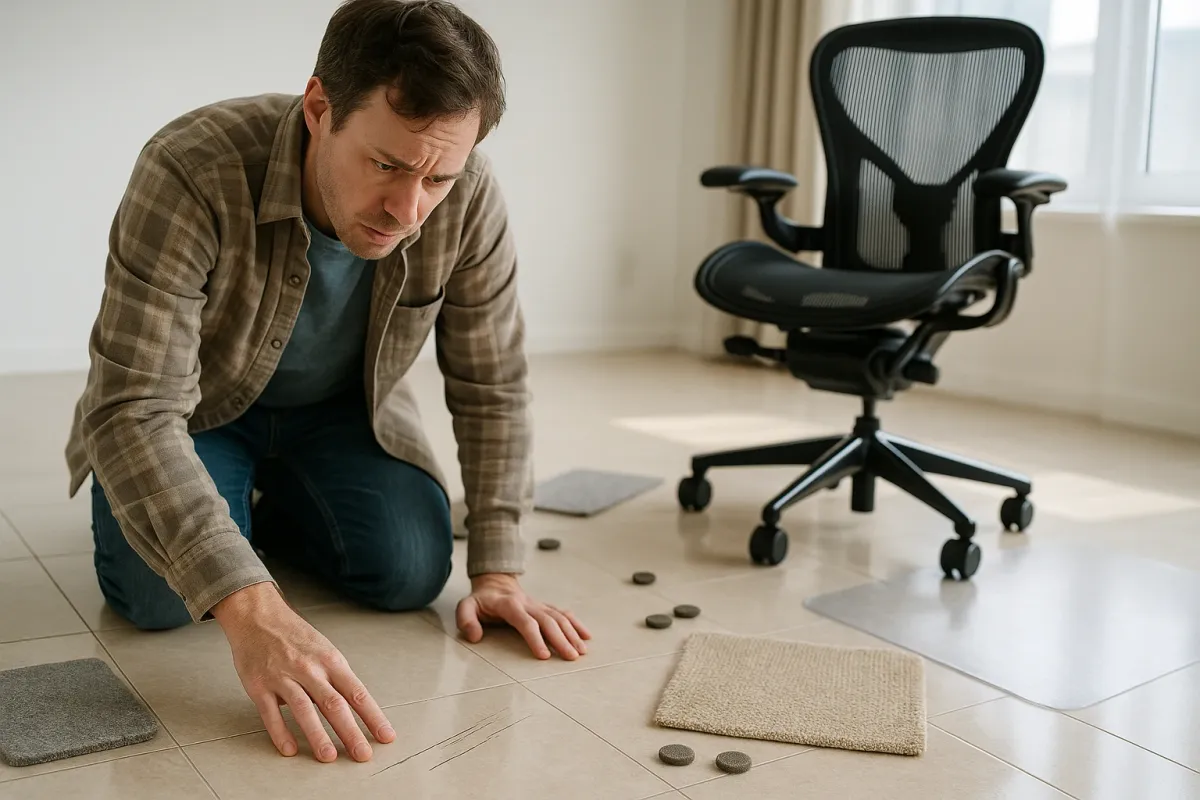
For homeowners, the viral “chair theft” story is a reminder that our own investments are at daily risk of low-level abuse: chairs dragged across glazed porcelain, rolling castors carving micro-grooves in polished marble, heavy furniture leaving ghostly imprints in luxury vinyl tile. The good news: there are discreet, highly effective repair and prevention strategies that can keep your tile surfaces as composed as a corner office—no HR intervention required.
Below, discover five refined, tile-focused repair and protection insights inspired by what happens when furniture and floors collide.
1. The Castor Conundrum: Repairing Micro-Scratches from Office Chairs
The Aeron saga has many homeowners glancing suspiciously at their own office chairs. Hard plastic castors rolling over tile can create a constellation of micro-scratches, particularly on polished porcelain, ceramic with a softer glaze, and natural stone. Often, these marks are not deep enough to require full replacement, but they are visible enough to degrade the surface’s elegance.
For polished porcelain, a professional-grade polishing compound specifically formulated for tile can often blend light scratching. Avoid generic abrasives; instead, look for cerium oxide–based or manufacturer-approved polishing systems. The process typically involves progressively finer grits, applied with a low-speed polisher and strict control over pressure and dwell time. Amateur over-polishing can create dull “eyes” on an otherwise glossy field.
On natural stone like marble or limestone, restoration-grade diamond polishing pads in a carefully stepped sequence (often 400–800–1500–3000 grit) can restore sheen, provided the damage has not penetrated too deeply. This is generally not a DIY-first project; a stone restoration specialist can evaluate whether resurfacing a single tile, a section, or the entire room is the most visually coherent approach. The crucial takeaway: light, uniform micro-scratching can often be rehabilitated—if you resist the impulse to “buff it out” with household cleaners and improvised abrasives.
2. Silent Protection: Converting Risky Furniture into Tile-Friendly Pieces
The office drama highlights an uncomfortable truth: furniture is rarely designed with hard-tile preservation in mind. Most mass-market pieces assume carpet or resilient flooring, not honed travertine or rectified porcelain. As homeowners upgrade their floors, they must retrofit their furnishings to coexist respectfully.
For rolling office chairs, replace standard nylon castors with soft polyurethane “rollerblade-style” castors designed for hard floors. These distribute weight more gently and reduce point pressure on grout joints. Look for models with a high load rating and sealed bearings—cheaper versions can grind debris into tiles over time. For ultra-sensitive surfaces (high-polish marble, gloss ceramic), pairing upgraded castors with a premium, phthalate-free chair mat specifically rated for tile can provide a double layer of protection. Avoid brittle, low-cost mats that can craze, yellow, or transfer texture to the surface below.
Static furniture—dining chairs, sculptural accent chairs, bar stools—benefits from high-density felt pads, but not the flimsy, shedding variety. Opt for industrial-grade pads with beveled edges, adhered with solvent-based adhesive rather than a weak PSA backing. On textured porcelain or honed stone, consider Teflon- or UHMW-based glides which resist grit embedding and last longer. The sophisticated approach is proactive: treat every point of contact between furniture and tile as a design decision, not an afterthought.
3. Hairline Cracks and Impact Stars: When Weight and Tile Disagree
In open-plan homes where office zones bleed into living areas, it’s increasingly common to see heavy seating, filing cabinets, and credenzas stationed over tiled floors. Concentrated loads—especially when moved—can cause hairline cracks or starburst fractures, often appearing at corners or along grout lines. Unlike dramatic breakage, these subtle flaws demand nuanced repair.
First, diagnose: is the crack purely in the glaze, through-body tile, or does it align with substrate movement (for example, over a poorly placed subfloor joint)? A tile professional might use a straightedge, tapping, or even a borescope or moisture meter to determine if there’s underlying deflection or moisture-related failure. If the substrate is compromised, any superficial repair is temporary theater.
For stable, isolated cracks in individual tiles, a carefully color-matched epoxy or polyester resin can visually “disappear” the damage, particularly on patterned tiles. This involves micro-cleaning the crack, sometimes slightly widening it with a precision blade, then filling, leveling, and polishing. On uniform, large-format tiles, such a repair must be executed with extreme precision to avoid a visible “scar line.” In more serious cases, a surgical tile replacement—removing a single unit without disturbing its neighbors—is the gold standard. Specialists will use oscillating tools, diamond bits, and dust-controlled methods to protect adjacent grout and tiles, then re-install with a flexible, premium thinset and high-performance grout to resist future stress.
4. Grout Fatigue: Reviving Joints Stressed by Rolling Loads
Repeated traffic from wheeled chairs and mobile pedestals doesn’t just threaten tile faces—it fatigues the grout joints that structurally frame each piece. Over time, you may notice crumbling joints, micro-chipping at tile edges, or discolored, compacted grout where rolling paths are most common. This is both an aesthetic and structural problem; compromised grout invites moisture, debris accumulation, and further edge damage.
The refined solution often begins with a selective grout removal, not necessarily a full tear-out. High-precision oscillating tools with grout-specific blades allow for surgical extraction in targeted zones. Once the old grout is removed to an adequate depth—typically two-thirds of the tile thickness or to the substrate—a premium, polymer-modified grout can be installed, tailored to the tile type and joint width. In high-traffic, wheeled environments, consider high-performance cementitious grouts or even epoxy grouts, which offer superior abrasion resistance and reduced porosity.
For homeowners wanting a coherent visual refresh, a grout recoloring and sealing system can unify old and new sections, masking prior inconsistencies. Modern grout colorants, when professionally applied, create a micro-coating that simultaneously re-tints and seals. The key to longevity is pairing this with a small behavioral shift: defining no-roll zones for ultra-heavy items, repositioning rolling paths, or subtly adjusting furniture layout to redistribute stress over the tiled field.
5. Designing a “Respect the Surface” Home Office from the Ground Up
The office-chair headline is, at its heart, about boundaries: what’s yours, what’s shared, and what must be protected. Translating that ethos into home design, a truly premium tile installation anticipates stressors—office chairs, swivel stools, rolling carts—and builds in defenses that feel intentional rather than reactive.
At the specification stage, choose tile with your usage profile in mind. For spaces expecting high castor traffic, favor porcelain with a robust PEI rating and a surface finish that balances elegance with abrasion resistance. Ultra-high-gloss tiles can be stunning but unforgiving; a satin or honed finish often ages more gracefully under the realities of daily use. Pair this with an appropriate underlayment and substrate preparation designed to minimize deflection—large-format tiles, in particular, demand stringent flatness and support.
Finally, memorialize your “respect the surface” rules the way offices define ergonomic norms. Integrate discreet storage for felt pads and spare soft castors, establish a seasonal inspection ritual for grout and joints, and consider a professional tile maintenance visit every couple of years for polishing, sealing (if stone is present), and corrective detailing. In doing so, you turn reactive repair into a curated stewardship—your floors become not just a backdrop, but a well-managed asset.
Conclusion
The saga of the $1,800 office chair is more than office gossip—it’s a parable about how premium objects demand thoughtful boundaries and intelligent protection. In a home defined by exquisite tile, the true luxury is not merely the material itself, but the discipline with which it is safeguarded and, when necessary, exquisitely repaired.
By refining castors and glides, expertly addressing micro-scratches and cracks, rehabilitating fatigued grout, and designing with future stress in mind, you transform your tile from a vulnerable surface into a resilient stage for daily life. In an era where a single chair can spark legal consequences and online debate, consider this your quiet counterpoint: a home where every movement—every roll, slide, and step—is choreographed to honor the surfaces beneath it.