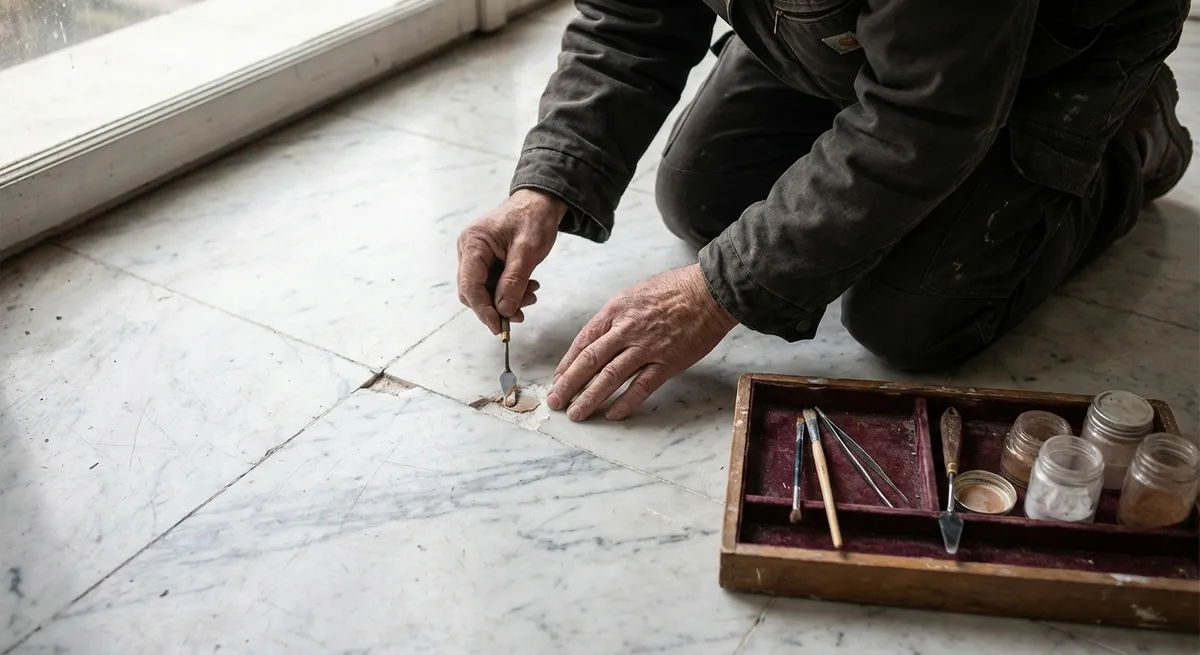
Seeing Beyond the Chip: Diagnosing the Whole Field, Not Just the Flaw
True luxury lies in thoughtful assessment before the first tool touches the tile. When a single tile fails, it is rarely an isolated event. Substrate movement, improper setting materials, thermal expansion, or moisture intrusion may be speaking through that one conspicuous flaw.
Begin with the broader field rather than the damaged tile alone. Gently tap surrounding tiles with a wooden dowel or the plastic end of a tool; hollow or “drummy” sounds can indicate inadequate coverage or bond failure beneath. Sight down grout lines from multiple angles, watching for subtle lippage or slight cupping that might suggest substrate irregularities or structural movement. Around wet areas, pay close attention to discoloration in grout, efflorescence, or soft spots in adjacent finishes—potential indicators of moisture migration.
This investigative stage informs whether a localized repair will be elegant and enduring, or whether a more extensive intervention is warranted. A single replacement can be exquisite; a patch that ignores a systemic issue becomes a short-lived disguise. Treat diagnosis as the most important craft in the repair process—it is where sophisticated results begin.
Color Is Not Enough: Curating Sheen, Texture, and Light for Invisible Blends
Matching replacement tiles is only partially about color. In elevated interiors, the eye is finely attuned to subtler cues: sheen, light absorption, edge profile, and even micro-texture. A tile that matches in hue but reflects daylight differently will telegraph its presence every morning.
When sourcing replacements, compare candidate tiles under the same lighting conditions and at the same time of day as the installed surface. Observe them dry and, for natural stone, very lightly dampened to understand how they will read after cleaning or exposure to humidity. Pay attention to gloss level: a high-polish porcelain dropped into a field of soft-matte tiles will break the continuity, while a slightly more honed stone can appear prematurely “aged” in a polished setting.
Texture is equally critical. For stone, consider whether the existing surface has been subtly patinated by years of use; a freshly honed, factory-finish piece might need gentle, controlled abrasion or precision honing pads to visually “age” the surface into alignment. For structured porcelains, run fingertips across both original and replacement tiles; a mismatch in relief pattern can catch light differently and betray the repair.
In the most refined projects, homeowners or their designers often retain a labeled archive of surplus tile from the original installation, stored in a stable, dry environment. This simple habit ensures that future repairs can draw from the same production run (or at least the same series), keeping the surface’s visual language coherent over decades.
Grout as a Design Instrument: Using Joints to Disguise, Not Highlight, Repairs
Grout is often treated as a mere filler, but in high-caliber repairs it functions more like tailoring. The width, profile, and tone of the joint either conceal or amplify the intervention. A replacement tile that is perfectly placed but badly framed by mismatched grout will still read as a patch.
Begin by reading the existing grout as you would a fabric: note the exact shade, sanded versus unsanded composition, and the degree of wear. Over time, grout typically softens in color and loses a bit of its crisp edge. This means a brand-new grout mix “matched” to the original formula may still appear slightly brighter and sharper. One sophisticated strategy is to create a deliberate micro-transition: regrout a small cluster of joints surrounding the repair, feathering the new material into the existing field so the eye reads a gradual shift rather than a single hard boundary.
Consider grout profile as well. A concave, too-deep joint around a newly set tile surrounded by naturally flush, lightly filled joints will visually isolate it. Skilled installers will tool the fresh grout to mimic the existing profile, including subtle imperfections that make it feel native to the field.
Finally, grout choice can be elevated into a durability decision. High-performance, stain-resistant or epoxy-based grouts in localized high-impact zones (around kitchen workstations or entry thresholds) can quietly reinforce vulnerable areas while maintaining the original aesthetic. Discuss with your installer whether a carefully planned upgrade in a targeted area can both improve performance and support a more lasting repair.
Respecting Movement: Elegant Repairs that Anticipate Expansion and Stress
The most exquisite repair is one that never has to be done twice. That longevity depends upon an often-overlooked principle in tile work: controlled movement. Rigid finishes set over dynamic structures demand proper accommodations for expansion, contraction, and deflection. When these are missing or compromised, cracks and debonding inevitably follow.
When repairing cracked tiles, investigate nearby transitions: between tile and hardwood, at doorways, near large windows, or at long uninterrupted runs. The absence or failure of soft joints (flexible, sealant-filled joints used instead of grout) frequently correlates with cracking patterns. Rather than simply replacing the broken tile and regrouting as before, a refined repair might introduce or restore discreet movement joints in strategic areas, often color-matched to grout for visual subtlety.
In heated floors, confirm that the repair process respects the radiant system’s layout and operational guidelines. Sudden temperature swings after setting can compromise new bond strength. A sophisticated approach staggers floor heating activation gradually, in line with tile and adhesive manufacturer recommendations, so that the restored area acclimates gently.
Think of movement accommodation as the structural equivalent of a couture garment’s hidden seam allowance. It is a quiet insurance policy, built into the system, that allows the surface to adapt gracefully over time rather than fail dramatically at its weakest point.
Preserving Patina: Repairing with an Eye Toward Future Aging
Luxury tile work is not merely about pristine newness; it is also about how beautifully a surface grows older. When a tile or section must be repaired, the most thoughtful approach anticipates how that area will age relative to the rest of the installation.
For natural stone, this may mean deliberately finishing a repaired zone a half-step “behind” the existing patina. As the floor continues to be walked on, cleaned, and lived with, the repair will visually “catch up,” eventually dissolving into the field. Over-polishing a patch to an artificial, mirror-like shine in an otherwise gently worn stone floor can create a permanent highlight that never fully integrates.
Sealers and protective treatments deserve equally careful handling. Applying a high-sheen, solvent-based sealer on a repaired area in a matte-sealed field can introduce a patch of amplified reflection. Instead, identify the original sealer type and gloss level and either match it precisely or re-treat a logically defined zone (for instance, an entire bathroom floor rather than a single tile) to maintain visual cohesion.
Finally, consider the lived patterns of the space. High-wear paths in hallways or kitchens will naturally diverge in appearance from seldom-used corners. Where a repair intersects a traffic path, expect that area to age at a different rate than adjacent, untouched tiles. Communicate with your installer about cleaning protocols and maintenance schedules that allow the repaired section to evolve consistently with the rest of the room, avoiding “new” and “old” zones that call attention to themselves.
Conclusion
Sophisticated tile repair is, at its heart, an exercise in restraint and discernment. It prioritizes diagnosis over haste, subtle calibration over quick matches, and structural foresight over short-term camouflage. For homeowners who view their surfaces as enduring design elements rather than disposable finishes, these principles transform repairs from necessary interruptions into opportunities: to refine performance, to tune visual harmony, and to preserve the quiet luxury of a perfectly resolved plane. When perfection does chip, the goal is not simply to erase the blemish—but to restore the narrative of the room so seamlessly that the interruption is never remembered.
Sources
- The Tile Council of North America (TCNA) Handbook – Authoritative industry guidelines on tile installation, movement joints, and best practices that inform durable repair strategies
- Schluter Systems – Movement Joints Overview – Technical information on the role of movement joints in preventing cracking and failure in tile installations
- Custom Building Products – Grout Selection and Technical Data – Detailed specifications and guidance on grout types, performance, and color considerations relevant to high-quality repairs
- Laticrete – Surface Preparation and Tile Installation Resources – Professional-grade recommendations on substrate evaluation, setting materials, and repair considerations for tile and stone
- Natural Stone Institute – Stone Care and Maintenance – Best practices for maintaining and blending repairs in natural stone installations, including patina and sealing considerations