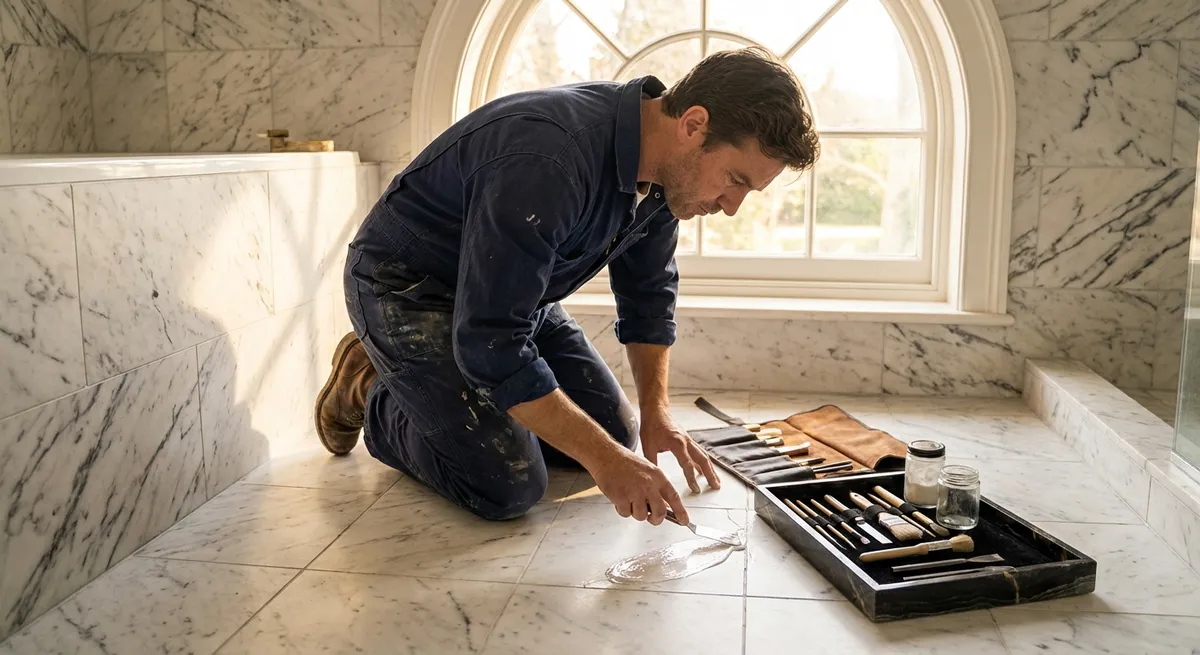
This is where refined repair strategies matter. Beyond standard patching and caulking lies a more cultivated approach—one that respects the original design intent, material character, and long-term performance of the tile assembly. The following insights are designed for those who expect their surfaces to look as considered in year ten as they did on day one.
Reconstructing the Story Behind the Damage
Sophisticated repair does not begin with a trowel; it begins with diagnosis. Every crack, chip, or hollow tile is evidence of a larger story in the assembly beneath.
A seasoned tile professional will first read the clues: Is the crack aligned with a structural joint? Does it migrate across grout lines or stop at them? Are multiple tiles sounding hollow in a pattern, or is the anomaly isolated? Subtle differences—such as a crack that mirrors a beam line versus one that wanders organically—signal whether the underlying cause is structural movement, installation error, or simple impact damage.
For homeowners, the important shift is philosophical: insist that any repair proposal explain why the failure happened, not just how it will be covered. A premium repair plan will address substrate issues (for example, inadequate underlayment, insufficient movement joints, or moisture migration) before touching the tile. Without this investigative step, even artfully executed cosmetic repairs risk becoming recurring maintenance instead of a one-time intervention.
Color, Texture, and Sheen: The Triad of Invisible Blends
Most tile repairs fail the elegance test at the point of visual integration. The color may be close, but the repair still reads as a patch because two other factors are neglected: texture and sheen.
True seamlessness depends on a disciplined match across three dimensions:
- Color tone and undertone – Matching the dominant color is not enough. Porcelain and natural stone often have warm or cool undertones that shift under different lighting. A skilled repair involves layering pigments or stains to echo these subtleties rather than attempting a single-color fill.
- Surface texture – Honed marble, tumbled limestone, and lappato porcelain all interact with light differently. Repair compounds should be sculpted, sanded, or micro-polished to mimic the microtexture of the surrounding tile. A flat, glossy fill in a honed tile will always register as artificial, even at a glance.
- Sheen level over time – New repairs can be too perfect. High-traffic floors develop a lived-in patina that a fresh, high-sheen repair will not immediately share. Premium work often includes deliberate softening or controlled abrasion to harmonize the repair’s reflectivity with the aged field of tile.
Homeowners commissioning repairs should expect test samples on inconspicuous areas and should review the work under both day and artificial light. Tiles reveal very different personalities at noon and at dusk; a truly invisible repair will behave correctly in both.
Protecting Layout Integrity: Why Tile Replacement Is a Precision Art
Replacing a single damaged tile in a field of carefully aligned joints is far more complex than simply “popping one out and dropping one in.” The original layout—joint alignment, pattern rhythm, and transitions to thresholds or baseboards—is what gives a tiled room its quiet order. An imprecise repair can disturb that equilibrium.
An elevated replacement strategy considers:
- Joint continuity – Existing grout joints may have relaxed or widened slightly over time. The new tile needs to be set with minuscule adjustments (sometimes fractions of a millimeter) to preserve this rhythm.
- Plane control – Older installations may show imperceptible changes in plane due to substrate movement. The repair tile should be feathered into the surrounding surface so that no edge catches light differently or telegraphs under bare feet.
- Cut strategy – In patterned or large-format installations, it may be wiser to replace a small cluster of tiles within a natural “break” in the pattern rather than a single isolated unit. This can hide micro-variations in thickness or pattern registration between production batches.
- Adhesive choice – Modern mortars with non-sag and deformable properties can help reconcile slight discrepancies between original and replacement tiles, maintaining bond strength while allowing subtle adjustment.
The most successful tile replacements are those you forget—because the original layout logic remains entirely intact.
Moisture, Movement, and Micro-Flexibility: Silent Guardians of Long-Term Repairs
Cosmetic perfection is meaningless if the underlying physics are ignored. Tile assemblies live at the mercy of moisture and movement. Any repair that does not respect these forces is, at best, temporary.
A refined repair strategy includes:
- Correctly detailed movement joints – Rather than “grouting everything solid,” a premium approach preserves or discreetly introduces flexible joints at perimeters, changes in plane, and long runs of tile. This allows the surface to absorb structural shifts without transferring stress back into the tiles.
- Moisture-aware materials – In wet zones (showers, steam rooms, spa areas), repaired areas must re-establish the integrity of waterproofing layers, not just tile and grout. Superficial fixes over a compromised membrane merely delay more severe failure.
- Balanced rigidity – Modern setting materials can be chosen or specified for their flexibility, allowing the tile layer to tolerate subtle expansion, contraction, and substrate behavior—especially important over heated floors or wood-framed construction.
- Breathability where needed – Certain substrates and historic structures benefit from solutions that manage vapor rather than attempting to trap it. Repair work that respects this can prevent efflorescence, staining, or future debonding.
When your repair professional speaks fluently about expansion, vapor transmission, and substrate compatibility, you are far more likely to end up with a floor or wall that ages gracefully.
Five Exclusive Insights for Homeowners Who Refuse Compromise
Beyond general best practices, there are a few lesser-known nuances that sophisticated homeowners consistently leverage for superior results:
Reserve a “future repair library” of spare tiles and grout
At installation, set aside not only full tiles, but also cut-offs, trim pieces, and the exact grout used—labeled with manufacturer, color code, and batch number. This curated reserve allows future repairs to draw from original materials, minimizing the need for imperfect matches or visible transitions between production runs.
Document your assembly like a design asset
Treat cross-sections, product data sheets, and installation notes as part of your home’s design dossier. Detailed records—substrate type, waterproofing brand, mortar class, underfloor heating layout—allow future professionals to diagnose and repair with surgical precision rather than exploratory demolition.
Insist on sample repairs in concealed locations
For high-value stone or statement tile, request a small, representative repair trial in an inconspicuous area (inside a closet, behind a freestanding tub, or beneath removable cabinetry toe-kicks). This allows you to evaluate color blending, surface refinement, and grout integration before authorizing work in highly visible zones.
Use targeted lighting to evaluate proposed repairs
Before approving a final repair, inspect the area under raking light (light directed nearly parallel to the surface) from multiple directions. This technique exposes subtle lippage, texture mismatches, and sheen inconsistencies that overhead ambient lighting can conceal. What passes under downlights may be glaring under morning sun.
View repairs as an opportunity for subtle upgrades
Thoughtful repairs can quietly elevate performance: replacing a failing shower niche with a better waterproofed assembly, integrating refined movement joints in long runs, or upgrading to a more stain-resistant grout formulation during localized regrouting. A strategic mindset treats necessary repairs as moments to discreetly refine the entire system, not simply erase the defect.
Conclusion
In finely detailed homes, tile surfaces are not merely finishes—they are architectural statements. When those surfaces need intervention, the measure of success is not just structural integrity but visual discretion. The most sophisticated repairs are those that restore both performance and poise, aligning materials science with a curator’s eye for detail.
By demanding root-cause analysis, insisting on nuanced color–texture–sheen matching, protecting the original layout logic, respecting moisture and movement, and applying the five insights above, homeowners can ensure that each repair is less an emergency and more an exercise in quiet craftsmanship. The result is a tiled environment that holds its composure year after year, even when perfection occasionally cracks.
Sources
- Tile Council of North America (TCNA) Handbook – Industry-recognized standards and guidelines for tile installations, including movement joints and substrate requirements.
- American National Standards Institute – A108/A118/A136.1 Specifications – Technical standards for installation materials and methods that inform proper repair practices.
- Schluter Systems Technical Articles – In-depth resources on waterproofing, movement joints, and tile assembly detailing for long-term performance.
- LATICRETE Product & Technical Data Sheets – Manufacturer guidance on mortars, grouts, and repair materials, including suitability for various substrates and conditions.
- University of Florida IFAS Extension – Concrete and Masonry Movement – Educational overview of movement and cracking in rigid assemblies, relevant to understanding tile substrate behavior.