Understanding the Surface: Assess Before You Intervene
The mark of a sophisticated repair is restraint. Before any tool touches the surface, the true cause—and extent—of damage must be understood. A single cracked tile may be cosmetic, but it might also be your home’s way of whispering about movement in the subfloor, temperature fluctuations, or moisture trapped where it doesn’t belong.
Begin with a visual and tactile inspection: hairline cracks suggest stress or movement; spiderweb cracks around impact points indicate a direct blow; hollow sounds under tiles can hint at poor adhesion. Pay close attention to grout lines—crumbling or discolored joints often precede tile failure. In wet areas, look for subtle cues such as persistent dampness, efflorescence (a chalky white residue), or slightly darkened grout.
If multiple tiles are cracked in a pattern, the structure may be speaking louder than the surface. In that case, no amount of patching will provide a lasting solution without first addressing the underlying issue, whether that is deflection in the subfloor, inadequate underlayment, or moisture intrusion. Repair, done properly, starts not with replacement, but with diagnosis.
Exclusive Insight #1: Treat Tile Repair as Conservation, Not Construction
Most tile repairs fail aesthetically because they are approached like a quick patch rather than like conservation of a finely made object. A truly premium repair respects the original design narrative: grout tone, joint width, tile sheen, pattern rhythm, and even the patina that has gently developed over time.
Think of each tile as part of a composition rather than a discrete unit. When one tile must be replaced, the objective is not to make the new tile “pop,” but to ensure it quietly recedes into the chorus. This often means:
- Using remnants from the original batch when possible
- Sourcing reclaimed or discontinued stock from specialty suppliers
- Considering a “soft swap,” where a new tile is placed in a less visible area, and an original tile from that discreet zone is moved into the more prominent repair area
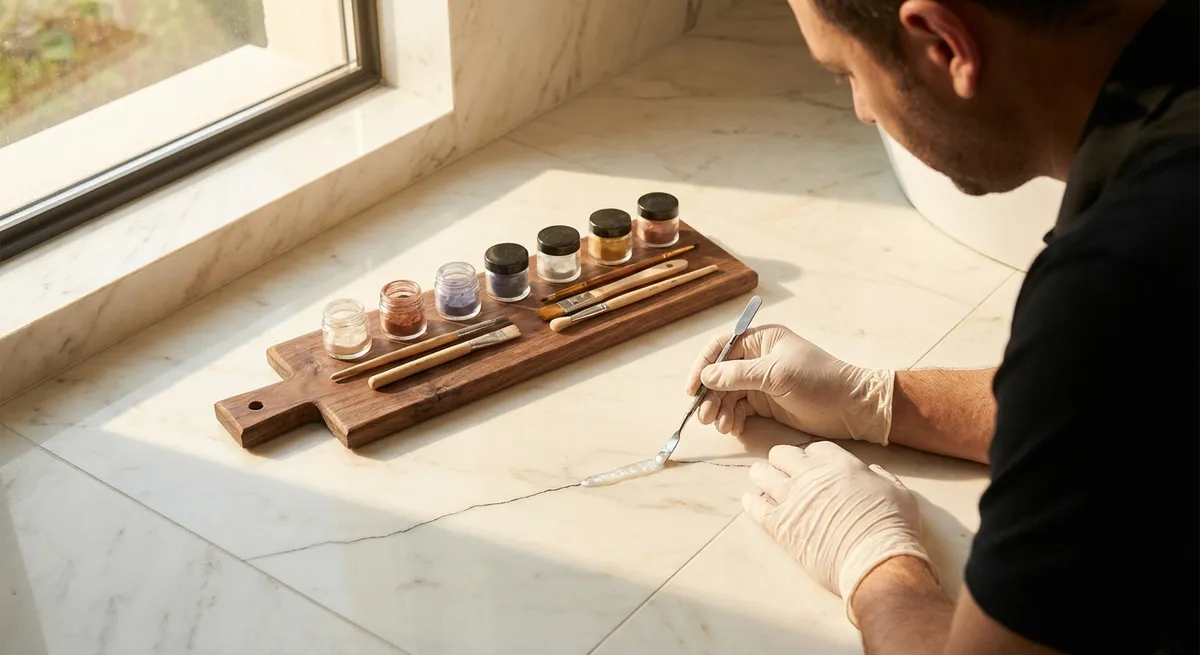
This conservation mindset may also call for micro-repair rather than replacement—a carefully executed fill of a tiny chip on an expensive stone tile with color-matched epoxy resin, for example, instead of disturbing surrounding grout and substrate. In premium interiors, the least invasive solution that maintains structural integrity is often the best one.
Exclusive Insight #2: The Art of Invisible Grout Matching
Nothing betrays a tile repair faster than grout that is “almost right.” Grout is the quiet frame around each tile; its tone and texture are as crucial as the tile itself. Over time, grout shifts in color from sunlight, use, and cleaning agents, so matching fresh grout to aged grout requires more than simply referencing the original manufacturer’s color chart.
Start by cleaning the surrounding grout thoroughly with a non-acidic cleaner and allowing it to dry completely; you want to match the true existing color, not dirt or soap residue. Then test multiple grout samples on a board, allow them to cure fully, and compare them in the actual room lighting at different times of day. Slightly warmer or cooler undertones become far more visible in natural light.
For small repair areas, a skilled professional may custom-tint grout or use a grout colorant over cured grout to fine-tune the shade. Sanded vs. unsanded texture must also be matched, as even a perfect color match can look wrong if the visual grain is off. This attention to the grout frame allows replacement tiles to visually melt back into the plane rather than stand out as “new.”
Exclusive Insight #3: Strategic Tile Swapping for Seamless Floors
When an exact tile match cannot be sourced—a common dilemma in high-end, discontinued, or imported collections—one of the most elegant strategies is strategic tile swapping. Rather than forcing a near-match into a focal area, the repair can be concealed with a thoughtful redistribution of tiles.
The approach is simple in theory but sophisticated in execution:
- Remove the damaged tile in the prominent location (for example, in the center of a kitchen run).
- Identify a visually low-impact zone: under an appliance, inside a pantry, beneath a freestanding vanity, or at the periphery of a room.
- Carefully lift a sound original tile from this discreet area.
- Install that original tile in the focal zone, and place the newer, less perfectly matched tile in the hidden area.
This method ensures the most visible portion of the floor or wall remains perfectly coherent with the original design. The compromise is relegated to a location where it is either unseen or functionally negligible. The result: a floor that still reads as original and uninterrupted, even to a critical eye.
Exclusive Insight #4: Moisture Management as a Preventive Repair Strategy
Many tile “failures” are really water stories in disguise. Particularly in showers, baths, and kitchens, the most refined repair begins by rethinking moisture management, not just swapping surface materials. If you are opening up a tiled area for any repair, it is an invaluable opportunity to assess and strengthen waterproofing.
Behind the tile, look for evidence of trapped moisture, darkened backer board, or mold. If the original installation relied solely on grout and tile for water resistance, consider upgrading to a modern waterproof membrane system when feasible. Ensuring that corners, niches, and transitions (shower floor to wall, tub edge, curb) are correctly detailed will dramatically extend the life of both old and new tiles.
On the surface, well-executed caulking at change-of-plane joints (wall to floor, wall to tub, inside corners) is essential. Grout is rigid and will crack with movement; a premium 100% silicone caulk in a color-matched tone accommodates subtle shifts while maintaining a refined, continuous appearance. Addressing moisture elegantly is not just risk management—it’s a long-term investment in the calm, flawless presence of your tiled spaces.
Exclusive Insight #5: Precision Demolition—Removing One Tile Without Disturbing the Room
In refined environments, the most critical phase of repair is often the least glamorous: demolition. The goal is clear—remove only the failed tile and its setting material, leaving its neighbors completely undisturbed. This requires patience, precision, and the right tools.
A professional-grade repair typically begins by scoring the grout joints all the way down to the substrate with a grout saw or oscillating multi-tool fitted with a grout removal blade. This “separates” the tile to be removed from the surrounding field. Then, a series of small, controlled holes may be drilled in the center of the damaged tile to relieve tension, allowing it to be removed in fragments rather than in large, forceful chunks that could stress adjacent tiles.
Thinset or mortar is then carefully removed down to a uniform depth, creating a level, clean pocket. The replacement tile is dry-fit to ensure flawless elevation alignment; even a 1 mm “lip” can break the smooth line of a premium surface. Only when the replacement sits perfectly flush should fresh mortar be applied. This kind of surgical demolition preserves the original craftsmanship while making room for an impeccable repair.
Harmonizing Old and New: Elevating the Patina of Time
The finest tile repairs are the ones that dissolve into the story of the room. You are not trying to freeze your surfaces in a pristine, museum-like state, but to guide how they age—gracefully, coherently, and in keeping with the character of your home. A hairline crack in an antique encaustic tile, tastefully stabilized rather than replaced, might be more honest and more beautiful than a jarringly perfect substitute.
Think of every intervention as a dialogue with the original installer: matching their discipline, honoring their layout logic, and preserving their intentions while subtly upgrading what time, building movement, or moisture has revealed. When approached with this level of thoughtfulness, tile repair stops feeling like crisis control and becomes something more nuanced: the ongoing curation of a surface you expect to live with, and walk on, for decades.
Conclusion
Repairing tile in a refined home is far more than a technical exercise—it is a study in discretion, continuity, and respect for craftsmanship. By treating repairs as conservation, mastering the nuances of grout matching, embracing strategic tile swaps, elevating moisture control, and insisting on surgical precision in demolition, you transform repairs from necessary interruptions into carefully orchestrated enhancements.
The result is not merely a floor or wall that looks “fixed,” but a surface that still reads as original, composed, and intentional. In the world of distinguished interiors, that quiet seamlessness is the true measure of success.
Sources
- Tile Council of North America (TCNA) – Handbook & Resources – Authoritative technical guidance on tile installation and performance standards.
- Schluter Systems – Waterproofing and Substrate Preparation – Detailed information on modern waterproofing membranes and best practices behind tile.
- Custom Building Products – Grout & Caulk Color Matching – Reference for grout types, color options, and matching strategies for repairs.
- Laticrete – Tile & Stone Installation and Care – Professional resources on mortars, grouts, and repair-related products.
- U.S. Environmental Protection Agency – Mold & Moisture in Homes – Background on moisture issues behind surfaces and their impact on indoor environments.