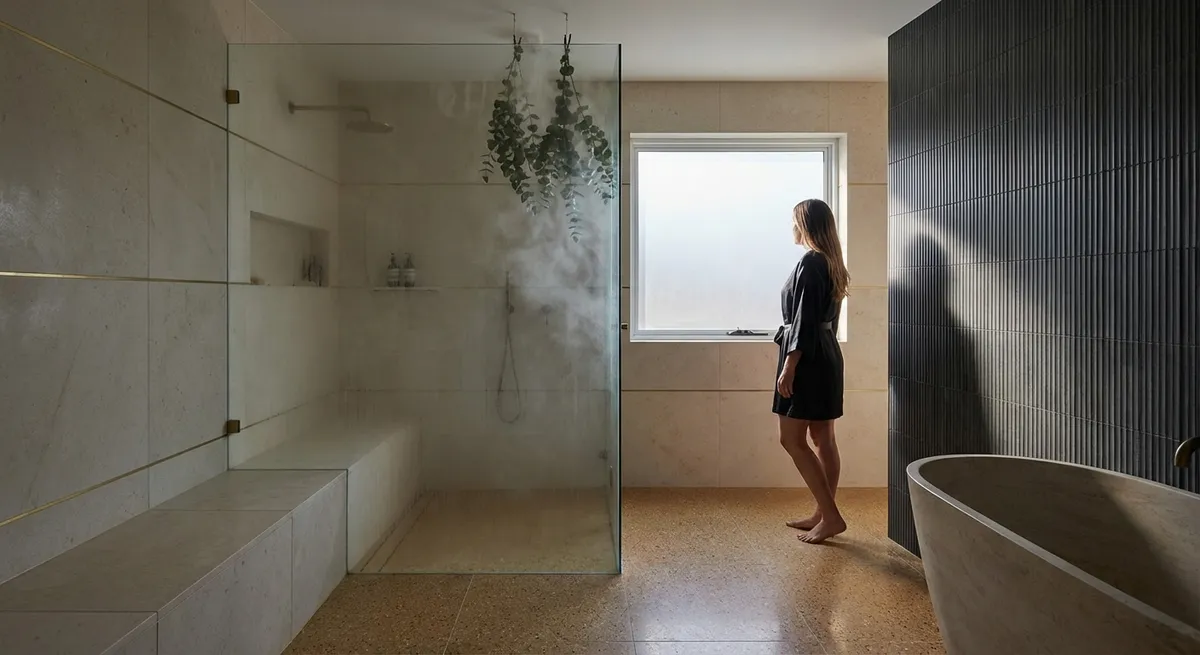
Below are five exclusive, design-forward insights that move beyond obvious trends and into the realm of quietly luxurious tile work.
1. Curated Color Temperatures Instead of Color Palettes
Most tile discussions stop at “warm” versus “cool” colors. In sophisticated spaces, the conversation becomes about color temperature as a lens for coordination—how your tiles respond to natural light, artificial lighting, and neighboring finishes hour by hour.
In a north-facing room, for example, cooler daylight can make blue-grays feel cold and uninviting. Opting instead for neutrals with a whisper of warmth—think limestone-toned porcelain or greige with subtle ochre undertones—keeps the room balanced throughout the day. In sunny south-facing spaces, cooler stone visuals or desaturated greens can tame intense light and create a gallery-like calm.
Consider the temperature of neighboring materials: brass fixtures demand different undertones than stainless steel; richly stained walnut cabinetry asks for a different “partner” than pale oak. The result is a tile composition that feels inevitable, as though the whole room was conceived in one breath.
Exclusive insight: Before finalizing tile, test large samples vertically and horizontally under your actual lighting at morning, midday, and evening. Photograph them at each time. Choose the tile that feels cohesive in all three light conditions, not just in the showroom.
2. Micro-Scale Patterning as a Background Luxury
Statement patterns have their place, but in elevated interiors, the most enduring luxury often lies in patterns you notice slowly—a shift in joint direction, a modulation of tile size, or a quiet inlay that appears only when light hits at an angle.
Instead of a single, loud feature wall, consider micro-scale patterning that rewards close inspection: a change from stacked to offset joints at the shower threshold, or a subtle herringbone “frame” around a field of larger-format tiles. These details lend rhythm and deliberation without stealing attention from art, furniture, or architecture.
In entryways and kitchens, thin pencil borders or tone-on-tone mosaics can define zones without resorting to hard lines or contrasting colors. In bathrooms, a softly textural mosaic on just the shower floor creates tactile interest while maintaining a serene envelope of color.
Exclusive insight: Design one “quiet complication” into each tiled space—an intentional shift in pattern scale, joint direction, or layout that a casually observant guest will discover later. This is where a room gains its subtle narrative and sense of authorship.
3. Seam Choreography: Treating Grout Lines as Architecture
In refined tile work, grout joints are not an afterthought; they are a form of linear architecture. They influence how large or small a room feels, where the eye rests, and how refined the installation appears.
Aligning grout joints with key architectural lines—door thresholds, window mullions, cabinet edges—creates visual calm. When joints land arbitrarily, even expensive tile can appear restless. Thoughtful “seam choreography” uses layout to draw the eye through the space: long runs of uninterrupted joints in a hallway, or a central alignment that quietly anchors a shower niche and valve.
Grout color is equally strategic. A near-match to the tile allows the surface to read as monolithic and sophisticated. A slightly deeper tone can add shadow and definition in highly minimal spaces. High-contrast grout is powerful but can quickly feel graphic; in luxe interiors, it’s best reserved for deliberate, controlled pattern moments rather than field tile everywhere.
Exclusive insight: Ask your installer to produce a scaled layout drawing—not just counts and cuts. Insist that critical features (island legs, tub centerlines, doorways, niches) be used as reference points so that grout lines align purposefully with the room’s architecture.
4. Mixed Sheens and Textures for Light-Scaping
Premium tile design is as much about light as it is about color or pattern. By mixing sheens and textures within a restrained palette, you can sculpt light, shadow, and reflection in sophisticated ways.
A matte floor tile paired with a satin or semi-polished wall tile creates a subtle tension that feels intentional, not flashy. In showers, a slightly textured floor paired with smooth wall tiles offers both safety and visual refinement. On backsplashes, pairing a soft-gloss tile with a honed countertop creates a nuanced interplay where one subtly reflects and the other absorbs.
In rooms with limited natural light, glazed or gently lustrous tiles can amplify brightness without appearing glossy or harsh. In sun-drenched environments, honed or matte finishes reduce glare and produce photographs that feel editorial rather than overexposed.
Exclusive insight: Instead of varying color dramatically, vary surface interaction with light: honed, matte, lappato (semi-polished), and subtly faceted textures. Within one color family, this creates the kind of layered richness typically associated with custom millwork or high-end stone fabrication.
5. Future-Proof Focal Points Anchored in Proportion, Not Trend
Timeless tile design is less about picking the “right” pattern of the moment and more about understanding proportion. When focal points are anchored in scale and balance rather than trend, they stay relevant longer and adapt gracefully to evolving decor.
In a primary bath, a full-height tiled wall behind the tub—kept in a classic, low-contrast tone—can be elevated later with art, lighting, or hardware changes without requiring demolition. In kitchens, wrapping tile neatly around corners and under cabinets, rather than stopping abruptly at arbitrary heights, lends a bespoke, built-in look that outlasts seasonal styles.
Consider where the eye naturally lands when entering the room. That’s where proportion matters most. Oversized tiles on a small feature wall can feel forced; instead, allow the scale to breathe. Sometimes a smaller tile, meticulously installed, feels more luxurious than large panels forced into an awkward footprint.
Exclusive insight: Design focal moments to be background-capable. If everything else in the room changed—faucets, paint, textiles—your primary tiled surfaces should still feel composed, not dated. This is the hallmark of a truly investment-grade tile decision.
Conclusion
Exceptional tile work is not defined by price tags or dramatic patterns, but by the intelligence of design decisions made long before the first tile is set. When color temperature, micro-scale patterning, grout choreography, texture interplay, and proportion all work in concert, tile becomes an enduring expression of quiet confidence.
For the discerning homeowner, these details are not indulgences—they are the difference between spaces that feel merely finished and spaces that feel resolved. Thoughtful tile design, once installed, becomes the calm, enduring backbone of a home that will continue to feel considered and current for years to come.
Sources
- Porcelain Tile Certification Agency – Technical Resources – Offers technical insight into tile performance, standards, and material characteristics.
- Tile Council of North America (TCNA) – Handbook & Resources – Authoritative guidance on tile installation methods, layouts, and industry best practices.
- American Institute of Architects (AIA) – Materials & Design Articles – Addresses architectural considerations such as proportion, light interaction, and material coordination.
- National Kitchen & Bath Association (NKBA) – Design Resources – Provides design-forward perspectives on kitchens and bathrooms, including layout and surfacing strategies.
- Harvard Graduate School of Design – Project & Research Archive – Showcases advanced design thinking around materials, space, and light that informs high-end residential interiors.